

July 2, 2026
–
0 minutes to read
Crescendo Consulting Group
How a US management consulting firm grew past the system it inherited - and finally got visibility into what their work really costs
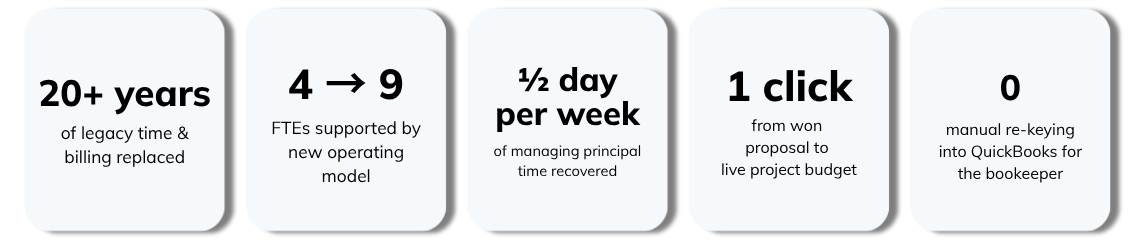
For 20 years, Crescendo Consulting Group ran on a time-and-billing system inherited from the accounting firm it had once been part of. It worked... until the team doubled in size, the projects got bigger, and the spreadsheets piled up on top of the software just to keep the lights on.
“We had a lot of disconnects and we had to do a lot of manual work-arounds. It really did us a disservice when it came to project management - tracking budgets and where we are with the actual budget compared to where we are with the project work.”
- Katelyn Michaud, Managing Principal, Crescendo Consulting Group
Today, the Denver-based public-health consulting firm runs on CMap. One year in, they have half a day a week of the managing principal’s time back; they do their invoicing in minutes; the bookkeeper no longer has to rekey invoices into QuickBooks; and - for the first time - they have live margin visibility on every project instead of a post-mortem calculation at close.
At a glance
The challenge
Crescendo specializes in community health needs assessments - the kind of regulated, multi-stakeholder research work that hospitals, healthcare systems, and nonprofits commission every three to five years.
It's niche work, and it's also work that has grown, fast: a team of four for most of the firm’s life expanded to nine by the time Katelyn bought the business in 2022.
The operating tools didn’t grow with them. The original time-and-billing system, taken across from the firm Crescendo separated from in 2003, kept time and billing in one place, but it never linked to project management.
To answer the simple question, “Are we tracking against budget?”, someone had to maintain a parallel spreadsheet, reconcile it by hand, and hope nothing slipped between the two systems.
“We had time and billing within that system, but we could never link it to project management. So it was really hard to track budgets - you essentially had to manually track your budget compared to what you’re putting in your time and billing system.”
- Katelyn Michaud, Managing Principal, Crescendo Consulting Group
By the time the renewal notice arrived last year, the workarounds had outlived their welcome. “There has to be alternatives out there,” Katelyn told the rest of her peer network. “It’s been 20 years.”
Why CMap?
The shortlist came together quickly. A question to Collective 54, the peer group Katelyn belongs to for owners of professional services firms, surfaced a handful of credible names. Crescendo ran a head-to-head between two of them.
CMap pulled ahead on the things that mattered most to a firm that had spent 20 years working around its software: project management linked to time, a fee estimator that turned a won proposal into a live budget in one click, and a bilateral QuickBooks integration that ended the bookkeeper’s double-entry workflow.
“CMap really was the one that became a clear winner around the project management aspects of it. The fee estimator within the system - we always did that in spreadsheets. So it’s really nice that we can do it in one system and it gets pushed through throughout the project lifecycle.”
- Katelyn Michaud
The decision wasn’t painless. Katelyn is open about it: “I think historically that’s why we were with the previous system for 20 years - it was a comfort thing.” She left the search later than she’d have liked.
But the renewal pressure made the call for her - as did the financial breathing room to absorb the first-year onboarding cost. The alternative was another 20 years of the same workarounds.
“Sometimes you just have to rip off the Band-Aid and go with it.”
- Katelyn Michaud
What changed
From manual budget tracking to live margin
The single biggest change was the one Crescendo had been working around for two decades: budget and WIP visible in the same place as the time being booked against them.
“We’re better able now to track real-time progress where we are with actual work project compared to our budget, because it does it all in one system very nicely.”
- Katelyn Michaud
What used to live in Katelyn’s parallel spreadsheet, which was pieced together monthly from time exports, now lives in a single dashboard she can check before any client meeting.
From “profit equals cost subtracted from revenue” to true margin
Crescendo had been doing the right thing instinctively: looking at the delta between a $50,000 project and what it cost to deliver, and then calling that profit.
But CMap surfaced the gap that approach missed - the loaded cost of the team doing the work, not just the unburdened cost.
“We have everyone’s hourly billable rate in there… but you can also put in your real cost rate for each individual that has that inclusive of margin. We’re better able to track that profitability and margin over time. Because we didn’t have a good system to track that, it was hard to ask: are we actually really profitable on this or not?”
- Katelyn Michaud
The same data feeds end-of-year decisions on bonuses, as well as the more uncomfortable but more important conversation about whether projects are priced for the team Crescendo has, not the team it had three years ago.
From spreadsheet pricing to evidence-led pricing
Crescendo’s growth has been fueled by hiring earlier-career staff alongside the senior bench. That changes the economics of every project; the work a managing principal might bill at 10 hours runs at 40 in the hands of someone learning the discipline.
CMap now gives that pattern back to the firm as price-setting evidence.
“It’s helped us better predict the true cost of a project going forward - so we’re not losing money out if we essentially underbid. What is the true cost of doing this work, to make sure we are getting paid as much as we can for the work that we’re doing?”
- Katelyn Michaud
From bookkeeper double-entry to one-click invoicing
The bookkeeper had been pulling every CMap-equivalent invoice into QuickBooks by hand. With CMap’s bilateral QuickBooks sync, the invoice clicks straight through. Expenses go the same way. Crescendo’s monthly close is now just a quick check - no more chasing.
“It’s nice now that if we create an invoice within CMap, we just click a button and it pushes directly into QuickBooks. It saves time on her end - and we can do the same with expenses. CMap is good at telling me, ‘Hey, this invoice hasn’t been paid in two months.’ Then I can follow up with the client.”
- Katelyn Michaud
What’s next
Crescendo is leaning further into the parts of CMap that go beyond the fundamentals. In particular, they're looking at resourcing, where the goal is to spot capacity squeeze before it becomes overtime, and to make trade-offs across the project portfolio rather than inside any one engagement. Katelyn is candid that resourcing maturity is a journey rather than an on-and-off switch.
More broadly,. she’s watching CMap’s roadmap with anticipation: “You guys take feedback,” she says. “We would love to see this - and you put it on the list.” That, after 20 years of working around software that didn’t move, is the thing she didn’t know to ask for.
The takeaway for firms like yours
If you’re running your consulting firm on a stack that pre-dates your growth, the question isn’t whether the workarounds work. They do, until they don’t. The question is what you would do with the time and the visibility you currently spend covering for them?
What to take from Crescendo’s story:
- Stop subtracting cost from revenue at project close. Loaded-cost margin in real time is a different lens - and it changes how you price the next project.
- Treat your time-and-billing renewal as the trigger to look, not the deadline to act. Six months is the right horizon; two months is the rip-off-the-Band-Aid horizon.
- Score vendors on the things you’ve been working around - not the things you’ve already solved. For Crescendo, it was budget-linked-to-time and QuickBooks bilateral sync; for you, it may be different. Make the list before you take the demos.
- Bring your bookkeeper into the buying process. They’ll tell you what costs them three hours every Friday. That’s the test.
keep reading
Similar Articles
Resource Hub
Book a demo
To see exactly how we can help you drive your company in the right direction, book a demo with an expert.
Book a demo


