
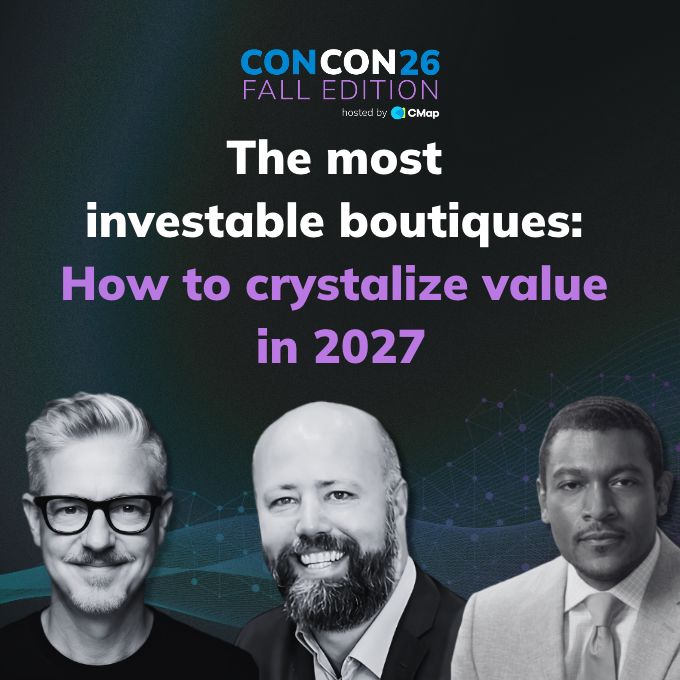
The most investable boutiques: how to crystallize value in 2027
The session, at a glance
An M&A attorney with close to $1 billion in deal value, a PE-backed CEO who’s rolled three firms into one, and a former Bain consultant who sold his own boutique.
- Revenue quality sits underneath EBITDA, and client concentration is where buyers look first.
- The simplest test of founder dependency: who else originates work with your biggest clients?
- AI went from impressive to expected in a year. Investors now want to see it in the price and the SOW.
- The unexpected deal-killer is often tax, and it’s usually a million-dollar problem.
Three key stats
- 20%: if any single client represents more than 20% of your revenue, buyers see concentration risk
- 50%: the same applies if any two, three or four clients together represent more than 50% of revenue
- 7x to 5x: when buyers can’t trust revenue quality, a deal that could have gone at five to seven times EBITDA tends toward five, often with earnouts or retention bonuses attached
Watch the full session
The most investable boutiques have institutionalized their clients, their propositions, and their AI
Manny Clark opened with a cautionary tale. He described a near-100-year-old US law firm, with roughly $2 billion in annual revenue, that unraveled after a large rainmaker departed, others followed, and the clients went with them. If it can happen at that scale, it can happen to a boutique.
This panel brought together an M&A attorney who represents professional services founders in transactions, a CEO running a PE-backed data and AI consultancy built from three acquisitions, and a former Bain consultant who sold his own 60-person firm and now trains consulting teams. Their shared view: investors are buying a firm that keeps winning and delivering when any single person walks out the door. In the next five minutes, you’ll learn what buyers measure first, how to prove you’re not founder-dependent, and how AI now shows up in valuation.
What makes a boutique consulting firm investable in 2027?
Revenue quality you can prove. EBITDA still sets the price, because it’s a measure of the cash flow a buyer expects to inherit. But Manny Clark argued that what sits underneath EBITDA matters more: how much of it is repeatable, ideally contractually recurring, with easy renewals or high switching costs.
Client concentration is the part most firms underestimate. Manny’s thresholds are specific: any single client above 20% of revenue, or any two to four clients above 50%, and a buyer starts asking what happens if that client leaves or reprices. When buyers can’t trust the revenue, multiples compress. A five-to-seven-times deal tends toward five, and deferred consideration such as earnouts appears.
Christian Barnard added that the right optimization depends on your investment thesis. Strategic buyers will accept lower EBITDA for a capability they need, such as a top-tier partnership or specialist AI skills. PE-backed buyers are more margin-sensitive because they’re underwriting synergies. Deri Hughes tied it together with “proposition repeatability”: propositions that create value for clients repeatably and predictably, which makes the growth engine easier and gives investors a track record they can trust.
The cause of most discounted valuations is the same: revenue that depends on relationships the firm doesn’t own.
“Consider if there are any of your customers who represent more than 20% of your revenue. Or alternatively, if there are any customers, or any two, three, four customers who represent more than 50% of your revenue, understand that for a buyer approaching an estimation of the value of your company, they look and say, if that customer leaves, or alternatively, if they decide they want to reprice, what’s my leverage there?”
- Manny Clark, Shareholder, Winstead PC
Concentration is the number on the spreadsheet. The question behind it is who holds those relationships.
How do you prove your firm isn’t dependent on its founder?
Count how many people beyond the rainmaker originate work with each client. That was Manny’s answer to a question from the audience. If a $10 million client’s work is all originated by one person, you have a dependency, and if that person leaves, the client probably follows. If origination is spread, the firm has a real chance of keeping the business.
Manny framed the bigger lesson as institutionalizing your client base so clients are held by the firm itself. The question he wants every founder to ask: is our business connected to our personalities, or to our firm?
Deri Hughes sees the same pattern from the growth side. Too many firms still rely on a few relationships and a founder’s black book, with a “do great work and win more” model. He wants to see an “authority-led growth model”: the whole team sharing a point of view and building personal reputation, so leads arrive for people outside the senior team and those people can convert them. On the people side, he argued that most firms are constrained by their team’s ability to win work rather than by the market, so developing people six months faster to each promotion point directly builds equity value.
Christian added a related test for firms that rely on partner ecosystems: investors like deep partnerships, but they also want proof you can win without the partner channel.
“To me, really, the way you measure it is you look at your clients and ask how many people beyond that rainmaker are actively originating new projects, new matters with that client. If ultimately you’ve got a $10 million client and $10 million of that is all originated by one person, you’ve got a dependency. So if that rainmaker leaves, that client’s probably gonna leave too.”
- Manny Clark, Shareholder, Winstead PC
Spreading relationships across the team protects revenue. The panel’s next point was about what investors expect that team to be using.
How should AI show up in your valuation story?
In the price and the statement of work. Christian Barnard said that if AI isn’t named in the price or the SOW, it won’t count as AI revenue in diligence. A year ago, clients were impressed that a firm used AI. Now it’s table stakes, and clients expect the gains to show up in pricing, outcomes and timelines.
Christian described a progression in how firms use AI. Rolling out individual licenses is a reasonable first step, but the return is hard to prove and it won’t move valuation much. Embedding AI into workflows, connecting it to historical data, CRM, past estimates and delivery performance, lets the firm do much more with the same team. The premium sits with firms that also deliver AI solutions as tracked client revenue. As AI breaks the old link between revenue and headcount, he said, the value story shifts from the size of the team to what the team produces.
Pricing is moving with it, at different speeds on each side of the Atlantic. Manny has quoted around $2 million of legal work on a flat-fee basis in the last two months, after clients shifted from “don’t use AI” to “how are you making our bills lower with AI?” Deri sees UK clients well behind that, and most UK consulting firms still using AI individually (“we’ve just rolled out Copilot licenses”), which he sees as an opportunity for those who move quickly.
The driver is that clients now use the same tools. Firms still delivering the way they did in 2024 are visible to them.
“The second category, the meaningful category, is those firms that embed AI into their workflows, or even better, completely redesign their workflows using AI and agents… It’s the work where the clients pay you for AI outcomes. So if AI isn’t named in the price or in the SOW, it won’t count as AI revenue when you go through diligence and go after an investment.”
- Christian Barnard, CEO, OneSix
Every speaker came back to the same idea from a different angle. Value lives in what the firm owns: client relationships held by more than one person, propositions that deliver predictably, people who develop fast, and AI embedded in how work is won and delivered. The practical advice was just as consistent: understand your investor’s timeline, deliver bad news early, plan your tax structure from the start, and treat culture as something you lead.
CMap helps boutique firms build that foundation from bid to bill, so the data on margin, pipeline and delivery is clean enough for AI to use and solid enough for a buyer to trust.


So you... Let me see if I've got some wonderful guests joining me. Oh, here we go.
Yes. Hey.
Look at this. Oh, Maddie, we've got, like, basically the same type of studio setup. And we're not...
You should have just joined me same company.
Might be. Yeah. Are you just next door?
It may be.
Yeah. Hey, Derry. Hey, Christian as well.
Hey, man. Good to see you.
Yeah. Likewise.
As I was mentioning, Chris... Christian joined us on our first ConCon. Manny Manny was scheduled, and you were you were there.
We just had some audio technical difficulties, so I'm looking forward to this. And Darius joined us on our podcast before, so welcome to you first time at ConCon. Delighted to have you here. What I've done with the previous three sessions is enable you all to do your own intros, which is hopefully very nice of me.
But if I feel like you've undersold yourselves or missed anything in particular, before we delve into the actual body of the content, I'll I'll make a couple of comments. For the audience basis, we've got three topics underlying the main headline. So the first topic we're gonna be looking at is what makes an investable firm. Then we're gonna be looking at some of the exact bottlenecks that could be leader, founder, c suite, VPs, and then how to crystallize the value.
As ever, please do use the chat to give us your insights, perspectives, throw out any questions. If you've got questions that you don't want everybody else to see, use the q and a. And then we have another three polls that we'll be launching during the conversation. So go into the polls.
Give us your response. Take a look at what other people are saying so far during the other three sessions, got some, like, incredible insights. And I think you can all see all of the historical polls in there as well. So so have a chore through those.
Really interesting. Okay. Without further ado, Christian, do you mind leading us off with your intro?
Absolutely. Great to see you, Ben, and thanks for having me on ConCon this year. My name is Christian Bernard. I'm the CEO of One six.
One six is a data and AI consultancy. We help our clients design, build, and scale modern data platforms and AI solutions. We're actually backed by a private equity firm called Superstep Capital. We're a Snowflake elite partner, Anthropic Select partner.
Prior to joining one six, I spent about a decade, a little over a decade as the chief operating officer for two other boutique consulting firms. And I was part of taking both of them to market through the investment banking process, roadshow, one of them post acquisition integration.
So I'm hoping to, share some of those learnings here today. I was hired as the CEO at super... After Superstep Capital, rolled three acquisitions up into what is today called one six. So I've got sort of operator getting a a firm ready for an investor, and now I'm in the CEO seat to increase the overall value of our firm for our for our teams and for our clients and for our shareholders.
Wow. Cool. Very good. Manny?
One, Ben, I wanna thank you for giving me another chance, you know, to participate in ConCon. I had some pretty tough technical difficulties. For everyone out there, my name is Manny Clark. I'm a Charlotte based, m and a attorney and a shareholder with a firm called Winstead.
So Winstead is a 300 attorney law firm. Most of our offices are in Texas. We have a few other offices in a few major markets, Atlanta and New York. I'm in Charlotte.
And my focus really is representing professional service firms in connection with their m and a activity. Most of that has been, you know, on behalf of founders, sellers, operators. And so I am deeply attuned to, you know, the pains that they feel in connection with, you know, their m and a, the successes that they feel as well. I've been doing...
I've been practicing about fourteen years. Six of those years have been devoted really only to this practice. We've done almost close to about 1,000,000,000 in transaction value for, you know, our various clients.
So I've, you know, I've seen the the big $100,000,000 deals and, you know, the tiny $5,000,000 deals, and and they're all great. And, you know, I'm really excited to be talking, you know, with both of these two gentlemen and excited about our conversation.
Cool. Nice stuff. Derry?
Yeah. Thank you, Ben. A very big pleasure to be here. So I'm Derry. I'm the founder and managing director of Honeycomb Consulting Skills Training. So I've been in consulting for twenty years now with... From Bain and Company through to being an independent through to selling a boutique consulting firm, about a 60 person firm where I was chief finance and operations officer. We sold that firm to Tenayo back in 2017.
My consulting background is primarily in deal environments, commercial due diligence, private equity value creation, merger integration, all of that type of stuff.
These days, a lot of our clients are, you know, all of our clients are are consulting firms, mostly boutiques. A lot of them are owned by private equity, going through deal processes, starting to think about how they can maximize equity value, and we we deal with the the people side of that. And how do you how do you build the right engines to develop people, get... Reduce your founder dependence, and make sure that you are... You're building a a system that enables your firm to thrive beyond that.
Very good. Like, tremendous intros. I've been fortunate to cross paths virtually and in person with all three of you over the years. There's been many a mutual client or a connection who has, like, either been a customer of yours or a reference.
So I know that all the work that you'll do and the businesses that you're part of do do great things. So I'm really excited to get your perspectives. And actually, in those intros, I was learning even more than I knew about all of you already. So that was quite good, Christian.
I didn't realize the the one sixteen was three in one, so that sounds really cool. I might have to flex some of my questions on the fly to dig into that.
A quick fire opener just to get us going, though. So what's the most surprising thing that you have found is critical in build... Building a firm's value, let's say, like, right here, right now versus twelve to twenty four months ago. Christian, it'd be great if you've got an initial perspective on that and then Manny and then over to Derry.
Yeah. I I love this I love this question. You know, even a year ago when we were talking, think AI was the topic of the last con con that we were on together.
A year ago for me, you know, a client was impressed that we used AI in in our delivery process and how we interacted with them. Now it's table stakes. Right? A year later, now now clients assume that we're using AI across the entire life cycle from the first call to the last status report. They expect those gains to show up in the pricing they're getting, the outcomes they receive, the timeline, all of which are compressing, right, because of AI. They're using AI as well.
So I think if if companies are still delivering the way that they did in 2024, '25, clients can tell because their own teams are using the same tools now, because the barrier to entry has has has gotten so low. That's the first thing. The second thing, I think, as the as the firms mature and actually run on AI, meaning we use AI to increase operational leverage within the within the organization, the old links between revenue and headcount start to erode. They start to break a little bit, meaning the shape of the organization as a consulting firm needs to change.
Your sales and delivery models need to change.
When you start to use AI to deliver outcomes for clients, you should be able to deliver more with the same number of people.
And I'm not talking about people reduction. I'm talking about actually creating value through increasing your operating leverage by using AI. And I think, actually, investors, think, have started started looking for this because it says, you know, the margin improves without adding incremental headcount for incremental revenue, which is super important. A year or two ago, the value story was the size and location of the team. Now I think the story is more about what the team produces and the outcomes that we can deliver for our clients.
And then the third thing, final thing is that, you know, once hours aren't the cost driver of... Hours are important. Creating estimates are important for delivering services, of course. But if they're not... If the hours aren't the cost driver and you're using AI to, again, create that operational leverage, you stop selling hours. So then what you need to do is make outcomes, make real definable business outcomes, the thing you're selling, and then change how you sell your services. And that looks like selling, you know, value based pricing, selling options, creating optionality for per clients, delivering outcomes. Because clients buying AI want to see the return, so we typically sell the results, not the hours.
Manny, there might be a couple of things in there that you've seen as well. In addition, there might be something completely different. So over to you.
I'm I'm gonna take, you know, a different tactic there, although I completely agree with Christian. And I think we can certainly get, you know, deeper into what I think is a new lesson that's being taught about what recreates an investable firm, you know, within 2026. But mine is actually a a lesson that I think generally the market for professional firms, their founders, owners may not have, you know, totally absorbed at this point even after a few hundred years of professional services firms operating. And really that lesson is about the importance of institutionalizing your client base rather than allowing that client base to, you know, be not only attracted by, but be held by different personalities within the firm.
And, you know, there's really a, you know, clear example of that operating in the market right now or rather not soon operating in the market. This is not to take a slide at the firm in question, but we've witnessed something really remarkable happen with the collapse of the recent very large law firm, Weil Gotchel, here in The United States. So if you're not, you know, aware of the subject of that firm, this is, you know, a very large law firm. We're talking between two and three thousand, you know, billable timekeepers who are operating, you know, roughly annual revenue of about $2,000,000,000 a year, annual profits per partner of $5,000,000 a year that almost collapsed overnight.
It really...
It it occurred because of functionally a bank run that occurred among the partnership where you had, you know, one very large brain maker to determine that they were gonna depart from the company, and that cascaded into a number of brain makers, you know, also departing. And now that the result of that is you have a firm, a very, very healthy firm, you know, venerable, almost a 100 year old firm that is gone. And by December, we'll no longer, you know, continue to be in the market. If you read anything on the story of this, and a lot of it comes from reporting out of the Wall Street Journal and Bloomberg Law, It it...
The entire story really is about, one, a difficulty in diversifying their client mix and in their service mix. So there was a a strong focus, as I understand it from the articles, on building up public company m and a services and delivering those relative to the new and, you know, very lucrative private equity services that law firms are delivering that tend to be a bit higher margin relative to those kinda customary public company services. And that was the first move that were...
It was the first thing that caused some rainmakers, particularly those within Wallace private equity group to depart. But following that, there was no real investment from the firm and much of this because of many of the firm elders, some who were deeply connected to its public company m and a practice, indicating they did not wanna move into some more of those lucrative spaces. And once they departed, ultimately, their colleagues also departed as well. And what I think this speaks to really is is if you look at all of those partners leaving, they leave with their clients.
And the question is, why are they leaving with their clients? Why hasn't the firm been able to to keep those clients and make them sticky? You know, why why isn't the firm able to impose switching calls associated with not imposed switching calls, but why don't those switching costs exist, you know, the movement of those clients to different places. And it's a lesson I think that we all need to, you know, pay attention to.
I as another professional service practitioner because it's one that continues to threaten all of our businesses. You know? Is our business connected to our personality or separately is it connected to our firm? I think that's a question you need to ask if you believe that you're investable, and it's one that you need to have a defensible position on.
Yeah. And if it can happen to a firm of that size, it can definitely happen to an SMB or boutique. I love the different perspectives shared there. Derry, over to you.
Yeah. Thank you. And I agree agree with both of you on that front. And I think if if I may, I might just try and put something across the top of all of those perspectives as the as the thing that kinda drives it and operationalizes it in some way. So I, the phrase that I think of is proposition repeatability.
So do you have propositions in place that can repeatably and predictably create value for your clients? And if you have those and you need to have those in order to make the AI workflows work, you need to have those in order to get your revenue per consultant onto an exponential curve. The way I... I've I've used this phrase, the exponential junior consultant in many places, which is if they're if they're... That junior consultant is fully plugged in to your systems, your AI workflows, and your clients' data flows, they can create exponential value, which, Christian, to your point of, like, breaking the link between the revenue and the headcount. Like, that's that's the feature for it. And I think if you can get your firm to have the track record of solving a particular problem repeatedly through the propositions that you deliver and you can prove that you can do that, your your growth engine gets a lot easier.
You break that dependence on the personality that money references because that's baked into the way that your firm works, your methodologies.
And that allows you to then create value and talk to investors in a way that where they say, I know exactly what I'm buying into. I can prove the track record, and it's and it's built into the the DNA of the business that I'm buying. The proposition repeatability is my way of operationalizing and thinking about all of those things that that these guys talk about. I love that.
I'd like to get into the metrics as a first starting point as well.
So all the conferences I've gone to, all the podcasts I listen to, all the content I consume, like, growth pipeline, like, the the three things that always surfaces the... Some of the key metrics that determine the true value of a firm. Like, which of those right here, now do you feel is the most important? And if it's not one of those three, could each of you point to another metric or a KPI that that is a big determinant of value? Manny, why don't we start with you?
Absolutely. You know, look, EBITDA's importance really is... It... It's just another way to measure cash flow associated with the entity. Ultimately, whenever you're selling your company, most of your price is gonna be to be captured in how much of that cash flow... Cash flows can a new buyer assume that they're going to get.
And so that...
That's why we use EBITDA. You know, it's...
You know, there are some, other dynamics around ensuring that we're we're not also looking at things like taxes or, you know, your debt service that are cutting into that that profit when measuring what your price is. But, you know, that EBITDA really only tells, you know, the top line of the story. Below that is, you know, what I think is a more important issue, which is revenue quality. And revenue quality really is about of that EBITDA, how much of it can we say is not only repeatable, but is recurring and is contractually recurring.
Or there's some other thing that we can point to to say, I I can be assured as a buyer that this will continue to come in the door because I can mandate it via contract or or similarly because there may be really, really high switching costs associated with moving to, you know, another service. So when you think about revenue quality, I think the easiest way to consider it is what's the the gold standard for it? And it's you have a contract, that contract indicates here is what you should expect to come across in terms of revenue for the services that you deliver. And that contract has a pretty simple and easy renewal scheme, which is the customer can easily renew it or simply it evergreens, and the contract renews repeatedly.
And so the the buyer ultimately who received the contract understands, I can trust that I'm gonna continue to receive that revenue. There are other facets to that concept of revenue quality, which also relate to things like customer concentration. And that's another area that, you know, I think it it isn't captured adequately in what most firms measure. But this is something that, you know, if you're a firm out there and you're wondering about your investability, consider if there are any of your customers who represent more than 20% of your revenue.
Or alternatively, if there are any customers or any two, three, four customers who represent more than 50% of your revenue, understand that for a buyer approaching, you know, a a...
An estimation of the value of your company, they look and say, if that customer leaves or alternatively, if they decide they wanna reprice, you know, what's my leverage there? You know, what...
Am I able to find a new customer easily? Because I may lose a really significant portion of revenue or alternatively lose a significant portion of margin associated with that. And so, you you know, it's it's a key measure, your revenue quality and additionally your customer concentration. Key things you always wanna keep in mind as to whether that EBITDA is something that can be trusted.
And when it can't be trusted, the reality is what happens is you see some margin...
Not margin compression, but you see multiple compression, you know, associated with your sales. So what could be a five or, you know, the seven x sale ultimately tends more towards five, and you're more often to see things like earn outs or retention bonuses, you know, or other kinds of deferred consideration structures offered there. So those are...
You know, in in my view, EBITDA always, you know, ultimately determines what price you're gonna receive. But below that, you know, what defines EBITDA is revenue quality.
I appreciate you putting some benchmarks and numbers to it in terms of, like, client concentration and also the multiples. People always love to know that sort of stuff. Christian, what's your thoughts?
You know, I think I can't argue with EBITDA, especially being part of a a PE backed consulting firm at the moment. But I think, you know, having having done this a couple times, I think I think it it matters, you know, what your what your investment thesis is. Right? I think we need to start optimizing for what kind of investment you wanna attract and start doing that early. Because if you don't do that as a firm, if you don't have your own investment thesis, that means you're probably not doing well and the valuation is not gonna turn out in your favor anyways. So for instance, a strategic buyer is gonna is gonna really look for capabilities that they don't have and they need to acquire.
Maybe they want unique AI skills, you know, a top tier partnership with a Snowflake or Databricks, proof of growth.
But they'll they'll take lower EBITDA. Right? They'll take lower profits because it's an asset that they need and they don't have. They're buying a capability they don't have.
If you wanna optimize to get an investment or or do a transaction with a large strategic, that is a path that requires a certain level of optimization, a different optimization. And I don't think EBITDA is as important if if that's the path that the founders and the leadership team wanna take the consulting firm.
Compared to, you know, PE backed strategic wants the same capability but inside their own vertical. And they're probably more sensitive to margin because they have to invest in the potential synergies. And those synergies, if they don't if they don't come to fruition, are gonna be risky, and and and they've gotta mitigate that risk.
Derry, actually, given that you're in that people's space, is there anything outside of those more in the people based metrics that you've observed become an important part in how a firm's valued or indeed how they look at themselves as they're trying to, like, grow and scale?
Well, I think we've lost, we've lost Christian.
So I think there's a... The the people based metrics are quite interesting, actually. They they often fall a little bit down the list of things that an investor is is looking at. And...
But they can... They're the things that can trip up an investment quite tightly. I mean, we all know these stories of firms that have sold into to bigger firms, and then they've lost all their people within a year or two.
Even if they're locked in for a year or two, it's quite common you then see everybody leave. And often the the founders will leave, and then they'll hire back a bunch of those people, and they'll start the same firm again having having banked some some money from the deal that they did. So the people metrics can be super important. The the way I think about it from a people perspective is, like, how do we develop people in a way that drives equity value?
And so if you think about, for example, if you take a a consultant who's contributing, like, a 100 of contribution margin by themselves, for example, to your business, and depending on the old business model and the type of clients you serve in your pricing, that could be 50 k, and it could be 250 k or whatever. But say say it's a 100 k. If you then develop that person and you've got a provable method for developing that person so that they're then looking after a a pod, and then they're looking after a whole team, and then they're looking after multiple teams.
And the faster you can progress them through...
Because most most firms are not constrained by the market opportunity in front of them. They're constrained by their team's ability to go and win that business. So if you can develop your team through six months faster to every promotion point, then you are gonna develop higher revenue per consultant, which I think, you know, we talked about that already, but that is a critical metric still. And they're gonna look after more of that team, whether that's a human team or or agents.
Whatever they're looking after, they're looking after more revenue for you. And so what I'd love to see is is firms that have built that development engine where they are understand that promoting people quickly, not not faster than they're capable of. They've gotta be developed so they're ready to be promoted against a a strict set of criteria. But if you can develop them faster, then you build equity value.
And if you can demonstrate that you can push people through that development pipeline, and particularly when you develop them into sales capability and you can you can take somebody from contributing £0 of new revenue to 7 figures, that's when that starts to really tell a a great equity story.
I love it.
I love all the the the different perspectives that we're getting on both those questions. So let's move on to the next one, which is what unexpected factor or that you would cite as unexpected. It doesn't necessarily have to actually be, but, you know, perception is reality.
The the firms listening to should be... Should pay more attention to that you think maybe is not got the focus on that really it should do. Christian, is there anything that springs to mind there for you? And then we'll go to you, Darri, and then Manny.
Yeah. I think there's there's three things... Actually, things that I'll call out quickly.
You know, partner status, meaning, you know, getting to a high level tier of partnership, having a solid partnership relationship, I think, can result in significant inbound deal flow and credibility, and I think investors notice that.
My advice would be to pick one or two partners and go deep.
I think investors particularly prefer depth in in an ecosystem. It could be a hyperscaler. It could be data platform. It could be security software.
The one caveat there on the on the partnership side is is... That I'll share is that I think investors also ask if you can deliver and win... You can deliver revenue and win without the part... Partner channel. So it's sort of like a a double edged sword there.
So we need to show both channel sourced and independently sourced wins and revenue along with organic growth rates for a solid balanced portfolio. The other thing I think that's under... Underrated right now is having functional positioning. And what I mean by that is organize around a defined buyer, like the office of the CMO or office of the CFO or legal.
You know, it it it does a couple things that increase valuation. First, it gives you a solid market and a very simple market to focus on and go after.
You can target, you know, those buyers where they are. You could get... You develop and understand their language. You know what the conferences they go to, etcetera.
And I think, more importantly, it increases your domain expertise and IP, all of which are highly valuable to an investor.
Industry expertise, I I think it goes under underrated, undervalued within the firm, but investors are really interested in having, you know, proven credible case studies where a consulting firm can be known for having expertise in a specific industry vertical. And in the data and AI space, the the more regulated that industry is, the better. Financial services, health care, etcetera, because of all of the risk that comes along with not being... Not having that that credibility in that industry vertical.
And then IP is really important. I think Manny mentioned IP. And having having real IP, meaning not things on a slide that you say that you can do in a repeatable fashion, but true IP that can accelerate the delivery of outcomes for clients is incredibly valuable right now, especially in the world of AI where I I mentioned earlier that the barrier to develop a POC or a MVP is so low.
Anyone can do it. In fact, our clients are are building things just as fast as we are. So then it comes down to, well, what's the IP? Do you have an accelerator or some form of of technology that's repeatable that can get me, the client, to market faster. And so speed to value is really one of the the measures and the necessity in developing a a core set of repeatable IP.
Nice. Darius, are things that you're saying that you think is sort of, like, undervalued, underappreciated?
Yeah. I mean, I would say Christian's point there about the proposition repeatability, the the IP is super important. I think the thing that a lot of firms still sleep on is the is the way that they manage their growth engine.
So, like, being able to demonstrate that you're gonna grow is super important to most investors. The the odd trade buyer maybe doesn't worry about it too much because they're buying assets and IP, but most financial investors are looking at is our cash flow is gonna grow predictably over time, and therefore, I'm gonna pay pay it up for that. And that growth engine, so many firms are still reliant on a few relationships, founders that have a black book, a bit of a...
We'll do great work, and then we'll win more of it, delivery led to growth model. And not enough are putting the time and effort into building what I call an authority led growth model of getting out there into the world and and sharing what you do, sharing your proposition, sharing your point of view, and making that cascade down the team beyond beyond the senior team so that you're you're building that personal brand and reputation for everybody in the team so that they become a go to person. And I think the the more you can demonstrate that leads are coming in to people outside of your your senior founder team, that those people are then able to convert those leads and and that your growth engine is working to predictably generate new opportunities is is super important.
I still see so few firms who are properly invested in that. They often are hiring marketing teams who are focused on building a corporate brand, who don't really understand how to build authority, personal brand, how to build connections and leads for individuals. They don't have enough in place around proposition, the clarity of articulation of a proposition, and they don't energize the whole team to be thinking this is an important part of my job. And whether I'm super busy on delivery, I've still gotta make time to write a bit of content to to go and go on a podcast.
You know, go and contribute articles and things, and that...
Then that gets into this boom and bust cycle, which is really hard for investors to tolerate.
So, Manny, the guys have taken some good ones there. Is there anything that you've spotted when you're working with firms or people who are looking to invest through m and a that just you know, like, how have they missed this time and time again?
Christian and Derry have taken some absolutely fantastic ones. So, note that I'm going to have to actually pick a...
Piggyback, you know, quite a bit off of, you know, what Derry indicated. So you...
There...
I do think there continues to be a struggle, and this is not just, you know, among, you know, smaller professional services firms. But additionally, among the much larger ones, I I think it's also reflected in the story, you know, I I brought up with respect to Wow, which is the difficulty of effectively farming relationships with clients. And really that speaks exactly to what Gary was mentioning, which is, are you able to, you know, ensure that not only a sales lead, you know, has a direct connection to a client is maintaining and and basically keeping that client enthralled with your business.
But separately, can you bring other folks into the matter to, you know, serve the client in other ways, to find different ways to, you know, to to identify new areas that the...
That that client would benefit from your services. That really, you know, that is, you know, key to whether you have a sticky relationship with the client and whether it's institutionalized or not. So for example, I see there's a question within, you know, the chat about, you know, what...
How do you measure, you know, founder or rainmaker dependency? To me, really, the way you measure it is you look at your clients and ask how many people beyond that rainmaker are actively originating new projects, new matters with that client. If ultimately, you've got a $10,000,000 client and $10,000,000 of that is all originated by one person, you've got a dependency. So if that that rainmaker leaves, that client's probably gonna leave too.
However, if it's spread, you now have some ability to say, okay. If he leaves, I've got another fantastic partner who has a direct connection and a hook with that client. We may be be able to drag a lot of that business back.
And so, yeah, that is... I I think that that's absolutely key. Know, again, to piggyback off of what the dairy dairy indicated, which is you wanna ensure that, you know, you're properly farming clients and that the entire institution rather than single rate makers are are, you know, dug in with them. And investors are keen on that and will... They invest accordingly on good companies who who get it right.
Manny, here's a a quick follow-up as well. Like, I'd I'd love to know.
AI is everywhere and content I read and and and here's the thing, you know, investors are looking for AI AI readiness, and that can mean a number of different things. But, like, how how real is that? And is there is there anything in particular that you're seeing in the m and a space and the x space where, like, acquirers genuinely are looking at something around AI, whether it be delivery or... I'd love to get your insights there first, and then, Derry, come to you and then Christian.
Yeah. I'd... Absolutely. And so there there are a range of different things that investors are looking for and and a different ways in which professional services firms have adapted to a new... An environment with AI in it. So from my perspective, what I'm seeing, one, almost all of my clients, you know, one at... All my clients are entering at m and a. So I get the benefits of seeing who's actually doing well, who's getting to sell their companies. All of them have, you know, some, you know, some relationship with AI within their service mix. So it is... I'm delivering something, for example, it may be data analysis or data data storage tools that are key to you being able to deploy an AI effectively within your organization to use, you know, your institutional knowledge and to ensure that it, you know, enters every phase of delivery.
That, you know, that is one example. I'll also give you an example, you know, on my end, which is, you know, you were increasingly seeing it play a role within pricing.
So I'll say this is the same for me as well. We... In 2025 or really in 2024, we first started having discussions with clients and the discussion was, hey. Don't you go using, you know, AI, you know, in any part of delivery.
We we wanna ensure that all of our data remains private and, you know, we, yeah, we have some concerns about that that leakage, you know, occurring through, you know, use of the the foundational models. That's totally shifted.
Twenty twenty five, we started getting the message, hey. You have to ignore what we previously said. How exactly are you, you know, making our bills lower? We have to do the use of AI. And so one way in which we've addressed that, you know, from my end is that we've modified our pricing strategy. It is absolutely the case, and I think Christian mentioned this before that if you're using AI, you should be able to deliver things more quickly and with less people.
And it's true. You can do absolutely fantastic things, you know, within the professional services space just relying on the foundational models or even small language models. And so the way that we've modified our practice, and then I see my clients also doing that, is they changed their pricing strategy from, in some cases, a, you know, purely time and material strategy to one that looks more like flat fee. I've done a lot. As a matter of fact, I've quoted probably within the last two months about $2,000,000 worth of legal work purely on a flat fee basis. And the idea there really is, you're right, client. I can deliver, you know, better and I can deliver faster and the ultimate cost associated with delivery is lower because of AI.
But at the same time, I wanna ensure on our end that we're not we're not also killing our margins and, you know, killing our ability to generate revenue associated with that. So there's the the middle ground there is the flat fee. It is, hey, we're gonna come in at the low end of what market is for the provision of this service, but it's gonna be fixed. And so you'll pay that fee, we'll deliver, and our margins are protected. And you get, you know, the service that you would have expected from, you know, a high caliber law firm, but at the price of a lower caliber law firm.
Clients have been really happy with it, which you've also seen is quite a lot of success based pricing as well. It's the idea simply, we know we can get your your project done and we know now at this point that we can get it done and our costs associated with it have dropped significantly. And so we we believe that we can, you know, offer you a price that if we miss or if you don't obtain what you...
You're seeking, you know, you pay a a much lower price. You may pay nothing. Or alternatively, if we hit it out the park, we all succeed, you know, alongside that. And so that's how you're seeing the market shift in professional services.
And I...
You know, from from my perspective and what I know we're hearing within law is if you're not shifting and we're hearing this from our clients. If you're not shifting and our bills are not changing, then we're beginning to look at the practitioners who are, you know, are willing to make that shift with us.
Hey, Derry. How pleased or disappointed are you when you look at your exit in retrospect and thinking about how you could have leveraged AI within that world. Because I'd imagine if you if you think about the timing of it, that that was pre... That one... You could have been tech enabled, but it was certainly pre AI AI. Right?
Yeah. It certainly was. And that that business was interesting in many ways, because it was pretty underinvested in because, because of the way that the partners wanted to compensate themselves. And in my in my judgment, they left a bit of value on the table because they didn't invest in it enough over the years.
I...
I'm fascinated by what Manny just said because I I think this is an example of a a difference between The US market and The UK market. We've got clients in in both sides of the pond, and we see this difference in them as well. In The UK, the the market is well behind what you just described, Manny. Either the the expectation from clients is still more in the, oh, we're not sure we want you using AI.
It's starting to shift a little bit. And most consulting firms, most of our client base, when we we work, we work with, what, 50 firms a year, something like that.
Very few of them are in any way, I would say, AI enabled now. They've got... Everybody's using AI, but they're using it in in individual capacities to solve individual problems.
Often, the the answer when we ask about it is, oh, yeah. We've just rolled out Copilot licenses. And everybody's starting to use Copilot. So there's very little of that sophisticated approach. I'm I'm I've got a good relationship with a with a firm that I regard as being on the absolute cutting edge of that, and we're not far off where they are with our internal AI usage, and we're way ahead of most of our our clients on that. So it's... Think I there's a real difference between the markets at the moment. And so I would say to those in The UK watching this, you have a real opportunity if you move quickly to get ahead of the game because what's happening in The US is definitely where we're going.
It's interesting about the contracting thing as well, Manny. We... We're... We've just gone on contracts with one of the big four firms, for example, and they are pushing hard for us not to use AI in our delivery. That... That's still in that opposite opposite space, which we're, you know, fighting tooth and nail because our business runs on AI, so we can't do it now if we have to not not use AI. So, yeah, there's a lot of lot of variation out there.
And they're using it, but I'm I'm opposite at least one of the big four right now, and I'm very aware that they're using AI in their in their deal work.
They 100% are. Yeah. Christian, when you when you did the the three firms into one at one six, like, how much or how little did AI capability in any sense play in those acquisitions?
Well, look, Ben, I'm I'm super biased. The last firm I was at was a a native AI consulting firm, and and one six is is all data and AI as well. You know? Yeah. I double down on what Manny said about the impact to pricing, moving to outcome based pricing, value based pricing. We see a lot of that as well. It's the only way to protect the firm's margin if you're actually using AI to deliver more efficiently.
There's a great report by McKinsey. It's called Beyond AI productivity creating value in private equity. It came out this... Earlier this year.
They surveyed 471 PE backed companies, and I happen to agree with the four categories that they described about how AI is building value within consulting firms.
Because I think from an investor standpoint, investors now expect AI across the entire workforce. It's not a matter of is it in or is it is it is it not. So one of the four categories, which I don't even count the first one is not using AI in your business. Like, it's not gonna work.
You're you're you're gonna be lost. You're gonna be behind, and you're not gonna create value for your clients, which is why we exist. Right? The first category, think Manny mentioned, or or maybe it was dairy, but, you know, if you're rolling out Copilot or ChatTPT or or or Quad to individual users, that's great.
It's a great great first step. Right? And that may improve overall intelligence within the organization, but the ROI of that investment is really challenging because you're spending a lot, and you're not getting a lot of value out of it. And therefore, firms using AI in that way aren't gonna get the increase in valuation that I think they would expect.
The second category, the meaningful category is those firms that embed AI into their workflows or even better completely redesign their workflows using AI and agents. So imagine you connect your LLMs to your historical data, your CRM data, your sales data, past estimates so you can run, you know, variance reports on estimates and and how you're actually performing against them, how they were delivered, you know, creating a tremendous amount of operating leverage within the firm.
And then you can deliver high value outputs at lower costs. So you're essentially doing faster, more efficiently, and that'll increase margin. That's the second category. I think that's highly valuable, and I think the majority of firms are working in that direction.
The third category, I think, is the most valuable, and that... Those are the firms that use AI internally, but they're delivering AI solutions for their clients. Right? And I think that earns a premium valuation when AI is a solution revenue that you can actually track.
And it's gotta be the work that gets done. Right? It's the work where the clients pay you for AI outcomes AI outcomes for their business. So if AI isn't named in the price or in the SOW, it won't count as AI revenue when you go through diligence and go after an investment.
Obviously, we're in that sort of, like, second category. And out of the three that you mentioned, it's definitely the one piece that we see across boutique consultancies relatively under leveraged. Like, the richness and the depth of data that boutiques have on lot... You mentioned pricing, delivery, cash, financials, like, it can be a game changer once you harness that and truly understand, particularly if you're focused on things like margin and EBITDA. I'm just gonna speed the pace on because I have noticed the time and we've got two sec... Two sections to just get through. So I'm gonna go to the sec... Second section, which is crystallizing the value.
We'll start with you, Christian, on this one. What what is some advice you give others aspiring to working with investors? Like, you mentioned you've got super step in with... From private perspective. Like, is there a single lesson opportunity that, like, might not be obvious that everyone listening can learn from?
I don't know how obvious this is, but, you know, being very aware of the investors' timing, you know, what's their horizon, whatever the fund timeline and return targets, you know, that's gonna shape every decision that they push for, and you need to be aware of that as a leader.
You know, find out early when they plan to invest, when they plan to exit, and what what, you know, what return they're looking for is gotta be table stakes, the very first thing. The other thing that I found out personally very, recently is, you know, no surprises in working with private equity firms. Bad news, early builds definitely more trust than, good news late, And credibility with the board and those investors comes from forecasting accurately, not from hitting one big number one. So I think consistency, no surprises, and and and delivering on what you promise is is most important when going after an investment with a PE firm.
Nice. Like both of those. Manny, whether you work with them yourselves, you've probably heard a ton of stories from people working with investors and PE. Is there anything that when they come to you on the phone and they're like, I didn't expect that. That keeps recurring?
Yeah.
You know, so I've had the benefit because a number of my clients have, you know, had their initial exits via PE, you know, to stay with them, to occasionally do some work for their companies, and then to also directly represent them, you know, opposite the PE, in the post closing as, you know, a a counsel on behalf of management.
And so I've seen, you know, some, you know, home run events and I've seen the horror stories. And so maybe I kinda talk a little bit about the horror stories here. And maybe it's not so much a horror story. It...
It's just a reality. If you are investing with PE, you know, the likelihood is that at the end of, you know, your exit, you're leading a highly levered business. And so with a highly levered business, you now have, you know, a business that does not have quite as much margin for error when it comes to, hey. Do we make the right hires?
You know? Did we, you know, invest, you know, the right dollars in in connection with acquisition costs? Because quite a lot of your cash is going to be tied up in debt service. And so I've seen, you know, those instances where there are tough conversations that are had with management, you know, six months, twelve months, twenty four months following the closing.
And, unfortunately, I've seen some of my clients replaced, you know, as CEOs or who have left the company and who are no longer affiliated with the very company that they built. This is not, in my view, any kind of indictment, you know, of PE. The reality is that PE, in many cases, is a bet on yourself.
You're deciding, hey. I wanna take some chips off the table with respect to your initial exit, and your rollover equity component really is a... I think that on a second sale, I can really hit it out of the park.
But behind that, you've got, you know, these debt obligations. And separately, you now also have obligations to the LPs, you know, and to the sponsor itself to deliver, you know, a fantastic return. And so if you fall short of that, there are losses, you know, that that, you know, are associated with it. If you hit out the park, you can really hit it out of the park. So those are the things that, you know, I'd always recommend to... For people to keep in mind with investing in PE. It's, you know, it's a high risk, high return business.
Derry, you can take choice here. We can either give a response on that, but I have also got a question that's specifically with you in mind, a mystery question. Which do you take?
Well, I I did I did wanna I did wanna add something to Go for it, Ed. Go for Chris. That's alright. I'll be...
I'll make...
I'll keep it quick, though, bud. I just wanted to, like, make the point here that the investors you're dealing with that you've you've engaged with, they're humans for the most part. Right? They have a level of humanity.
And, like, treating them like humans or maybe even treating them in the same way as you treat a consulting client who's going through a stressful period. Like, try and just get to know them, connect with them, understand what matters to them. Because exactly as Christian said, these things go wrong when you deliver bad news. And I...
I'm speaking from personal experience here of having having missed our year end numbers and not...
I've not been good enough at predicting our revenue in heading up to the year end immediately after we sold the business. Huge amounts of pain because we got our predictions wrong.
But if you can understand what drives the investor that you're dealing with, what they care about, why they're stressed, and they're under a lot of pressure often, And you can help them alleviate that in exactly the same way as if you're doing a great job with your consulting clients. Just connect with them on a human level. Your life is gonna be a hell of a lot easier.
I appreciate that transparency as well, and I'm glad I'm glad that I didn't delve straight into the mystery question. But here it is, and you can take us off on this one, Derry. So I've heard lots of people talking in the consulting world about investments in ACs and, like, how culture and integration is critical. I kind of like to dig a little bit beneath that and uncover, like, is that genuine sentiment? And, like, what are the actual ways to deliver that? So it's not just like a flashy slide where, you know, you're you're smooshing smooshing teams together.
Yeah. It's super...
Well, it's it's super important...
Less important if you're selling to private equity because often you're saying as a standalone firm. Although if that then becomes a a roll up and a a conglomerate of businesses, then, yeah, integration becomes super important. If you're selling to a a trade buyer, if you're part of one of those roll ups, then it's it's super important. And as I say, we know these...
Everyone knows these stories of of people that just leave immediately afterwards. In fact, I've I've seen firms where the the senior consulting leader on the acquirer has come in a a few weeks after the acquisition is completed and talked to the team that they've acquired and shown a complete misunderstanding of that team structure and what they care about and who those people are. In this particular case, they they went in and bought a a classic analytical consulting pyramid and stood in front of that whole team and said, we operate an inverted pyramid where we only have gray head experienced people to a room full of 20 something analysts.
He then said, well, what what are we doing?
So in order to make that work, like, you've gotta make sure that people people feel at home. You've gotta get the incentives right so that people are incentivized to stick around long enough to make it seem like it's gonna work. And then it just, to my mind, it comes down to good old fashioned leadership of, do I understand my people? Do I understand what they care about? Am I gonna be vulnerable and and communicate well and take them through this change journey that they're going through?
And if I don't do any of that stuff, I can't really expect them to stick around and be productive.
Because we're running close to time, Christian Mani gonna give you the same options offer Derry. Do wanna chip in on that one, or do want one of my special mystery box questions?
I wanna chip in on that one really quickly because it's close to home.
Go for it.
As I mentioned, you know, One six is is a is a great company. It's also built on the backs of three companies that had three different sets of founders.
And I think, you know, those companies each come with their own language, processes, rituals, meetings, incentives, which are all cultural items. Right? And when companies are bought and sold and merged, you can't promise nothing will change. And I've seen this happen in the past before because you lose credibility if you say nothing's gonna change because you have to move the business forward or you're gonna die. You have to you have to reinvent yourself and and move forward. Right? So I think what you can do is be clear about what changes and when, and here's what I've seen work.
Assess... Assessing the culture before the acquisition, you start from a better place. I think RPE from Superstep did an excellent job acquiring companies that already had a high level of cultural alignment before integrating them. So you're starting off from a a much better place, you know, compared to what you mentioned, Gary, which sounds, like, somewhat of the opposite.
And then, you know, create one purpose, mission, vision, and and set of values as one company and do this with the team.
It shouldn't be a top down mandate from leadership, and this really is a is a galvanizing moment, right, to create a new cultural platform for the organization to move forward with.
And then, you know, we're gonna reorganize as one company. We're... We organize around a set of capabilities and build teams of experts... Leading experts, which will foster learning and collaboration and and create a new organizational dynamic that can be ultimately way more productive than three organizations standing alone, and then align your KPIs with incentives as a... As a... As the next step.
Manny?
So there's no way I could follow both of those excellent answers. So I will go ahead and take a mystery box question.
Okay. So my mystery box question for Manny was...
Okay. What's the gotcha, particularly in due diligence or later stage investor discussions that knocks value off that... And, again, maybe something that somebody listening would least expect, not like EBITDA or pipeline. Is there anything just hidden in the cracks?
Absolutely. And I'm sure, you know, your listeners will probably wanna hear from Christian and Dario this one as well. The the one unexpected thing, and it's not unexpected for me anymore, it is tax. Tax ends up... Tax can end up taking up, you know, a huge amount of your deal consideration if you don't plan ultimately ahead at the start of how you form your organization. So, you know, let me let me give you an example, and this is kinda some more, you know, war or horror stories, you know, however you'd like to figure.
You know, here in The United States, you know, quite a number of professional services firms are organized as s corporations.
Basically, it's a closely whole... Held company. It can only be held by individual people, not entities. And I mentioned that because people mess that part up all the time, and it ends up costing them not hundreds of thousands, millions. I mean, we've we've had an instance where we knew a client defaulted their s election, so that's... They're deciding to be an s corporation.
And, you know, in order to receive their private equity investment from, you know, a PE, they, you know, had to take some rollover equity and the rollover equity because of, you know, the failure in the s election caused the entire rollover consideration to be taxable. So that is you're getting dry tax. It's you get shares and you gotta pay tax on them, which is a absolutely horrible result particularly in a, you know, above $100,000,000 transaction.
Tax can really be a problem even for folks that are not s courts. So, you know, we'll often see instances where... And this is probably the most common thing we see is not actually paying attention to your nexus with the various jurisdictions in which you operate. So you've got folks who are operating all around the world, you know, all around, you know, the country, and so you may not be aware that you owe tax in those specific jurisdictions and your PE will become aware of that after tax diligence. So I'd say if there is, you know, any advice that I would... I can impart to you is, you know, from the start, get you... Yourself, you know, a good CPA to work with. And prior to a transaction, it may be, you know, helpful to to, you know, ask back to that CPA. Hey. Do you... You know, if it's not you, is there someone, you know, within your firm who has, you know, some good transactional tax experience?
It is it is a million dollar problem almost every time.
Well, what what... We're at time, and what a way to finish it with that piece of advice. And I'm glad I got a mystery box question in there because otherwise, we wouldn't have got that million dollar bit of insight.
Christian, Derry, Manny, always a pleasure. Never ever a chore. You've finished concom with a bang, loads of great insight.
Just conscious of time. So in The UK, people will be heading off to fireworks night. In The US, everyone's probably having a a a quick chat around the table about the midterms and things like that. So I'm gonna hold on to people for too much longer. Any final words from you, Fri?
I'll just say thank you very much for for being here, and, an absolute pleasure chatting with Manny and Christian, and you, of course, Ben.
Likewise. Thank you. Likewise.
Join the story live
Sign up to upcoming webinars and live demos with industry experts
From reports to answers: Intelligence reporting and insights in CMap
Ready to transform your operations with CMap?
CMap replaces your existing homegrown systems, centralizes your data, and solves your ops pain


