
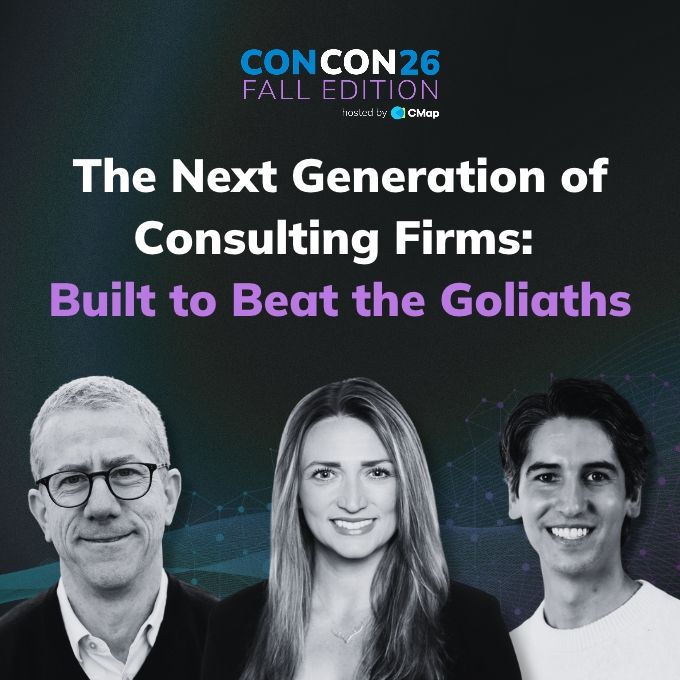
The next generation of consulting firms: built to beat the goliaths
The session, at a glance
Three people who build, market and advise boutique firms on what’s working against the big names right now.
- The Goliaths' real advantage is a name. The fix is being known for one specific problem.
- Ask ChatGPT about your client’s pain and it may tell them not to hire you. Your answer has to be discernment.
- Being a great consultant and running a great consulting business are different skill sets.
- Treat every client as a snowflake and you give your margin away.
Three key stats
- 53% of firms say clients are either more skeptical of their value (28%) or squeezing on price (25%) because of A
- 46% say their biggest margin pressure comes from clients pushing back on rates (24%) or doing more in-house or with AI (22%)
- 13% are investing most in niche specialization to grow their brand, against 39% investing in thought leadership and content
Watch the full session
Clients can ask ChatGPT first now, so boutiques win on discernment, specialization, and how well they run the firm
Kerrie Luginbill ran an experiment for a client stuck at around $7 million in revenue. She typed their target buyers’ pain points into ChatGPT. The first response told the buyer they didn’t need to hire anyone, then offered to build them a roadmap. That’s the competitive set boutiques now face: the Goliath with the brand, and the client with a chatbot.
This panel brought together a compliance technology founder, a positioning specialist and a former Big Four partner turned growth adviser to answer one question: where do boutiques still win? Their answers came back to being specific about what you do, being senior and personal in how you sell it, and running the firm with the discipline of a business you’d want to own. In the next five minutes, you’ll get all three.
How do boutiques break out of the “referral dungeon”?
By specializing so you’re known for solving one particular problem. Kerrie Luginbill sees boutique firms trapped in what she calls the referral dungeon: if the founder doesn’t know someone, the firm can’t get in the door. The Goliaths don’t have that problem because buyers recognize the name. Kerrie has heard buyers admit they hired McKinsey “just so we could kind of see what the McKinsey thing is.”
Kerrie’s framework has two ways to niche. Vertical positioning means picking an industry. Horizontal positioning means solving a very specific type of problem, either within a vertical or across several. The right choice depends on where your value comes from: a problem similar enough across industries to codify into a methodology, or an industry so complex it needs a specialist thought partner.
John Howard added a practical layer. Even capability-led firms do better when they can speak each buyer’s language, so a utilities buyer and a healthcare buyer both hear something specific to them. Nik Fuller’s firm takes the horizontal route (privacy laws apply to everyone) and differentiates on delivery. He opens sales conversations with what FLLR doesn’t do: no privacy policies, no legal advice. Just translating technical requirements into operational outcomes.
Kerrie’s own firm made the switch from generalist to specialist after repeatedly losing the deals it wanted most to specialist firms.
“If you are a boutique firm and you’re trying to figure out how to break out of that referral dungeon, you’ve got to specialize and you’ve got to go more niche with what it is that you’re selling, so that you can become more well known for solving one particular problem instead of being a generalist boutique.”
- Kerrie Luginbill, Partner, OTM
Specialization gets you in front of the right buyer. Increasingly, that buyer has already asked an AI for help.
How do you compete when the client can ask ChatGPT first?
You compete on discernment: knowing which answer applies to this client’s situation, which comes from years inside complex, similar problems. That was Kerrie’s answer after her ChatGPT experiment, and it was echoed across the panel. Nik Fuller put it more bluntly. Knowledge is commoditized with AI, so people pay for execution.
The pattern Kerrie sees is commoditization hitting almost every industry. Buyers of expertise usually know their problem but not the solution, which is exactly what they can now type into a chatbot. The more savvy the client base, and the more they’re building their own automations, the bigger the risk.
In practice, the panel’s answers were specific. Kerrie is helping clients create content that gets cited inside AI answers, build positioning against DIY, and build their own context layer: data and patterns tracked across clients that make their methodology more useful than a general LLM. Nik invites prospects to “meet the family”: the delivery lead and the engineer who’ll run the work, so buyers see who’s behind the proposal. John’s approach is to be generous with expertise, publishing material clients can use without ever hiring you, because a chunky problem still needs someone to hold their hand through it.
The cause of the threat is simple. A chatbot subscription costs a fraction of a consulting fee, so firms have to explain clearly why someone should hire them instead of testing it themselves.
“The big word we’ve been throwing around with the conversation around why choose AI versus choose this consulting firm is the word discernment. AI isn’t gonna make the discernment for you that these years of expertise and these people who have been inside of these different complex scenarios have to apply to your particular situation.”
- Kerrie Luginbill, Partner, OTM
Winning the work is half of it. The panel was just as clear that the firms that last are the ones run with discipline.
What separates a great consultant from a great consulting business?
A different set of skills. John Howard put it plainly: the things that make you a great consultant aren’t necessarily the things that make a great consulting business. Firms that get to their first few million on great work often find it won’t carry them to the next stage.
The biggest danger John sees is chasing top-line growth without watching gross margin: selling at the wrong margin, losing control of overruns, and drifting into adjacent work that dilutes the niche that made you successful. For firms moving away from time and materials, he urged leaders to stop obsessing about utilization and start obsessing about margin per head, and to teach their teams how a consulting business makes money.
Day to day, the fix looks unglamorous. Write down how you do the thing you do over and over, and train people on it. Kerrie hired a fully non-billable systems engineer to shadow her team and rebuild their solutions, and saw large EBITDA percentage improvements within about six months. Nik Fuller’s advice from founding FLLR: sell more recurring revenue from day one, and raise prices. He tells his team to “go find the no on price first.”
The cause, as Kerrie described from her own 20-year journey, is the consultant’s instinct to treat every client as unique. It feels like great service. It’s also how margin leaks.
“I am as consultant-y as it gets. And so, like running a firm, I wanted every project to be a special snowflake… I think no matter what your intention is with your firm, you should run it like you want to sell it, even if you don’t ever plan on selling it, because all that means is better margins, better revenue, better profit center.”
- Kerrie Luginbill, Partner, OTM
The panel’s advice adds up to a single idea. Clients buy your judgment, and the firm around that judgment decides whether you keep the margin it earns. Specialize so you’re known for something. Bring discernment AI can’t. Then run the firm like a business: repeatable methods, a clear view of margin per head, and the data and context that make your methodology yours.
That’s the foundation CMap is built to give boutique firms, from bid to bill, so the knowledge that wins the work is in everyone’s hands.




So what do the next generation of boutique consultancies look like? What's important to them, and how can they beat some of the Goliaths who are leaning heavily into partnerships with LLMs, who have got some of the scale and the brands. For me, though, when I look at the data, at least, there genuinely is a rise of the boutiques. There is a higher volume of boutique firms and SMBs in the market.
They are taking market share. They have the flexibility and nimbleness to win in the in the...
What looks to be the forward looking markets. I think very well positioned as opposed to some of the bigger firms. So we've got three fantastic panelists who are gonna be sharing their insights, and I believe they're gonna be joining me any minute now.
And whilst they do, I can see them dropping in and some very happy smiley people. We have got Nick, John, and Kerry, and they will be giving intros in a second. But for all of you, I think what I'm hoping to get out of today's session is insights from the panel around the people that are running boutique professional services firms. You've got people in here who work with tens, if not hundreds of similar firms to yourselves.
We've got a cross section in terms of domain expertise. We've got people who have sat either side of The Atlantic based in North America and in The UK, but with North American experience as well. So we pulled this panel together to bring all of those views and opinions into a one single place, and and genuinely delighted to have all of them with us here today.
So let's start with some intros. Nick, do you mind leading us off?
Absolutely. And and hey, everyone. Thank you for making time here. My name is Nick Fuller.
I lead a tech services firm called Fuller Consulting. We're compliance technology consultants. It's a very niche space, but what we do is we help organizations comply with laws like GDPR, CCPA, but we do it from the technology point of view. So how do you implement the technology required for organizations, mid market enterprise strategic accounts to meet their compliance obligations?
So look forward to today's conversation here.
Cool. Thanks, Nick. Carrie?
Yeah. Hi, everybody. I'm Carrie Lugabill. I am one of our North American firms here, and I am the partner at a marketing and sales strategy firm called OTM. I specialize in positioning, and our firm actually specializes in working with b to b professional services firms. So very much firms that sell expertise, consulting firms, and our our specialization is helping them figure out how to build growth engines.
Very cool. John?
Yeah. Sure. Delighted to be here. Good to see you, Ben. I'm one of the cofounders and partners at Garwood Growth. We work with consultancies and investors in consultancies to help them make their firms more scalable, more profitable, ultimately more valuable.
Personal background, kind of over thirty years in boutique and big four consulting kind of as a practitioner, partner, and CEO. Kind of spent my career leading, building, advising professional services firms. So I've kind of seen challenges from the inside and outside and lived quite a lot of them myself. Looking forward to the conversation.
You all did a fantastic job. However, I think there's pieces that you're under...
Undersold yourselves individually. So I'm gonna quickly add some context for the audience. Nick has been on our podcast before, shared some amazing insights into building personal brands, how he moved out of big tech into running his own boutique consultancy, and he's doing a stellar job there growing like wildfire. Carrie crossed paths a number of times in the North American community.
She does some fantastic work with mutual clients in the marketing and sales positioning space, so props there. And then John used to run channel three. He went through a successful transaction and now has partnered with us multiple times through on implementing ops platforms for mutual clients as well. So, genuine experts, genuine insight, for today's session from the three of them.
Let's get started with the questioning, though. So where do you all three of you feel like the Goliaths are still winning, if indeed they are, or pulling ahead? And and, Carrie, if I can get your initial response, that'd be great.
Yeah. When I saw someone in the chat noted that they really like some practical examples. And so I'm gonna try to be as practical example wise as I can.
But in my world, it's all marketing, sales, and the conversation around how do you build predictable growth engines for more of a boutique provider. And I think the thing that the Goliaths have that is really challenging for us is that they have those big brand names. They have brand recognition. They have that dominance in the market.
And a lot of the boutique professional services firms that I'm working with are trying to escape that referral dungeon where it's like, if the founder doesn't know somebody, they can't get into any other firm. They're really having a hard time adopting outside of that sphere of their first degree connections. And the Goliaths have that edge because they have that name. I have worked with firms and done some focus groups and customer research where their ideal client, their ideal customer has said to my team on calls things like, Oh, well, we hired McKinsey just so we could kinda see what the McKinsey thing is.
And it's like, how do you compete with that when they're really not even sometimes hiring for outcomes? They're hiring because of a name. And so I think that is something that is going to be in place. And my practical comment back to that, my feedback to the community here watching, if you are a boutique firm and you're trying to figure out how to break out of that referral dungeon, you've gotta specialize and you've gotta go more niche with what it is that you're selling so that you can be become more well known for solving one particular problem instead of being a generalist boutique.
Nice advice. And talking about somebody who's done that, and I'm hoping comes in with some Goliath crushing advice as well. Nick, over to you. What's your perspective?
Yeah, the Goliaths are winning when they're the incumbent in organizations where they've pre negotiated spend for the year of the CFO and their their teams are unfortunately required to use them because they need to meet their spend obligations. Organizations are not jumping up with joy to go work with these big companies. They're doing it because they're told they need to, because they're told vendor onboarding is too difficult and it's going to take too long to bring in a new vendor into the organization.
What we find is you can often compete in win business there when you do specialize, when you can provide a differentiated product, when you're the deep experts and the work that you're providing requires deep experts. And that's about how you position, how you talk about your services. And when you build the right champion, they're willing to go to bat and bring you in. And once you build those relationships, those are your relationships now and the Goliaths can't touch that niche work and then you can grow and expand from there.
And, John, you must have, particularly in the vertical that you were selling into at channel three, Bing Health, competed against them a lot and no doubt with the firms you're working with now competing head on with them. What are your... What's your take?
I think I think I I completely agree on the point about specialization. I think there's also something about then. So if you're very, very good at a particular client problem, don't just be good at advice on that problem, good at actually helping them solve it. And be, you know, build the relationships and the kind of diagnostic phase that's almost inevitably there that builds trust. And they'd be prepared sometimes with kind of skin of the game, either around kind of fixed pricing or outcomes to kind of stay with them and solve the problem so that they know then They and their friends they refer you to can rely on you not just for good advice, but actually an implementation of something that will create a lasting impact in their business. So I think I... Specialization, but with kind of tangible impact, I would say.
Look. Were anyone questioning? I'm gonna go off topic already, but I did encourage people to be active in the chat, and a really good question's come in, which is niche niche within the solution or niche within the target market. If any of you have got a particular response on that, feel free to jump in, and then I'll go to q two.
Yeah. I can touch on this a little bit because this is a lot of the work that we do with our clients. And I will say, my firm as well, we transitioned from a generalist firm that was winning business, you know, in our local market. And what we found was that we would get opportunities, we'd get at bats with these higher value projects, the projects we really wanted to win, and we would lose to specialist firms. And so we realized several years ago, we've got to pick a niche. And we started, we picked it originally because we wanted to have a better opportunity at winning ideal state deals for our firm's growth.
There are a lot of other reasons why you should specialize that we can chat about, but that's really what the impetus of ours was.
But there are two different ways, at least in our frameworks, that you can specialize. So when we're looking at niche positioning, there is vertical positioning. Vertical positioning is picking a vertical, it's an industry. I work with biotech, I work with life sciences, manufacturing, that is vertical positioning.
There is also horizontal positioning. Horizontal positioning is where you solve a very specific problem or a very specific type of problem, and you can horizontally position in a vertical, or you can horizontally position across verticals. And I think the answer to which of those is right for your particular firm is what are people buying and why are they buying it? Where does the value come from what it is that you do?
Is it from understanding the problem so deeply and it's similar enough across these industries that you can really package that into a codified methodology or a framework or a layer of context that no one else can compete with? Or does the vertical really have such unique complexity that you need to specialize in the vertical itself and be a thought partner to those firms? So that would be my take on those two. I don't know, Nick and John, if you wanna weigh in there.
Just one thing, maybe question for you is observation on what we see and be interested in what you see. So we work with firms that are by nature, more of a kind of capability kind of focused firm than a vertical focused firm. But one of the things that we're seeing is that increasingly to be able to sell that capability well, you need to be able to at least give it a kind of flavor for different verticals, because like your entry point often with the client is, like, what's unique about... So if you can do utilities or manufacturing or health care, like, but convince me of that if I'm a utilities person versus a health care person. So even if the underpinning thing is the same, you do need to be able to speak to the vertical. Doesn't need to necessarily be deep, deep, but we find people have more success when they can kind of paint a layer of verticalization on top of a capability play. Don't know what you think here.
Well, this might lie... Loop nicely to Nick because I'm gonna assume you've got that, like, horizontal rather than vertical. How many times do you need to have the verticalization when you're talking to somebody about the sort of offering that you bring to market?
Yeah. For us in our space, laws apply to everyone, which is a beautiful thing for us. And within those, there's there's different specialties, but it's a a broad enough market where we don't need to specialize in any one industry as the nature of our work allows for it. Where we specialize is how we deliver the work and that's where we get to differentiate.
I often tell my clients and prospects and especially my sales team, we have about a team of five or a 40 person consulting firm about four years old, where I lead with what we don't do.
And we're not going to write your privacy policy. We're not going to give you legal advice. What we're here to do is translate the technical requirements into the operational outcome because we believe you know what you need to do, you just need to know how to get there. And that's where we get to differentiate is bridging that gap.
And we can be really deep expertise in this technology that we support where the Goliaths and others in this space, they want to be generalists. They want to solve every problem. They want to sell them accounting software too and then do audits after. And it's like, no, no, no.
You work with us because you want the best of the best and they're paying for our execution. That's where I think why we win because I'm not selling a six week strategy project. Personally for us, we feel like knowledge is commoditized with AI, anyone can go plug this into it. People are going to pay for execution and that's where we're going to win every day because we can actually execute at the highest level against a lot of our competition which can give a mediocre report and give a mediocre execution.
Now question two is around where do you specifically see boutiques when they're competing head on with a glyph, let's say in like a more formal RFP or tender process or it could be more informally, you just know somebody's already in there from another firm. Like, have you got any insights or examples of something that could be proposition pricing? I don't know. But... And and Nick, let's go to you first on this where you have beaten them head on.
Absolutely. We we just won an RFP at one of the largest insurance carriers here in The US just last week. And we won that for I think three reasons. One, because of our expertise in this space.
The champion there, we've built a relationship with her and she wants someone who deeply knows this While the rest of the RFP is bringing in the big four because they're already there. They're already involved. Everyone has relationships in these accounts, but they're not relationships in the space. And so don't be fooled by someone saying, well, they're already there and they know everyone, they don't.
There's some random partner somewhere who signed some SOW, they don't actually have these deep relationships. And so we're winning because we can build that personal relationship through our personal brand, through events and building that confidence. Two, we're winning because we get to differentiate in how we talk about our services inside of these accounts. We get to ask better questions.
We could get to raise challenges no one else has thought of, not providing generic responses to these RFPs, actually challenging assumptions inside of those and saying, hey, you're thinking about this, but you're thinking about it wrong. Like the most successful clients do it this way. And coming with that perspective point of view, we get to be more thoughtful because we're more focused and because we do this a lot and and we're not you know, bringing in people randomly trying to spin up and come up with a point of view for the first time because they've never done this. And so that's where we're able to really differentiate in...
Inside of these processes here.
And, John, what about with some of the firms you're working with? Where are those next generation firms beating the bigger firms in sort of head on battles?
I think where where there is it's kind of what Nick was saying. There's a real trust that the people who are selling you the work, you know, people who are going to do the work, and those people have have lived and breathed and solved the same problem that the client has. And that doesn't mean that everybody has to be a practitioner with thirty five years in that problem. Like, that doesn't mean you only have senior people it doesn't like but it is people know that they're going to get real experience and a strong outcome, however that's packaged up and delivered, as opposed to slightly more generic advice. Think that is, and that's not to say that big firms don't all give generic, I don't wanna disparage, like they do great work, right? But is a trust that comes from this person has been in my shoes and they're gonna be alongside me to help me figure out the solution and make that happen.
John, I'll jump in there. A great way to put FUD in this whole conversation and the deal cycle is come meet my team. It's not just me as the founder, you're not just talking to a sales guy. Come meet the guy who runs my whole delivery practice. Come meet the engineer who we think will be best to run this engagement for you.
Meet who's going to deliver this work. You're not just gonna get a partner who disappears in some, you know, kid straight out of school who doesn't know what they're doing learning on the first project. Like, use that to your advantage. Like, bring the team, show off, like flex your muscles on how great the actual folks doing the work are going to be, and you're gonna differentiate, I think, extremely well when when you just open up more and say, like, meet the whole company. Call my mom. Like, you're here to, like... We're here to win for you. Like, we'll we'll give... Roll out the red carpet for you.
The Fuller family's security expertise goes deep, does it? Kerry, why don't you finish us off on this question?
Okay. Well, I'll be a little bit of the black sheep here. I hate RFPs.
Won't do them.
And I think that's a decision that you get to make also as a boutique firm, right? You get to decide what types of work you're gonna go after. We, in particular, don't really go after RFPs. We ignore them. And if we do, like Nick says, the first thing we do is tell them their RFP sucks and that they should talk to us about how to make it better. And then sometimes we end up a thought partner with them and we help them craft, recraft their RFP, and then we bid on that RFP.
That's kind of a wild angle. But I do have some clients that compete in the RFP space. There are two things that I've seen them do. One, I've seen, positioning is not just positioning your firm for somebody, but it's also positioning against the competitors that are in the space. And so I've seen some firms do really creative positioning against the big four, five in their industry where they've said, This is the experience you get with them, and this is the experience you get with us. And they call it out and they position directly against it. It's a little risky, but it can work.
The other thing that I'll say is mapping your... Depending on what your firm does, if you take a look at your entire customer journey and you try to pinpoint what are those things that are happening before that RFP comes out, trying to find meaningful connecting points with those firms before that RFP comes out is a way that you can start to warm up that experience, which then if you wanna call them and tell them that you hate their RFP, they already at least know who you are.
So those would be my two points. But I definitely don't have the experience that Nick has because I don't like RFPs.
Oh, great. To be. That was said I like them, Carrie.
One likes them, but you know.
Can I just say, this is a bit off topic, but I'll kind of say, I think to Nick's point about kind of meet the family, meet the team, right? I think that it links maybe to something we might talk about later about kind of talent and is the pyramid dead and all those things. Right?
That that exposure of the... Of of clients, the team is not only good for the client, it's really good for the team as well. We find that, like, I think the future of kinda learning and developing more junior talents, like, get them involved in those conversations so that they understand kinda from the off. What's the what's the challenge you're you're trying to solve? So by the time they're into the engagement, they understand it as well as you do. So I think that that that that's gonna give everybody a better experience and help with your talent development, I think.
All good insights. And there was... I quite like some of the ideas around positioning around what you aren't as much as what you are.
All three of you touched on that at certain points. A a quick fire question to sort of finish the first topic, which is where's the danger? Like, if you were red teaming a boutique, like, where do you feel like the threat is for them in the current market and or against some of the boutique firms? John, why don't you take the lead on this and then we'll go to Kerry and Nick.
I think one of the biggest dangers is probably pursuing growth and building a kind of successful growing business, but without paying enough attention to the the kind of foundations that sit underneath it.
We we, you know, we work with clients who sometimes they've got a they've got a firm that has see... Succeeded well, but what if we cut them to the first few million revenue isn't necessarily risk when we get them to the next phase. So, you know, a couple examples in that. Like, revenue can start to... You know, people can be really focused on the top line without paying enough attention to what's happening at the gross margin level. And, you know, so so we work with people to make sure they can understand, are they selling at the right margin? Can they see that all the way through to delivery? Do they have control of of margin and and overruns and things like that so that they're getting they're getting the profit, not just the growth. And that requires a kind of attention to some of the operational mechanics of how you run the firm and the economics that isn't necessarily the forte of all founders, if you will.
And second, to come back to the thing, you know, we've been talking about around differentiation. So you can you see people lose focus on the thing that made them successful in the first place. So, you know, a boutique that has built a strong reputation in particular niche might start winning work and getting kind of drawn into other things that might be sensible adjacencies or might turn distractions. If they turn out to be distractions, you can end up having diluted the very thing that was making you successful in the first place. So I guess the upshot there is the danger is you build something that's growing, but doesn't actually have the kind of sustainable foundations underneath it that's going to create not just a growing firm, but a profitable and valuable one.
Talking my language with that one, John. Kerry?
Yeah. That was very accurate, John. I think when you start layering AI tools in there, that becomes even more important for sure.
So can you repeat the question again, Ben?
Yeah. So what's the big... What's the biggest danger that you see for boutiques? And you can take that broadly, but, obviously, the context we've been talking about in the first few questions was against the Goliaths. So is there anything in the market or how... I'm thinking for you, like, wise, sales wise, that you see as a red flag in some of the firms that you're working with?
Yeah. There there are really two prevailing things that we're seeing a lot of. And so the first is, competing with the new DIY utilizing AI. We're seeing commoditization just hit almost every industry because if you think about the way that people buy consulting or buy expertise, a lot of times they don't know what the solution is.
They just know what the pain is that they have. So they know the problem. So now they can open Clot or they can open ChatGPT and they can say, I'm having this problem. And so I have a client that does ERP style implementation with a very specific software provider that I will leave unnamed because I'm not being paid to name them right now.
And so this firm is, they're in one of those ceiling points. It's like that 7,000,000 revenue, they're really trying to break through it. We got them to specialize in a specific vertical. We've got their go to market really wrapped around that.
And we're seeing things kind of waver. And I'm like, what is going on? And so I went to, I pulled up, I think it was Chad GPT, and I started putting all of those symptoms in, that I was like, These are the things. These are the things that we target.
These are the pain points that our customers have. And I'm typing them in. And the first response was like, Hey, you don't need to go hire somebody to fix this for you. Here's a bunch of things, and do want me to build you a roadmap?
And that is the experience that people are having. And so depending on the savviness of your clientele, and if they're all, if you know that they're all out there trying to kind of configure their own bots and running their own AI automations and their own scheduled skills and all of these things, then DIY with AI is a pretty big risk in the environment. And it is going to require having to explain why they should hire you instead of go test these things out.
Especially depending on your fee, your fees could be, it's like very disparate. Oh, my ChatGPT or my Claude subscription is this much money. And so that's been something that we've been really, really addressing with clients in creating content that can become cited inside of those responses, building out positioning against DIY.
And that is also a vote for specialization.
I know I've said that before, and it's not my only message, but specialization allows you to get really deep in a specific thing, and that allows you to have more discernment. And so the big word we've been throwing around with the conversation around why choose AI versus choose this consulting firm is the word discernment. AI isn't gonna make the discernment for you that these years of expertise and these people who have been inside of these different complex scenarios have to apply to your particular situation. And then the second thing that I'll say that has been a pretty big hurdle for my clients, and I've been doing this for about eighteen years.
So, you know, things have changed. I went from putting ads in phone books to whatever it is we're doing today. And the big risk that our B2B services based clients are having is the dark funnel, People are having these conversations in closed door communities. They're doing LLM research first.
It's so hard to track the actual touch points that make up the customer journey that it becomes increasingly difficult to figure out what levers to pull when things are working or when things aren't working. And so trying to find alternative ways to gauge what that journey looks like and the true length of it, that's something that we're still working on every day. And it's this big needle in a haystack to figure out what are the touch points we need. There's something like, I think I saw a new report the other day, and it said 88 was the new number somebody threw around.
It was like 88 touch points for a deal that's over $10,000 or something like that. It's like, you don't know that. No, how could you possibly know that? But the idea is that it takes a lot of touch points, and we can't see 60% of them.
I love the difference in, like, the the number one priority of our team between John with the ops and the margin, and then carry on AI versus DIY. Nick, where are you gonna come in on this?
Yeah. Where a boutique struggle is where are they gonna find their next deal?
It's all about building that motion that's repeatable. And often times what I find deep experts who start consulting firms, they do it because they they deeply know this space. What they do is they love solving the problem and I'll say this to the customer. They love solving the problem and deep experts will do whatever it takes to solve this problem to the point where they forget they're running a business and they need to keep selling and where orgs struggle to scale, struggle to find fit to keep moving is they lose sight of the real goal of this business is to sell work and to grow and add clients and customers and that's where you're gonna find boutiques.
If I'm gonna red team a boutique, I wanna understand like, well, what's your go to market? How do you find customers? Like when you join our company, I walk you through a PowerPoint of how Fuller Consulting works And there's a whole section of how we find customers. Here's the operational way.
Here's the opportunistic way. Here's why we spend money at these conferences. Here's how our sales team gets paid. Here's why we do these webinars.
So everyone fundamentally knows why does Nick post on LinkedIn? It's because it literally brings us business. Why do we spend hundreds of thousands of dollars going to conferences? It's because it brings us business and we're in the business to grow.
We are a grow or die consulting firm and that's what we're focused on. Because if we don't grow, our margins will eat us alive.
And so we have to constantly grow the business. And that's where I think boutiques will struggle if they're not focused on growing here.
Wow, grow or die. Grow or die baby.
Isn't every firm a grow or die firm?
They are, but we don't realize it because someone's going to come to you. It's end of the year, everyone's knocking on my door for a raise and a bonus. And I wanna provide that.
But I need to keep growing the top line because if I don't grow the top line, my margin shrink. And eventually, we don't make money. And what are we doing here if we're not making money?
Well, if you wanna know what Nick would do, you can go listen to the podcast where he talks about his, potential forays into... Think it was gardening and, like, cutting down trees and things like that. It was a good listen. Okay. Topic two is all about the firms of the future.
If you were starting your boutique again, what would be the one lesson or or challenge or thing that you've learned that that really stands out that you've overcome that applies more than ever now? Nick, going to you first.
I think this is...
Obviously, there's AI. We're extremely AI pilled in everything we do. We are quite literally today restructuring how we deliver work. We build tools internally to make everything easier, all that fun stuff. But I think what I would do differently than what I did initially is I would have sold more recurring revenue.
And I would have from day one put some sort of managed service on a project and I didn't because I wanted to freelance and work twenty hours a week and I didn't want to be at a client long term, which was great for me then. But now I have a business and I want to grow or die. I need more recurring revenue inside this business. So that's a mistake I'd say we made early on as we didn't focus heavily enough on that. And then two, I would have raised prices. I was way too cheap.
I refounded the business with the business partners the first thing we did. Pushed price up and today we're still pushing price up. We have not hit the price ceiling inside of our deals, inside of our accounts.
You think a 10,000 project is too expensive someone. Then you try to say, oh, 100,000 too expensive. You then sell a $500,000 project to someone. These are small dollars for these big organizations.
They spend way more than what we're comfortable putting in front of these clients. And we're constantly, what we tell our team is go find the no on price first. That's the hardest thing to go find. It's really easy to get a yes.
It...
You could sell anything guys for a dollar. Someone will buy it. But how do you find that no and then get to the yes from there?
That's what we've been learning over the past probably eighteen months that's helping us really grow and scale our Love that.
Very good. And also what's interesting, if I think about the first twenty minutes about competing against the glass, nobody mentioned price, and I thought that would come up. So that's quite interesting in itself. John, what would you do?
It's a little bit linked to what I was saying earlier about the kind of foundation piece. The things that make you a great consultant aren't necessarily the things that make a great consulting business. Right? So I'd say kind of some of the stuff Nick said, focus early on building that reusable capability.
And we all think about that as kind of AI right now. Right? But like, there's also a lot of just kinda how do you do this thing that you do over and over again? Has anybody written it down and trained other people on it?
Right? There's some basics that don't need Claude. Right? That kind of...
And if you're doing those things well, it just makes life easier when you get into the next project or the next project. And I guess another would be kind of like, think about kind of where you wanna take the business. Like, what kind of business are you going to want to build? Are you trying to build a business towards an exit?
Are you trying to build a business towards a kind of firm you're gonna have for for a long time? We might talk about that later on some of the outcome stuff. But, like, think about not just what's in front of you today, but what's gonna create a valuable firm, whether you're gonna own that forever or do something else with it down the line, like, make sure those foundations that they become really, really hard to retrofit. If you haven't built in the habits and the muscles of kind of running the firm like a firm early on, it gets hard to do it because you haven't built the habits.
Carrie, what about you? Either from the OTM lived experience or an insight from a client who's going through that process?
Well, I feel like John's giving me heartburn because he's basically calling out...
You know? So our firm will celebrate 20 next year, and that's a really long time to have a professional services firm, especially a marketing agency. And I think one of the reasons that we've been able to make it this long is that we've actually reinvented the business probably three or four different times over the course of that, the S curves, things have been commoditized and market shifts, but we've done literally everything wrong several times in every which direction. And I would say if there was one thing that I could change, I would have done a lot of things earlier to John's point.
We did not, I am a consultant, like I'm as consultancy as it gets. And so like running a firm, I wanted every project to be a special snowflake. I was like, I can't reuse anything I've ever used before on any of these other clients, even if it worked really well, because this is so special, and it has to be so unique. And I think it took a really long time for me to realize that's not how you run a firm.
You've got to write down those processes and refine them and make them better every time. And a lot of the work that we do with clients is helping them take the special sauce that comes out of their founders and turn it into like a codified methodology or some sort of intellectual capital. And I wish we had done that sooner because I think we're on a good path toward, you know, building margin and being able to train people and being able to train LLMs. But if we had started, you know, ten years sooner, it would probably be much more effective.
No, it's really that element of switching from treating it like a lifestyle business to treating it like a business that you do maybe wanna exit one day. And I think no matter what your intention is with your firm, you should run it like you wanna sell it. Even if you don't ever plan on selling it, because all that means is better margins, better revenue, better profit center.
What's the point? We all love what we do, but at the end of the day, we all wanna make money.
Right?
You can repeat the like, every client is a snowflake for the people in the back one more time, because I was speaking to a firm the other day and they were like, well, we don't need to codify and productize any of our services because with AI, we can spin out custom projects every single time. And I was like, oh, please, please just just have a look because at least 50, 60% of what you're doing probably can be documented and repeated. I'm almost certain of that with every professional services firm. And then if you need to use AI to do some of the flexing, well, if you've charged a good price for it, that's gonna be your margin that you keep.
You don't have to lose it to completely doing everything custom time timing. And, anyway, I wasn't really supposed to interject there. My role is just to ask the questions. Okay.
So what do boutiques do when they can't compete on brands or with some of those big name firms? Carrie, do you have any perspectives? I mean, to be fair, you've given one which is like, don't even enter the RFP. Anything further to that?
Yeah. When I saw somebody in the chat had commented, there are certain firm types that the audience requires an RFP. It requires a procurement process, big buying committees. And so when I say I don't like RFPs, I don't have those buyers, but I do have clients that do.
And a lot of times it's what I said earlier in that, know that entire customer journey and try to find signals before there really signals. So something that we've been doing a lot of is trying to, in professional services and in consulting firms, a lot of times our buyers aren't like raising their hands. They're not doing software demos. They don't have those standard signals that I think SaaS companies or even product companies can typically rely on.
And so we have to find alternative ways to figure out if somebody is maybe gonna raise their hand in the future. And that is the piece that I don't think the Goliaths are doing, is giving that level of detail and attention and curiosity and out of the box thinking about how to build prospect lists, and then the patience to wait for those prospect lists to turn into active conversations.
But when it comes to competing, I think the Goliaths, honestly, I think they're all gonna deal with the same margin pressures that we're dealing with as boutique firms. And I think it's gonna change the game. I don't think that we're gonna see the Goliaths lean on their brand the way that they have for as many years, because I think people are buying things differently. And I think that buying process is gonna continue to change. And I think that's gonna level the playing ground for us as boutique firms. And so making sure that we are doing what we need to do in our go to markets and in our growth constructs, making sure that we have feedback loops from our sales teams to our marketing teams, that we're recording all of those sales conversations, running them through and synthesizing the things that people are saying so that we can be as clear and as specific in their words as possible, I think a lot of the playing field is going to level out.
I saw a few heads nodding. Nick, in particular, have you got a thought to layer on top of that or something completely different?
You can tell me. But for...
As we compete against Goliath, we're not going to have the biggest brand that your neighbor knows. You can have the biggest brand in your industry, in your space.
We're fortunate like we can go to any conference and someone will at least be like, Oh, I've heard of you.
And that's a big focus for us.
A quick tangent for us, services is a top of mind game. It's the last kind of firm that they thought of or heard of or saw who can solve this problem. You don't get them to just like go buy a project. They have to want to go buy a project and then they'll think of that last person they thought of in that process.
For us, go in on personality. Oh my gosh, the Goliaths are so boring. Like you can you can do so much in this world as you just have a decent personality. You show excitement, show interest in the organization's problem like you're sending them interesting articles, you're thinking of them, you bump into a conference, you're just like, how's the family?
How's it going? Just like being personal. You can win so much in this world just like with the decent personality compared to most of your competitors. Like It doesn't have to be a whole science fair project to nail down margin and Just all this be enjoyable to work with and you will find business.
The bar is pretty low honestly there.
Love it, very good, John.
Mean I think So funny.
You know, we can all get obsessed about kind of LinkedIn contacts and all that.
Like, don't have to be famous. Like, you need to be known by the right people for the right problems. And I think one way to do that is to be, like, really demonstrate your expertise and be really, really generous with kinda thought leadership and, you know, kinda spinning...
Like, demonstrating to people that you understand the problem, you've got some things that will help them solve it, even if you never sell them anything. So we we publish, you know, a number of kinda ebooks and things like that that are intended to be like, use this without us. If it's helpful, we're happy to have a chat. But here's some stuff we've learned over the years that might be useful to you.
Off you go. Right? And I think that that, like, just be like, almost overshare the solution to the problem. Because in reality, if people kind of...
Most people, if it's a chunky problem, will know, okay, I get the theory. Now I want somebody to hold my hand through it. And that's where I think the opportunity. So find, you know, find the right people who need the right kind of thing, and then just be really generous.
As as Nick says, be pleasant to be around. Make people enjoy your company.
Maybe that's the unwritten thing I've got from this session because I think about what I think... When I think of all three of you, I think of I've robbed so much free content from you all and repurposed it and leveraged it myself and dead easy to work with. And, oh, and third thing, like, all very highly visible. So maybe that simple trio of take homes is the way that others could, take that forwards. Very good.
I'll add one other thing too, Ben, just tactically. Be easy to contract with. Like, you can win deals by... From speed. And The Goliaths, it's going to go through a four to six week negotiating process. They're going to push them to use their paper versus the client's paper.
Be easy to contract with. That doesn't mean give up unlimited liability in your contracts. That doesn't accepting term for convenience in there.
Negotiate your key points, but be willing to work off their paper, be willing to be flexible to go win deals. You need to win clients, you need to make money to grow. Once you grow, you can be more aggressive on your deals like you can then become the Goliath one day but at first, you need to go win deals. So, be easy to contract with especially end of year right now. Clients want to spend money by the end of the year and they're going to go quite literally with the provider who can get onboarded quickest to do this work. So there's deals to win by the end of the year if you're just easy to contract with.
Nice.
Okay. I'm gonna rattle through some of the questions in our last of the third topics, just so that if there is Q and A coming in through the attendees, through the audience, we've got time for that. Just a very quick one.
How, if at all, do you think the operating model is changing for boutiques? Like, is there anything you're doing in your firms that you that you can share with the audience's work that hasn't worked?
And I put on here bonus points if anyone can give any time scales or a sense of success rate.
John, have you seen anything in particular yet changing?
I think there's a lot of change going on in the economics of consulting.
I think the...
If you think about speed of delivery and this kind of impression that what you can do, surely you can do all this stuff in half the time that you used to. And so now I'll have half the price very much and how do you respond to that? Or even if you can do things more quickly than you're thinking, well, I always charge for days. How do I charge for time?
So that whole, I think the shift around time and materials, fixed price outcomes is becoming very real for people. So there's stuff to navigate there. But I think what we see then is if you're trying to make that shift, particularly if you've been primarily a time and materials focused business is, like, you've gotta get...
You've gotta stop obsessing about utilization and really start obsessing about margin and about margin per head and how you drive profitability and how everybody who's in the team realizes, like, great result for the client, right level of business across the team, but we're here to...
Back to what Nick said earlier, we're here to make money, and we understand the mechanics of how our business makes money. I don't think, historically, we've done a very good job as an industry of training our people and how consulting businesses make money.
That was less important when we just kind of had days and we put a margin on that on somebody's salary and we sold time, right? The mechanics of delivery economics are gonna require a different kind of operating model. And back to what we said about the founder, paying attention to those things is not three founders kind of thing they wake up wanting to do every day. So if it's not your thing, then get somebody who's thinking about that because the the the the margin is where you make money.
Carrie, over to you.
Yeah. I... I'll build off of what John is saying in that our firm, we hired a fully non billable systems engineer to come in, tear apart all of our solutions that we offered, and basically help us rebuild them in the most efficient way that still provides value to our clients and still has that human in the loop approach to it.
And as a firm, I mentioned, we've made a lot of mistakes. If you were to ask me five years ago, if I would have this many unbillable people on my team, would have laughed at you. But her role, it's interesting. She was a product design.
That was her, she was industrial product design by trade. And then she came into our firm and started as an account manager. She really understood what we sold and what we did. And then we pulled the, ripped the band aid off and made her fully unbillable.
And what she would do is she would sit down with our team while they were doing their jobs. So this is a little nerve wracking. And she would shadow them and she would go, Why did you do that? Why'd you click that button?
Why did you start with that window? Why did you start with this screen? And she mapped this and looked for opportunities to leverage tools and systems to alleviate a lot of that so that we could go from point A to point B faster without eliminating a human touch to it, but just truncating and, building more margin in there and making it more efficient. And so that was something that we've done over the last two years.
And I will just say, within about six months, we saw EBITDA improvements in percentages, like large percentages jumping because we were delivering differently. And if you bring a bunch of consultants and tell them to deliver differently, we're just gonna start the new brainstorm on a different piece of paper. So we really needed somebody who was gonna think about it very differently.
The other thing that I was gonna say is bringing back this idea of specialization, AI methodologies, codifying something, tracking as much information across your clients, building your own context layer is key. Because when you think about how you're gonna compete against LLMs largely, it is by having your own data and having your own information that you are using as that context layer. So I only work with professional services firms, B2B, and I have thousands and thousands of data points that are very specific and wrap around that intellectual capital that we have. And that's what makes our codified methodology and our intellectual capital more powerful than if you just open an LLM up and ask it the same questions because we're adding this context layer that you can't find without having done some intentional storage and tracking of those patterns and those signals and that information.
I'm so happy that's come up. I did not expect anyone to talk about that. That's... I wasn't just punching the air for no reason. That's a genuine celebration. Nick, over to you.
Ben, tee up the question again for me real quick.
I was just asking, do you see the operating model changing inside of your boutique consultancy or has it changed at all?
I mean, your your business is four years old and I know you've hired an operator, so I'm guessing there might be something in that. But if there's other insights, that'd be great to know.
Yeah. Well, look, we've all kind of heard all of this, but I do believe we're going from a pyramid to a diamond from an org structure standpoint. We're going to have a really solid middle layer that can execute powered by AI that can go do a lot of this administrative work from like analysts used to do.
For us, I'm always fighting for simplicity.
I'm not the smartest guy in the world here. I'm not the most financially literate.
What I strive for is simplicity in the business and we're doing that in two ways. One, just structurally how we run our business is we're a fixed fee deliverables based organization. We don't do any T and M. One, operationally that's just really hard to do, sending invoices, chasing down more and more invoices.
Two, that's a difficult way to scale. You have to work to scale. You have to work to make money and you need a lot of headcount to make more money. And that is just challenging and that provides more people you have to manage and that's not very simple.
Internally, what we've done is very similar to Carrie and team is we have two dedicated full time AI engineers inside of our business. And their job is to one build teams to help us make it easier for us to run our business. And I'll talk about that. But one, the other resources, he's focused on building tools for our consultants to use. So a good example of what we've done to make it easier to run our business is I mentioned we have a full time sales team.
At the end of every quarter, I got to run commission statements and I got to understand what client paid, did they pay within quarter, what was like the spiff on it at that time? If that adjusts kind of their payments, we need to then get sign off on that for them before we go run payroll. Well, our fractional CFO would spend a week and a half figuring that out.
Now we've built tools like a fully automated commission dashboard. At any second of the day, the sales team can see each individual where they are to quota, if they're in accelerators, what they're expected to get paid by the end of the quarter based on invoices. They know when invoices have been paid and they know what's outstanding so they know what to go chase. So now they have these tools, they have this information to actually go run their book of business to help us be successful and help them be successful. And then from a delivery side, we've built internal tools to help us build documents so we can really standardize on what a blueprint or what an assessment looks like. We have an agent internally that our team can talk to that can ride shotgun inside of a delivery project to really digest the information that's going into our shared drives, digest meeting notes and come up with like, hey, you should ask these questions next time.
A lot of that goes towards like data governance carry like we have all this data is in a usable findable spot for the organization.
But we're fully transforming how we deliver.
And we just wrapped up our 2027 planning in September here for our team. And what I'm challenging them to think about is what does not a twenty first century consulting firm look like, but what does a twenty second century firm look like? What are we selling?
First, are we relevant in the next three years? What should we be thinking about? How do we deliver work? What's the headcount to get there?
What are the tools, processes that we need to make that happen so we can put ourselves out of business before someone else does. I think we have the unique opportunity now to do that. We're in a fortunate position like we're very techie or all of our guys are very techie so we can go build this stuff ourselves. But I I I'm trying to get us a head start, a moat, if you will, before others can catch up with us.
Well, maybe by the next ConCon, you you'll have got the answers and you'd be happy to share some of those with with us because that sounds like a big question and an interesting question.
The next one, you'll just be talking to my AI avatar.
It'll be great.
I won't be in a hotel room in Chicago randomly.
I have to. So I have to make an ambition like, well, first off, this session has been incredibly engaging so much so I've forgotten one of my primary roles, which is that we've been running polls in the background. And I promised at the top of the sessions, we'd do a better job of running the polls and sharing the insights compared to May, and I have just completely ignored it. But I I blame the panelists because I was in the conversation.
I was getting the insights. So with a couple of minutes to spare, if anybody has got any specific questions that they wanted to ask, please do so using the chat or the q and a. And I have to point everybody to the polls that are incredibly relevant to what we've been talking about. In the Riverside platform, there's a polls tab.
The first question was how are clients changing what they ask of you because of AI?
And there's some interesting insights and responses in there. Please take a look. Question two is where is your firm investing in growing, defending their brand right now?
And then the third question is what's putting the most pressure on your margins right now? So as I said, all three of those, if I'd had just interjected them at the right point, we could have discussed them. I don't know if... Can all of you three see those polls and the responses coming through?
I thought they lined up pretty well with the conversation.
So Well, that was planned.
It was my Almost like you designed it that way.
Almost like you designed it.
Then I do think... So there has been a question in the chat that come... Has come up, like, three or four times. And the question are we publicly publishing pricing in consulting now? And I think, correct me if I'm wrong in the chat, but I think this question is coming up because LLMs love listed pricing largely. And I also think, you know, the idea of, this is something I've been wrestling with with our clients, making consulting more viable.
And so if you think about the historical way that we have bought consulting type services, it is, I am going to have a sales call, a discovery call, maybe multiple sales calls. You're gonna consultatively sell me. You're gonna tell me, ask me about my problems, discover all of these ways that you can help. You're gonna solve the problems while we're talking. And that's gonna convince me that it's worth going into a long term engagement, maybe a $250,000 engagement with you. And when people are going to like an LLM and they're prompting their problems and they're getting these like, Hey, do you want a thirty day roadmap on how to solve this problem for yourself?
Do we need to, as consulting firms, list prices in order to compete?
And I am very curious what Nick and John say. And I think it's heavily dependent on the firm and how, you know, what it is you actually are selling, how you package it. But something that I've been playing with our clients is multi motion go to markets. So thinking, you you have your land and expand type of model where the land, something really viable, where the person doesn't have to go, I trust you innately to come into my firm, and I'm gonna spend over a $100,000 with you in the next however long to go through this process.
That requires an immense level of trust. That is why referrals are king in the consulting world. So if we were trying to get out and we're trying to create a colder front door and we're trying to invite people in, we do need something that's more viable. We need something that people are gonna go, Well, I'll try this.
And they're willing to take that risk on it. And so my take is, I don't think you need to publish all of your consulting prices. I don't think you need to have a pricing catalog on your website. But I do think that it would be worth it in the next year to package up a solid entry point, something that is urgent and expensive and a problem, but that you can solve to prove, like demonstrating your expertise in a sprint or something, and then put a price on that.
And so that's my 2¢ on it. But I'm curious, John and Nick, if you guys have any thoughts.
Yeah, I would agree. I think there is something about an entry thing that's easy to buy.
I think it is difficult to reconcile. That's my opinion. A, we we understand you and your firm and the problem you're trying to solve deeply, and we're gonna build something that's, like, might be quite repeatable. Like, it is, like, we have listened and understand your problem with, here's the price on the website that says how I solve the same thing for everybody.
I think you might know...
You might have a small, medium, large that you know you're gonna apply. I just...
I would personally find it a bit like, well, if you're claiming to be really experts and, like, really kinda you're gonna understand and solve my problem, but you've already kinda come up with a solution that I I think there's a slight dissonance there. That's that's me. It might not be the case for everybody, but it just feels...
And I also think, like, solving that thing for for for a client who's, know, a medium sized business versus an enterprise will inevitably have some differences. So I think it...
I think I think it's a bit hard.
Nick?
No. No. No. That's good. Put your prices on your website. And you don't know the problem yet. I think you should have like internally like what you think this should cost.
But beauty of being good at sales is get on the call and they think this is their problem, but really this is their problem. Let's walk them to that problem.
And otherwise you're set at a low anchor price and now you're digging yourself out of a hole.
That is that is the risk with land and expand for sure.
I I was just googling how much is full of consulting actually. So I was just making sure.
Final pricing catalog available.
Yeah.
I don't know. Yeah.
It says amazing value. That's that's all you need to know.
Look. Thank you all three of you for being such excellent panelists, like huge amounts of insight. We're gonna clip all of this up so that people can see the best bits, and also rewatch the whole session in its entirety.
Please do, if you're in the audience, connect with all three people here. They're always sharing great insights on LinkedIn, loads of content. I referenced it earlier. I I leverage it a lot.
Any final words? If not, we're gonna give people a couple of minutes pause before we start our second session. But, yeah, I wanted to thank thank you all three of you. And if there was anything else you wanted to add, please do so.
No. Just big thank you for letting us be part of it. Great, great event as always, and always pleasure to spend time with Ben Edwards.
Wow. Cheers, John.
Yeah.
Thanks, Kerry. Thank you, Nick. Thanks, everyone. Thank you.
Join the story live
Sign up to upcoming webinars and live demos with industry experts
From reports to answers: Intelligence reporting and insights in CMap
Ready to transform your operations with CMap?
CMap replaces your existing homegrown systems, centralizes your data, and solves your ops pain


