
How to build a consulting firm that doesn't rely on the founder
The session, at a glance
A live audience poll during this session found the exact problem it set out to solve: how can boutique firms move from founder-led pipeline to a predictable machine? Here are some key takeaways:
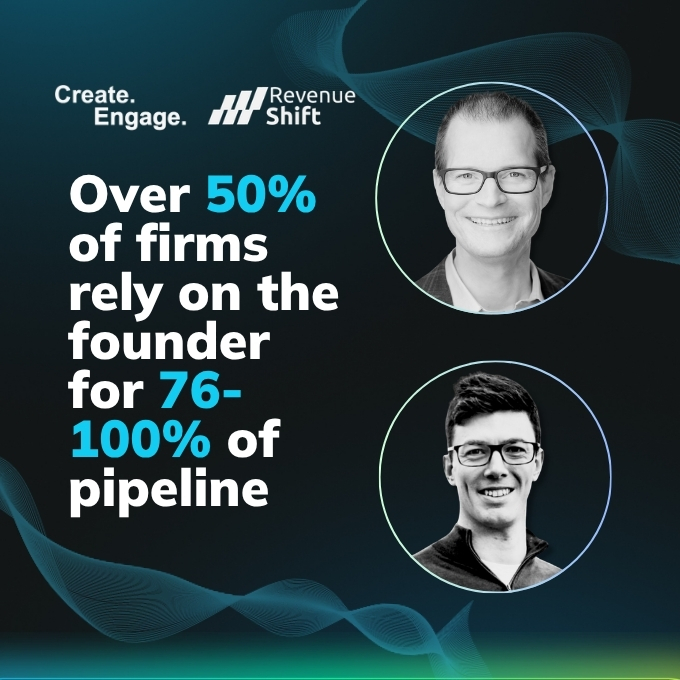
- In the live poll, over half of the webinar audience said that 76-100% of their new business is found through founders or partners alone
- Building a genuine growth engine takes 18 to 24 months, and the right time to start is about 12 months before a founder's network runs dry, not after
- The top three fixes for founder reliance: build up the principal layer, bring high-profile guests onto your own webinars, and invest in real, in-person community
- A firm's CRM, not a new AI subscription, is the most underused source of AI value a boutique consulting firm already owns
For more content & insights on how to build your firm beyond the founder, visit our Insights Hub.
Watch the full session
Over half of this webinar’s audience get most of their new business through the founder. Here’s how the other half broke past this bottleneck.
Every boutique consulting firm eventually asks the same question: what happens to growth once the founder's own network and referrals stop being enough?
Nick Synnott of Create Engage and Tom Hill of RevenueShift spent an hour unpacking exactly that, and a live poll during the session proved the problem is more widespread than most firms realize: over half the audience reported that 76 to 100% of their new business still comes through founders or partners alone.
The single biggest finding of the session is also the most actionable: moving beyond founder-led growth means building a small number of specific, repeatable systems well before the founder's network runs out, not replacing the founder. In the next five minutes, you'll get the three places that shows up most, without needing to watch the full session.
How dependent on the firm is a typical boutique consulting firm’s pipeline?
In a live poll run during this session, over half the audience reported that 76 to 100% of their firm's new business comes through founders or partners. Both speakers said this figure matches what they see across the wider boutique consulting market.
Nick Synnott frames this as a natural, almost inevitable starting point rather than a mistake: most boutique firms are built on a founder's own experience and relationships- their "black book” - and that's enough to build a healthy business of a certain size. Founder-led growth works fine on its own terms. But it stops scaling the moment a founder's personal bandwidth and connections become the ceiling on how much new business a firm can generate.
Day to day, this shows up as the boom-and-bust pipeline pattern both speakers described: sales and marketing activity drops while a founder is heads-down delivering a project, and then spikes again once that project ends and a revenue gap looms.
Tom Hill has watched this play out at firms ranging from a large global consulting firm to his own boutique, RevenueShift, and says the pattern repeats regardless of firm size, because it's a structural symptom of relying on one person's time and relationships rather than a system.
What causes the ceiling to actually bite, according to Nick, is timing: firms usually only start building a real growth engine once they can see the black book running dry… when the right moment to have started was roughly 12 months earlier. Because a growth engine takes 18 to 24 months to mature, waiting until the need is obvious all but guarantees a painful gap.
"Building a growth engine is an investment that takes time. It's an 18 to 24 month play."
Now you know the timeline, we’ll look at ways to reduce founder dependence in your firm..
What are the most effective activities for reducing a firm's dependence on the founder?
The most effective way to reduce founder reliance, according to Tom Hill, is building up a firm's principal layer so clients and prospects are hearing from multiple credible voices at the firm, not the founder alone - all backed by high-profile guest content and genuine in-person community.
Tom is specific about sequencing: the first and most impactful move is bringing principals along on the enablement and business development journey over time, so the firm doesn't depend on a single point of failure for new business. At RevenueShift, this looks like sharing LinkedIn content across the founder and every principal and colleague, deliberately, so clients see a team of experts rather than one person carrying the firm.
The second highest-impact activity Tom points to is webinars featuring high-profile external guests, people from well-known organizations that a firm's own network wants to hear from more than they want to hear from the founder. RevenueShift has hosted guests from major global companies for exactly this reason, then boosted the resulting content through LinkedIn to extend its reach well past who attended live.
The third, and the one Tom leans on hardest personally, is genuine face-to-face community, delivered through structured, recurring peer round tables rather than one-off events. In a market saturated with AI-generated content, he argues real human connection is what builds durable trust. It’s why RevenueShift maintains monthly virtual round tables for two industry-specific communities of 15 to 20 people each, supplemented with in-person dinners where geography allows.
"I think if your business is structured such that you have kind of an impactful principal layer beneath you, I think that's kind of bringing them along the enablement and business development journey over time, I think, is the most impactful thing, hands down."
Building that principal layer and community only works if the firm can actually see whether any of it is generating real pipeline – which is where the conversation turned to data.
Why a firm’s CRM is one of their biggest AI opportunities
A consulting firm's CRM is a massively underutilized AI opportunity. It already holds the rich, firm-specific data (who buys, what they buy, where they came from) that generic AI tools have no access to at all.
Both Tom and Nick pushed back on the instinct to reach for a new AI tool before fixing the data foundation underneath it. Nick points out that the more common problem is rarely a lack of tools. Many consulting firms still don't have a clear ideal client profile, or they have a CRM they only adopted because someone told them to and never properly used. Without that foundational clarity and clean data, any AI layered on top has far less to work with.
Where this becomes powerful in practice, in Nick's account, is when a firm's CRM data reveals patterns that would otherwise be invisible: discovering that 70% of a firm's projects come through one specific buyer type, or that half its work arrives through a single channel. That kind of analysis, connected to AI tools, used to take weeks and can now take days.
As general AI tools make information itself commoditized, a firm's genuine competitive edge is becoming how well it presents its own expertise and data - not whether it has access to AI at all.
The reason this matters more for a growing boutique firm than a flashier AI subscription is sequencing. Getting CRM discipline and a clear ideal client profile in place first is what makes every other growth activity, principal enablement, webinar content, community building, measurable and improvable, rather than a set of disconnected efforts a firm can never quite tell is working.
"Your CRM as a store of record has got unbelievable levels of data, and any system that you are properly using, that is where huge AI unlocks will come from."
All three of these findings point at the same underlying shift: moving beyond founder-led growth is about building a small number of systems with a principal layer, real community, and clean operational data. This lets a firm's whole team carry growth that the founder used to carry alone.
That's exactly the foundation CMap and CMap Intelligence are built to support, giving a firm's whole team the same clean, trustworthy view of its own data that this session's speakers say is the real prerequisite for AI, and for growth, to actually pay off.




Ben Edwards (00:03.04)
Hey everybody, thank you for joining us for today's webinar. Really excited for this one. Sales and marketing and moving beyond the founder are topics that I love to learn about myself. So I'm really keen to share that with all of you and obviously get the insights from today's panelists. So what are we going to be covering? This the subject matter is building beyond the founder, how successful firms can scale. It's actually been a theme that we've been running here at CMAP for
the summer as we recognise there are moments in a firm's journey where the founder maybe becomes the bottleneck, but as you scale and grow, you don't want to lose that nucleus, that culture, that inspiration that got a firm from zero to beyond start up phase. so delighted that we're going to be joined by Tom Hill from Revenue Shift, a North American based consulting firm who have really sort of
implemented some of the best practice around that headline. We've also got Nick Sinnet, MD of Create Engage, marketing agency for professional services firms. We were going to be joined by Create Engage's Ellie Hunt, who actually I believe runs the account for Revenue Shift, but unavailable today, but she still deserves the spotlight as you can see on screen because she was very much involved in some of the the prep and the promo. If you want to get a quick bit of insight before we start about
The overarching theme on that founder bottleneck, how firms successfully scale beyond the founder, then do scan the QR code for some more insights. The rest of today's session will though be more of a a topic-based and then running into a QA towards the back end of the session. Some housekeeping though, first. We have got the chat enabled. So on the right-hand side of your riverside.
Nick (01:39.852)
Thank
Ben Edwards (02:01.014)
Stream, you will see the chat icon. There is a public chat and you can post anything you like in there. but we probably will have some audience interaction throughout, and we'd love your contributions too. There's also a QA. that is just from U to I, so that won't be public. If you've got a question for Tom or for Nick or for me, and you want to post that and not let anybody else see, then
Nick (02:25.1)
Thank you.
Ben Edwards (02:25.41)
The QA is going to be best for that. And then we're going to be running some polls, which is the third tab along in that chat section, which will be covering a couple of interesting areas. And again, would love your participation. So the themes are outlined here on this holding screen, but what are the topics that we're going to be focusing on? Well, there's four main areas that I wanted to explore. The first off is moving from founder led growth to building more of a sustainable pipeline.
And this is a challenge I see time and time again, right? It's like how to turn that roller coaster of pipeline into more consistent and predictable demand gen. And for lots of firms, when you're starting out, you have to do a ton yourself. but the reason why we have Tom and Nick here is because there are things that potentially you can use expert partners for, you can outsource. So we'll be covering that as well. Lots of consulting firms have fantastic referral mechanisms and schemes that drive
a lot of their new business and that could be from networks, it could be from peer to peer relationships. So what are some of the things outside of that in a more traditional marketing sense that consulting funds professional services can leverage? So that we can then and then the fourth topic is is driving that more sustainable growth over a more extended period of time. So it's less on and off. There's more repeatable and consistent lead gen and pipe generation.
and for those of you don't know me as well, before we go into the intros, so I'm the head of partnerships at CMAP. I'm currently based in Orlando, Florida. I help with CMAPs go to market on the consulting side. So both sides of the Atlantic working with boutique consulting firms, mostly between twenty and two hundred staff, but sometimes a little bit either side of that, explore our operation solutions. So making sure that everything from quote to cash, bid to bill, you can do effectively on our platform.
But we have two esteemed panelists with us and it'd be great if we could get your intros first. So Tom, why don't you give us an intro from your side?
Tom Hill (04:35.468)
Absolutely. Thanks, Ben. Great to be here. Tom Hill, I'm based in Chicago. I'm the founder and managing partner for Revenue Shift. I've been in management consulting for 25 years, including leading the sales effectiveness practice at Corn Ferry Hay Group and another boutique called Lotus Blue Consulting. Revenue Shifts specifically is a boutique confer consulting firm built to help commercial organizations accelerate growth. We partner with our clients.
on how that to better design customer coverage, org enrolls, quotas and sales incentives for the commercial organization. We work with midsize to enterprise companies across technology, manufacturing, consumer and retail and insurance sectors. thanks so much for having me today.
Ben Edwards (05:26.744)
Thanks, Tom. Over to you, Nick.
Nick (05:29.036)
Thanks a lot Ben and really appreciate you having us on. So Nick Sinner, I lead the team here at Create and Gauge and we are specialist growth partner for boutique consultancies who are looking to build the engine that helps them create that repeatable lead generation and pipe generation that Ben talked about. We work with firms across the boutique spectrum ranging from those who are mid seven figures into eight figures and beyond. We've worked with over 70 firms
helped them build their growth engine and helped arrange of those from those who are looking to build that and run the business through to those who are looking to build and achieve an exit. And we've been on both journeys. Currently, I'm in Chicago today, actually in the same office as Tom. So looking forward to talking through the journey that revenue shift has been on and answering your questions.
Ben Edwards (06:21.784)
So before we go into the four main topics, just an initial scene setting question for you. When you think about a consultancy's pipeline, the roller coaster, the boom and bust, like what does that a ma immediately make you think of? What springs to mind?
Nick (06:38.668)
Sure, well, should I take what we see across the board and then maybe Tom, if you want to add what you've seen from the firms you've worked in. I think it's a very common challenge, and something we've all heard of and all seen, particularly where someone has built a firm based off the back of their own experience, their own black book. And the challenge it makes me jump to and something I'm sure we'll unpack today is that that boom and bust is caused by not having that engine to do
The core things that you need in terms of awareness, credibility, generate those leads and conversations across those stages of the pipeline. So naturally you're busy, your sales and marketing activity goes down, you end a project, suddenly you ramp it up. And that is that boom and bust. And that's the thing that we help clients avoid. That's where having that growth engine is what helps you create consistency. So those peaks and troughs, you're not seeing as pronounced or if at all.
Tom Hill (07:37.239)
Yeah, I think that's spot on Nick. I think the only thing I'd add is from a a firm you know perspective, you we deal with this and I've dealt with this at my former firms, even when it was the big global firm, Corn Ferry Hay Group, to the other boutique to revenue shift. It it's a part of the deal and you what we've tried to do is put in various marketing and growth tactics to you know fill in those gaps you know when there is a bit of the bust.
to level that out a little bit.
Ben Edwards (08:09.012)
And and Tom, this might neat like neatly weave into the first poll that we're gonna run in bit. Like when did when did you get the sense that you had to move beyond purely just founder, partner led sales and marketing?
Tom Hill (08:24.46)
Yeah, I think we knew that pretty early on. we founded our firm Revenue Shift a little over three and a half years ago. And coming from a larger firm, so my former firm, it was a bit of a kind of a an everything shop. I was one of nine partners who were doing vastly different things on on various engagements, everything from talent management to cost takeout to pricing strategy and
five or six other things and we were just the SFE practice on that. And so we kind of realized we needed to niche down and be very specific, which is one of the reasons me and my colleagues you formed Revenue Shift, because we knew the power of being able to invest in growth with a dedicated message, point of view and position in the market to to drive to drive leads and
ultimately close some additional project.
Ben Edwards (09:29.014)
And to get some perspective from all of you in the audience on that, we have our our first poll, which is we'd love to get your views on what percentage of business actually is coming through your your founders or your partners at the moment in time. so my colleague Sarah's gonna run that and that will be in the chat section, I believe.
Ben Edwards (09:56.803)
So should be live for all of you now and you'll see a couple of different bandings that you can respond to and then you'll be able to share with us what percentage of your firm's business is actually coming through the founders or the partners and it'll give us a sense of how big a challenge or not that is for for firms in our audience right here, right now.
Ben Edwards (10:23.896)
So just looking at some of the early responses, wow. I don't know if Nick or Tom, you can see this, but if not, I'll I'll verbally share it with everyone. So over fifty percent of people who are here participating in this webinar's firms, seventy six to a hundred percent of their new business is actually through the founders or the partners. and twenty seven percent
of the audience have over fifty percent of their new business coming through founders partners. So I think that sort of like speaks to exactly what we're going to try and get to the heart of here. So ideally when we hear from Nick and Tom, we'll be able to provide some really good insights for you all on how to solve some of those challenges. This might also be a good opportunity to run the second poll, Sarah too. So this the second poll just to and we've actually stolen this one from Nick.
Because I don't know if any of you watch Nick's webinars. he does a great job also in the consulting sector, providing sort of good insights into what's happening in the market. But we always like to get a sense of the size of the firms. So if you could respond to that poll too, it'll give us a really good indication of amongst the audience members, are you in that initial start up phase, going through to like initial growth? So maybe
Nick (11:22.966)
Thank
Ben Edwards (11:46.861)
Zero to a couple of million in revenue, sub twenty people, are you in that more maturation phase, twenty people to fifty people, running up to maybe sort of ten million revenue? and again, if I have a look at some of the responses here.
Okay, Tom and Nick for your benefit here. Almost everybody in the audience is in businesses that are sub a hundred people and the vast majority are in true boutiques, those firms with a couple of people to fifty people. So hope hopefully that'll help us in in terms of like finessing some of the things that we talk about. Okay. Really appreciate everybody's participation in those polls because that will no doubt influence some of the things and we can then
niche in on the areas that are most relevant for you. So so Tom, back to you. Given that context that you just shared about how you built out the firm and recognising early doors that actually you wanted to leverage some experts from outside of just your own domain and trying to build something more repeatable and presumably realizing that you couldn't scale yourself, even though no doubt you'd look to have loved to.
Nick (12:49.836)
you
Ben Edwards (13:03.682)
Can you see why it is tempting for businesses, whether it be economically, whether it be like more of a like a mentality approach, to do everything in house or go through that founder first approach? And then Nick afterwards would love your comment too.
Tom Hill (13:20.94)
Yeah, absolutely. I I mean I think there's there's kind of a lot under that, in particular. you know, I think you we took a strategy also of you purposely when we started the firm and I know this is too late for everyone on the call because you've already have your firm, but we didn't wanna we we didn't wanna pick our name the firm's name to kind of be tied to the individual founders as well. We wanted to
separate distinct name that kind of told people immediately what we did. It's obviously too late for everyone now, but you know, for your next next venture, we thought that would be would would be pretty helpful. You all of our work tends to be to be very project based. We don't have a recurring business model. So we're kind of in for three to six months doing a project. If we solved it, you know, there's some times where there's some extension opportunities, but often with the our type of work there's not. And so you
That being the case, you we're not kind of embedded with the clients long term, meaning that we needed to really focus a lot more on our marketing and strategy tactics in particular. And so some of the successes we've had to kind of branch out from the you know kind of partner-led model in particular, was one was we've partnered up with some adjacent businesses. You so our work is very much kind of
kind of as I said, kind of org and role design heavy and then quotas and compensation heavy. and so we found some natural partnerships with people in executive compensation, which are working with executive leaders and boards. there's a technology play to some of what we do. There's tools out there called SPM tools, which do like commission calculations. And so they're helping organizations you digitize and whatever. And so they you there's naturally some
some work that kind of falls out from that. And then sales training firms for us to help surface opportunities. And that's actually kind of both way sort of relationships because those are kind of easy questions we can ask on our end. So it doesn't feel forced from a discovery project to to find opportunities that way. I'd say a few things that haven't worked well in particular was things I've seen at my former firms was just taking a growth at all c cost mindset.
Tom Hill (15:45.005)
So really needing to take kind of a longer term view of how to push beyond partner founder led growth. And in particular, in my former firms, they used to hire external partners all the time. and it rarely worked. I mean, a success rate, putting it nicely, would be twenty percent of the time. and so really trying to our belief kind of when we founded revenue shift was kind of a growth from within, both from a
you kind of a a marketing growth standpoint tactics, but also growth within our of our people and and developing them that way as well. So those would probably be the two things I'd kind of highlight on that end. But Nick, I'm sure you've got some other other things you'd hear too.
Nick (16:30.346)
Yeah, I think there's lots in here and just so I stay on, I guess, track, Ben, it's very much at this stage, why some people do what some people don't in that early phase. Is that where it's most helpful to start?
Ben Edwards (16:43.52)
Yeah, and I think rolling off of Tom's comment as well, you'll have seen that no doubt as well, where people's sales and marketing strategy is well let's employ a another f partner who's got a black book.
Nick (16:56.564)
Yeah, and I think it's a great point Tom makes. And I think a lot of this stems from, and I completely emphasize with people on the call, is if you've come from a big shop, you've come from a big four in IBM, essentially, you've seen that work to a certain extent. And I think, as Tom says, I have a number of friends and associates who run consultancies, also a number of friends and associates on the recruitment side. And Tom's experience on partner hires is true across the board.
To your point, Ben, it's because you're relying on someone to hopefully have your gold in their pocket that they can just put out. And sometimes it's why they're called Rainmakers is they do a rain dance and sometimes it works and then they'll trade on that. Most of the time it doesn't. And this is where, as Tom highlights and what's led to their success is actually focusing on building the reputation of the firm and the brand of the firm. And I think this is something that
To your point and your question at the start of why do some people not? get it. You start a business and it's a line item. It's an investment in that growth. And I think typically in consulting, unlike some businesses, we don't think about actually the return on the investment and the profit that we make from a sale. And I always say this to people is if a client for you can do, let's call it a million dollars lifetime revenue, and you're doing 50, 60, 70 % margin,
And I've spoken to firms who are doing more than that, particularly in the US, it seems you can be really high margin in our business. You're making five, six, seven, $800,000 off that. And actually then looking at the investment case becomes much easier. That's though not something that we often see in the consulting side until we come out and start our own businesses. I think that sometimes where marketing is seen as a cost, and I get why, and we'll talk about how you can make growth the real driver, that's often why people don't.
But I do think the last thing I'd say on that Ben is, I'm over in the US right now and for all of our US audience, you know that you have to be out there in the market. We all know it with personal injury lawyers. They're my favorite. Billboards are my favorite thing over here. But in a world where everyone's fighting for your attention, your clients are being bombarded with people fighting for their attention. You have to do something to stand out. Otherwise, to your point, Ben, you're stuck in your black book and that eventually runs out.
Ben Edwards (19:20.642)
Tom maybe was is more of an anomaly from what I've seen where Tom you know you invested early and that's no doubt borne out the fact that you've been in other businesses and seen it. So therefore, you know that that's but Nick, when do you typically see people go from it being viewed as a line item and moving away from more of a traditional approach to actually, right, let's try and build a a marketing engine? Is is there an inflection point? Is or is it just we've realized
Pipeline is a problem. Let's let's call Nick.
Nick (19:53.729)
Yeah, I think it's a great point, And I think for a lot of firms, is that when they want to take growth and that next level of growth seriously, because I'm never going to sit here and pretend you can't grow a successful consultancy of a certain size just through your network. And if your ambition is that, that's brilliant. You will have a very healthy business of a certain scale. Where we see that, to your point, that inflection is when the black book runs out, but someone's goal is bigger than the black
And so if your black book is one, two, three contacts that you can keep following to the firms they move to every one, two or three years, you'll be very successful. If your goal is to scale and we work with a number of private equity backed businesses, for instance, or firms who are looking to get there, we talk about being eight figures are on the journey is firms who want to get to that eight figures and then secure investment, get onto that next turn. Those are the ones who really then need to be doubling down. And I think the key thing here, Ben,
And I know this is something Tom talks about a lot is building a growth engine is an investment that takes time. It's an 18 to 24 month play. And so that's where I think many firms, they do it when they know the black book's running out, where they really should be starting is 12 months before they see the black book running out. Otherwise you're going to have to accept that lag.
Ben Edwards (21:12.216)
That's fair. That's a fair call out. Tom, one one for you. As you're building out this approach at revenue shift, like what would success look like for you? Like what what type of things mean that you've achieved some of those sort of like repeatable machine versus the ebbing and the flowing of pipeline? What does that look like?
Tom Hill (21:38.403)
Yeah, absolutely. I mean, th I think first off we wanted to you create a system that would create conversations with new projec with new prospects. So we had just in our experience, you working with lots of sales organizations and kind of being in consulting, knew that we weren't gonna close anything overnight and and so forth. And so we wanted to get ourselves in the position to have more conversations and build more relationships, and kind of a a planting the seeds.
mindset on that, which kind of gets back to Nick's point about the the longer term play with this and not not kind of jumping around tactic to tactic. but specifically the things we were you highly focused on are you what sort of net new conversations can we get not only into the top of the funnel but kind of see their way through. and using that mostly for our principals on our team to help them kind of grow and expand their business.
Me and my other partner should be really focused on kind of our network and broadening it out, but using the marketing leads to help develop and cultivate opportunities for kind of the you really senior other senior people that aren't quite you running a book of business yet. we also wanted to see kind of return of former clients. so some of our marketing content, you know, almost being a bit of a remarketing play to people that
I mentioned kind of the long lost ones that weren't in our contacts, had moved a few places, you know, some of them kind of coming back, or other clients on a two to four year cycle, even. And we've worked with hundreds of organizations. We've got enough of a cultivating turn on that to you find and surface need ple pleads that way. You spending some time with our principals to get them out in the market. You we have them kind of co-d co-lead all of our our other outbound.
client-facing webinars and do some of the thought leadership and IP so that they can start to build a brand and a and a name for themselves. And then also having them focus highly on finding extensions at current projects and engagements to build deeper relationships with those customers and individuals who eventually move on and take on posit buying positions at a as a director of VP or or head of sort of role. So
Tom Hill (24:03.404)
That's kind of the longer term new approach we've we've you undertaken to to un to crack this code.
Ben Edwards (24:12.278)
I've heard other firms talk about that rather than follow the client, you follow the person, which I think is really smart, particularly in the industries where you've got your ICP where they're going on their own promotion and growth journeys. So the marketing engine speaks to them as individuals and no doubt well, I've I I've had a look at some of the content that you're putting out. Inf I know I know I know that it does. Nick, any further comments on that? Sorry, go on, Tom. Yeah.
Tom Hill (24:36.152)
Yeah, I think that's a great Yeah. Just just to build onto that, I think that's a great point. I mean, you half the time our buyer is the chief revenue officer and they say here in the States, you know, their average tenure now is you know eighteen to twenty four months. and other executive leadership, you changes tend to be a little bit volatile at companies. You know, you don't know when it's gonna happen, it creates a ripple. you obviously you searching and and and finding them at the next place and
Nick (24:48.428)
Thank
Tom Hill (25:05.088)
and trying to to do work there. But there's the underlying team on the project as well that has ambition and their steady state and kind of at that that client kind of know what's coming and know what's going on. So networking with them from that angle, but also trying to build a lasting relationship with them because eventually they'll move for a bigger opportunity that that fits more of their passion and and trying to be in a position to be a great partner with them.
Nick (25:33.579)
Yeah, think, I think that you were coming to me after and I think I just echoed to Tom's point. think having that approach of both a long tail, bringing in principles and other colleagues. And that's where again, the demand engine and the content is a great way of doing that because it's a nice natural step for that business development. Sometimes putting someone front and center is quite a leap for many. If you're going out to a pitch or a sales meeting, the content's great for that.
I think just to echo Tom's point, and this is often one of the areas that is underappreciated but hugely powerful in that growth is what Tom talked about of those returning former clients, that remarketing. I think it's just such a great point because for anyone on this call, you've no doubt been in business for a number of years. Some will be decades and there will be more people you've forgotten than you've remembered.
Those are some of the best leads because as Tom said, they might've moved roles two or three times, been promoted, you lost touch, but actually the content you're putting out, they're signing up for a webinar. It's a great reason to reconnect. Whereas actually if you're going to go through your whole Rolodex and try and find those people, that's an enormous amount of time and you'll get a lot of misses. Whereas actually having that content is really helpful to build that repeatable machine that you were touching on Ben. So I think it's just a really key thing that Tom highlighted.
is not just looking at brand new new, which is really important, but there's often so much low hanging fruit and people you may have known, people you worked with before or at this firm, that actually you can build that pipeline through by making sure they're seeing that content and they're aware of what
Ben Edwards (27:16.128)
Is there anything else that surprised you either to the upside or to the downside when you're starting with a firm and you're trying to build a more repeatable, scalable engine, like things that people over overlook or things that people like over invest time and effort and money into? And then Tom would love your perspective after that, after Nick talks broadly about like if any of that applied to you specifically at revenue shift.
Nick (27:43.081)
Yeah, so I think that there's quite a lot in here. So I'll share a few, Ben, and then we can, you know, we can sort of dive in and Tom, I'd love to get your take. So I think if we start on the, what is it that firms have the goal that maybe they're not looking at, know, where they can find cash in the sofa type examples. I think most firms have tons of great IP that they're not just, they're just not externalizing. And very often when we start with a firm,
They'll say, we're nervous about sharing IP. And the biggest advice I'd give to anyone on this call is share more IP than you'd be comfortable with. And that only applies more in today's world. Where I can get Claude or ChatGPT or your favorite AI to give me something, your AI, your AI IP is no longer sacred. What is unique is how you present that to the market. And I think it's something that Tom and the team do really well is presenting that with clients in their webinar session, for example.
I think then also looking at what other materials you've got. So sales material, Ben, a lot of consultancies will put days into proposals and sales collateral. Often a lot of that can be repurposed as thought leadership, as IP externally. I think then in terms of surprises, and this is something I know that Tom and the team do very well, and it's something actually that for us is almost, it tells success from failure with, know, if where I'm having an initial call with a prospect is having a CRM.
And I know that may sound unusual, but the amount of consultancies I speak to who don't have a CRM, or if they do, they installed HubSpot because someone told them to, and they're not actually using it. So having that pipeline discipline, because I think this is the biggest thing that we see is that disconnect. And this will be the final one at this point between marketing and sales is to drive that successful demand generation. Those two have to be unified. And that's where
connecting what are we doing, what's the strategy with what are we doing at the front end and then how are we tracking that and following up through the pipeline. That's what leads to success. So often that's disconnected. I've got lots more I can say on that, but I'll pause for now. Tom, guess, interested in anything in there you'd add. I know CRM is something you're very good at, but any other builds from you, anything that we said maybe that surprised you or anything you've seen that you'd add to this.
Tom Hill (30:01.996)
Yeah, I think the the CRM one I think is underrated at the the smaller firms. You know, I've had the benefit because we work with sales organizations of doing interviews and talking literally with hundreds and probably more than that, you know, sales leaders over over the decades and so forth. And so we've been able to kind of apply some of those learnings and our our questions and discovery to to our own practices and process. But even you kind of work working at my former firms and kind of
seeing how other consultants kind of used or interacted with the various CRMs that were in place on those, you could kind of tell that you those that didn't either if they were hitting their number were were kind of drawing a straight flush and and and things were working out that way that year, but that doesn't mean it was going to hit it n next year. And so that kind of discipline around outreach, kind of one-to-one follow-up, I think is really important. We talk a lot about
kind of the marketing strategy, kind of you building the awareness campaign and and doing some of the heavy lifting. But the other part is you as the individual, you know, getting on the phone and making calls to people in your network. One of the things I really like to do you when we've completed a project with a a certain sector or something. So say we did one with a retailer, you we've got a big enough network.
I'll call and and leave a message and with a few other retailers and and people I know kind of in the in that world and say, Hey, we just we just wrapped up this really cool project. We saw a few little trends. We're obviously not giving any proprietary information out, but thought it it might be interesting in terms of what you what you're seeing and see if you want to kind of trade notes. So it's a different way to kind of repurpose some of the marketing material, not just from a kind of a a growth and outbound you know standpoint, but also then
on kind of the hand to hand com combat one to one conversations with you people in your own network.
Ben Edwards (32:05.502)
Nick, I I realize you did say AI about five minutes ago. I thought we were thirty-three minutes in and we hadn't talked about it. But my point on CRM is so many consultancies I'm speaking to now are jumping all over AI. Understandably, I get it. But like your CRM as a store of record has got unbelievable levels of data and any system that you are properly using, like that is where huge AI unlocks will come from. And I too just think
any system of record is a massive undertapped AI opportunity. And your d your point around how actually it was from a content perspective, I wholeheartedly agree with. But also from a data perspective, like the the the wealth and the rich richness of qualitative and quantitative insight you can get now properly leveraged, even if you're a one per if you're in a solo consultant, let alone like a small consultancy, is unparalleled. Here we are, we're in August twenty twenty six and we're talking about CRM. I love it. Like
It's but it's still so incredibly relevant.
Nick (33:06.348)
Well, and just to add to that, Ben, and I think this is why we can go as deep on CRM as you want, because I know Tom is a guru on this. I think what I would add from a hat, also the signals that gives you is a lot of CRMs will plug into tools like Claude and actually the analysis you can be doing on where is your work coming from. And this is a big thing that we see in terms of, you you've asked what surprises you and I should have added this.
is actually how many consultancies don't have a clear what you called ICP, we call avatar. And I think this is where Tom and the team at revenue shift were very clear on who are they marketing to, who are they trying to attract. The amount of consultancies that I speak to, and if you're on this call and you don't have clarity on who your ICP is, and to be clear, ICP has to go beyond just we work with CXOs to do things. It has to be a real focus on who is the ultimate buyer for what you do.
If you don't have that, everything that flows from it is going to be less impactful, less effective. And the reason I say that, Ben, to your point on CRM is your CRM, as you say, as a store of record, has so much data on who are you selling to, for what, where did they come from? And actually going really deep on that often gives some of our hearts. We do it with a lot of our clients and people don't realize, we actually do a lot of work in pharmaceuticals or 70 % of our projects with this type of buyer or 50 % of our work came through this channel.
Having that data means that you can make informed decisions about your growth strategy. And so that's where I think, yeah, big fantasy RN, you tie it in with the AI tools and suddenly you can do analysis that would have taken weeks. You're now doing in days or less.
Tom Hill (34:43.298)
Yeah, even you know, why do why are we losing certain types of deals and kind of under understanding that? Do we need to change our approach in our conversations? Do we need to rethink how we price those sorts of projects? You know, are we willing to to lose those at various prices? There's there's a lot that you can unpack with, you know, better tools now that are easier to use. You don't need to be a a savant to you really guide your your business decision.
Where you want to go.
Ben Edwards (35:14.208)
I love that unpromptued segue down a a path that I was not prepared for. so I thank you both for that. so one of the other topics that we were looking at is is actually more on the the tactical side. And you've hit both of you have hinted at some of the things that work really well. But Tom, what what have you found that have generated consistently gen, you know, have enabled you to start having those conversations either again with people that have moved on or
people that are new that you just wanted to get in front of.
Tom Hill (35:46.147)
Yeah, absolutely. So I think there's there's several things that that we've we've done and they've all been kind of a a a build from from w where we started to where we are. You a lot of it s starts with the the play the playbook that Nick and Ellie and Korean Gage kind of built out for us around kind of the some of the classical you kind of growth and marketing strategy elements around you you email.
LinkedIn webinars in particular have been been a nice way for us to get in front of old and and and new. I think some of the other approaches we've done, I talked about some of those adjacent firms and and spending a decent amount of time and energy there. but other tactics for us have been you more proof of concept through case studies with with clients, in particular testimonials, both written
and video and we're finding now using those video testimonials for people that are cold to us and and don't know us act as a really great credentializer before we even have the first conversation with them if we've been introduced or something. So I think that from a BD perspective that's been been pretty helpful. We spent some time talking about you finding extension work where it makes sense at at clients to kind of fill the funnel as well.
we obviously do active partner check-ins on projects as well as full project, post-project debriefs with our clients. We use that to then not just to ask for referrals, but understand what we're doing well and not what's resonating. How can we you take some learnings for the next next approach? and the other two are you know kind of ones I've been been doing for a long time.
Nick (37:40.236)
Thank
Tom Hill (37:42.687)
even at prior firms, you the first is we use some of the surveys that we do. So on our projects, we'll often do some surveys if we're doing a a a a tech company, for instance, and they're looking at you doing some org design work or sales comp work. We'll we'll do some polling for other organizations in terms of what their spans look like or what their incentive comp structures look like or those sorts of things. And then we package that
you obviously we aggregate the information to distill it down and we provide that to our network and provide kind of the something of value, which is a reason for you trying to get a conversation started. So not just a general check-in, but hey, I thought of I saw this or we did this work and I thought of it to you because and make it personalized is is kind of one one tactic. And the other is we've built sales effectiveness communities, I call them.
of fifteen to twenty you individuals. We've got one specifically for tech organizations and one specifically for you manufacturing distribution organizations. And we do a monthly round table, various topics, kind of chat house rules. and it's a way to keep engaged with not all these are all clients. A lot of them are prospects who are interested in it. And and these two groups are actually not pure avatars for us of
Chief Revenue Officers or Chief HR officers. They're sales operations leaders, sales comp leaders, heads of rewards. But what we found is you we share a lot for them so they can be better at their job and they'll eventually move up into bigger and better roles. And then we also learn kind of what they're doing and kind of apply some of that learnings to help our clients or other people who are are facing similar situations. So it's a it's a nice kind of reinforcing mechanism for for both sides.
And we've done really well with that and using that piece also as part of our lead generation process for people that are cold to get them into those communities if they're interested and attend, share and build a relationship.
Ben Edwards (39:54.167)
I love that. I for both for completely different reasons. One of them I know speaks quite well to your OS NIC model where you've got bigger pieces of content where you've got it through your own IP, your own data, presumably anonymized as well to a certain degree, Tom, but then presented back to the market and no doubt s sliced and diced. And everyone's talking about community at the moment, like defensible motes, real interaction, again another combat to AI.
Nick (40:01.087)
Thank you.
Ben Edwards (40:23.778)
So again, I l I love that. I also love the fact like the you've gone the layer almost beneath who you sell to in anticipation that they grow and get there. I haven't actually heard anybody do that in another firm. So that is a long game and I'll rate that. That's cool. Nick?
Nick (40:41.001)
Yeah, well, I think a lot of it would be echoing what Tom's talked about because as you say, what Tom and the team here at Revenue Shift have is that complete demand engine. And for those of you who are trying to put what Tom talks about in buckets, for us, there are four things that you need to do when you are looking at that demand engine. You need to generate awareness, which Tom touched on with the LinkedIn content. You need to show credibility. And I think as Tom mentioned,
testimonials are a massive way to do that, particularly video. I've lost count of the amount of consultancies who, when I get in a room with them, we talk about testimonials. Yeah, there's a slight laugh about written testimonials because clients know whether or not they're made up. Sadly, they get too many that are made up. And I would never advise making them up. I've never known a client of ours to make them up, but I know it does happen in the space. And the combat to that, as Tom says, is if you...
have a client who's willing to do a video and that video can just be on an iPhone. It doesn't have to be at a studio. iPhones now shoot in 4K. They're fantastic quality. The fact you've got a human who's willing to talk about your business shows how impactful your work has been. I think then the second half and this is where a lot of people focus and it's important is generating leads and starting conversations.
Leads obviously as things like the webinars and something that Tom and the team here at Revenue Shift do really well is bringing guests, clients, people from their network on who are big industry names in their own rights. And this is something we see success for a lot of our clients. But if you've got a client willing to be on that stage with you, it demonstrates so much credibility as well. And then the conversations, those SFE communities, for instance, having a reason for humans to speak to other humans. Because as you said, consulting sales is a long game.
I've not yet met a consultancy who sells in, well, I'd say I've met one who said they sell in three months. Everyone else says they sell in nine to 12 months. So from first contact with someone warm to actually signing a check or signing a contract, nine to 12 months. And so you need to be starting those conversations because those are the things that lead to that work. And I think that's where actually having that mix of key channels across those different elements is what Tom and the team here do so well.
Nick (42:54.302)
I think Ben, to your question for our audience being tactical, that would be the thing I would take away from this. If you're looking at, okay, how do we drive that demand engine? Almost audit what you're doing. Do you have something that raises awareness, something that demonstrates credibility, something that generates leads and something that starts conversations? If you do, great. If you don't, you've probably just found that constraint that you need to solve. And so hopefully that helps for anyone who's kind of taking notes. I take notes of that. Hopefully it's something you can put into practice in your business.
Ben Edwards (43:23.02)
We've had a couple of follow up questions which I want to intersperse now rather than leave to Q and A. So I guess broadly Tom can talk a little bit more about the round tables because there's questions in here like do you have like a Slack group for the community? Are those round tables in person? Are those round tables virtual? That'd be useful.
Tom Hill (43:42.595)
Yeah. Yeah. So we don't have a Slack group for it. It's a little bit kind of just a controlled calendar sort of thing where we you send out a a monthly invite and who can come can come sort of thing. we do mostly virtual. We tried to do one here in Chicago and we didn't couldn't get enough people to make that kind of a regular occurrence. So
and a lot of our clients are in you six or seven big metro areas, Chicago being one, but one city wasn't quite big enough to to to do it for us. so we do the monthlies are virtual, but we've set a foundation with you kind of a a dinner and some other events local here in Chicago, which is probably thirty to forty percent of the number of people in the two groups combined, so that they can kind of interact and and
share where you everyone kind of you is on the calendar invite so they can see and or interact with each other separately and that sort of thing. We're not kind of like controlling it from from that standpoint. I think I hit all three questions, but perhaps I I missed the first one.
Ben Edwards (44:56.472)
Perfect. No, very good. another topic that we said we'd share some insights into with people was some of the things that haven't worked. so maybe what people overestimate or have spent too much money on, some lessons that people can learn from either of you there. Tom, why don't Tom, why don't you lead us off there? Is there anything in Revenue Shift or even prior to that where
Over investing, you look back and go, probably shouldn't have done that.
Tom Hill (45:29.41)
Yeah. I think the big one the big one is the partner conversation we had earlier. and in terms of affecting the bottom line. But in terms of with revenue shift, I'd say there was probably two things we you lessons learned would have done it differently. first was when we started off, we probably over invested in our website and and overdid that a bit. Now we work regularly with clients that are
You know, half a billion to several billion dollars, a lot of publicly traded companies here in the the states and so forth. So we needed it to serve as a credentializing mechanism for us, but we probably could have done that a bit in a much more cost-effective manner, kind of looking back. And I think the second one that surely did not work for us, which kind of felt like we were a bit lighting our our money on fire.
was we tried some from the first agency we used before we started working with Create and Gauge, they recommended a heavy SEO paid play. and that, you know, was a complete waste. And so for us that won't won't be entertained for a long, long time.
Nick (46:43.116)
I think some great points there, Tom, and firstly, just to echo what Tom said, think so often I see, and I think this Tom applies to exactly what you said about you worked with a prior agency who had got more of a SaaS player. think a lot of, particularly in the marketing space, we hear of, well, it's come from SaaS or it's come from retail. And actually what works there, so to your point, SEO, if I'm trying to buy
a webcam or a bottle or some tickets for a game, like being top of Google matters because you're the first thing I go to. When it's an expertise led sale, a long tail sale, that's rarely the first place someone looks and almost is even harder for them to look because if I want a compensation strategy for a particular region, for particular business, that's quite a niche keyword. And so I think we see that as Tom said, we've seen a lot of firms who've been burnt by that, let's pile into SEO.
I think then other things that, yeah, again, it varies by firm, but I look at it less as everything works. So if you want to get a client, you could say, we'll do the work for free. You will get the client. It's about the effectiveness of the activity. So this is where the things that we talked about before around, well, if you've got a database driving content to those people, so it's in front of them, those webinars, for instance, works really well.
having awareness on LinkedIn, and I know we've got some Q &A on LinkedIn, which we can dive into shortly. Being present works. We are here because we were present and the old saying, opportunity is where work and luck meet. We put that content out, Tom and the team here found it, and the rest is history. Focusing on those channels, I very often think of where people make mistakes.
It's almost a bit like gambling. If you're thinking, well, I'll put this out here, I'll put 10 bucks on black and I'm going to get some money back, which is where things like SEO fall for me, you're more likely to go wrong than right. If you think about how can I get my expertise out to the world and do that consistently enough to the right people, you're loading that deck in your favor. And so that's where I think rather than there's plenty more, Ben, that if people want more examples we can dive into about where not to go.
Nick (49:01.942)
I'd almost focus them on the positive and I'd take Tom's journey and almost take Tom and his example of revenue shifts as the playbook. That's where you want to be taking your turn.
Ben Edwards (49:11.468)
Yeah, there was there was a question about how would you judge that it wasn't effective. I don't know if you saw that and you're weaving it into your response there, Nick. No. The the question w well and it was I guess it was more directed to Tom, but the question was how did you know how did you know that the SEO and the PPC wasn't effective? And Nick but Nick, you followed it up. So I would like your perspective on that as well after Tom.
Nick (49:20.466)
No, no, didn't say what was give me the question, Ben and
Please.
Nick (49:35.414)
Yeah, go for it, Tom.
Tom Hill (49:35.555)
Yeah, I I think for us it was pretty clear. I mean, we spent nine or ten months at it, so it was a long enough kind of proof point in our view for it. And it generated one MQL. and so forth. So it wasn't even like we had several conversations and they didn't work out or anything. It was it was kind of a a goose egg on it. So it was it was pretty clear that that that wasn't the path for us.
And w and the and the those funds could be better spent in other sorts of marketing related activities, which you Nick and I have have talked about so far today. But Nick, you you know this world better than I, so
Nick (50:20.46)
Well, I think think Tom, you explained it very well. And I might then take a slightly different slant to the question and talk about how do you know in general the engine is working? Because I think it's the number one question that we hear. And I really get it because if revenue is going to be 24 months away, how do you assess what are the leading indicators that lagging metric? Because revenue is a lagging indicator. And equally, you can't let in your business just that run for 24 months and hope. And this is where
Actually, is metrics that I think many businesses don't track. They focus on what they hear in marketing. We should talk about, we getting impressions? Are people opening our emails? But Tom used the word around MQL. And the big focus for us would be, are we seeing that pipeline in terms of the marketing leads into what we call partner qualified leads? So these are the leads that partners like Tom look at and go, yeah, I want to follow up with that person. They're someone we could work with into conversations.
and onto opportunities is that funnel building. And that's where I think, you know, to Tom's point of view, if 10 months got us one MQL, okay, it's an efficiency conversation. Would something else get us more? And so for instance, if we've got, I mean, I'm looking at the ticker on the screen, you know, if we've got 40, 50 people on this webinar, that's 40, 50 MQLs. That is therefore, if I'm just picking between the two for my business, I know what I would pick. And so actually that driving...
towards those metrics, and this is where the CRM becomes so important, because you have to be able to track those leads into qualification and beyond. That's how you can then tell, are we building the engine in the right way? That still takes time, but you're able to see the leading indicators.
Ben Edwards (52:00.855)
My observation, having heard you both talk for fifty ish minutes now as well, is and I know being in sales and marketing, there are literally hundreds of things you can do. And actually, like some of the best advice reading between the lines is maybe just pick a handful of things and do them really well. Because all of these things can generate you leads, but actually like relative to the time, relative to what you've already got, relative to the
competency in the skills and the business relative to all the other things that you want to do. Tom, you probably have to like travel here, there and everywhere to meet these clients. Like that takes up time. That would you would you say that's a fair sort of high level summary?
Tom Hill (52:42.114)
I think it's it's f I think it is fair that pick some things and stick to them. But I also think to Nick's point that in the boutique world, and we've seen this with ourselves, there are certain things that work better than others. And so I think it's a matter of selecting selecting from the better set and then sticking to those. And and maybe you can't do everything in the better set right away and that that will take time and and and it's a build just like it has been for us, but
Yeah, that that'd be my response to that kind of approach and so forth.
Ben Edwards (53:18.186)
Nick Nick, you could you can take two options. We can either move straight to the quick fire QA, which will have to be Quickfire 'cause we've got about ten questions, or you can layer on anything else to that one.
Nick (53:30.324)
Well, why don't I layer quickly and then let's quick fire Ben. So I think to echo Tom and I always bring a, you know, an example from everyone's home life is if you want to get fit or healthy, there's a million and one ways you can do it. And again, if you turn on any cable channel, there's people selling you a million and one tools to do it, but there are ways that are more effective. And so start with something that's more effective and then stick with it. If you were going to go to the gym, you're going to stick with a plan for 12 weeks and then look again. And this is where to Tom's point.
You want to stick with something and you don't want to assess it, but you can only do that if you stuck with it for a defined period of time. Big mistake, and I've seen many firms do this is we did one of a thing that didn't work. We tried one webinar, it didn't work. We tried one of this and just jumping from thing to thing. That is where you're almost guaranteed not to succeed. So little adds to that Ben, and then yeah, here for rapid fire for our last five minutes.
Ben Edwards (54:25.378)
So one of the questions that I want to lead off with, it's more of a statement. I'm gonna try and turn it into a question, but it's a really good point. and it's this firm has got lots of leads. And it essentially w if you've got lots of leads but they're not turning into sales, like what do you do? What do you look at?
Nick (54:47.628)
Great question. I Tom, maybe I start and then you can talk about how you're doing this at Revenue Shift because it's a real challenge, And it's something that I would say we're tackling live with clients. mean, year one with Tom and the team, we're doing a lot of lead generation activity and a big focus for us in our growth operating system, to your point, that pipeline management, that is that key next step and something, and Tom, I'll hand over to you for this, actually building in that structured follow-up.
So leads are almost useless if nothing happens to them. It's how do you then take them on a journey? How do you reach out, follow up, nurture? But Tom, mean, you're living this at the moment. Do you want to talk a little bit about it?
Tom Hill (55:29.72)
Yeah, I think to add to that, I think it's some prioritization of the leads in particular. You know, not every lead is is created equal. You you most people consider leads, you they downloaded a piece of content. most people probably just want to download that to answer a question or two, see if it kinda hits the mark, and then they're moving on to the other hundred things that they're they're looking to do, that's on their punch list at their their company. So
I'd say a lot of the times the leads are not, you know, true, like I have a problem, I'm willing to hand hand out money, can you take it from me and let's go? you without knowing your business or so forth, I'd say you just have an expectation that a that a lot of those are people looking for a quick answer. Your your piece of content may or may not have delivered that and you know it's kind of what what sort of value or s or or can you bring to them over time.
to you have a get to a point to have a a meaningful conversation.
Ben Edwards (56:34.424)
There's a question here on the activities. I love this. what would the top three most impactful activities be that would address founder reliance?
Tom Hill (56:51.576)
You want me to take that and no
Nick (56:51.884)
to go Tom? Yeah, feels, you start and if there's anything I can add I will, but as the founder I think you've probably got a good perspective.
Tom Hill (56:56.744)
yeah,
I think if your business is structured such that you have kind of an impactful principal layer beneath you, I think that's kind of bringing them along the enablement and business development journey over time, I think, is the most impactful thing, hands down. But that's also a lo a longer term than just a you know, a twelve month marketing strategy. I'd say we've had
a lot of success with the webinars we've done with clients on them, knowing that people people want to hear more from what we've had you folks at at really big organizations like Google Cloud and Gong as our guests. They want to hear what they have to say more so than what me or my colleagues say. and so we've we've kind of leaned into that heavily in addition to boosting through LinkedIn some of those events.
to draw more people in. we found some that to be you fairly impactful and a good use of a little bit of marketing dollars would be we we probably combined the second one that's most impactful. and the third I'd say is the the community element and just you in the in the world of I'll use the buzzword to two AI and everything else. it's hard to sort out and tell what what's real and not. And I think
kind of the power of face to face is the best way to build trust and the and a and a relationship and a connection that I think you know generally people are are lacking with with everything in their day to day. So yeah we've we've kind of leaned in on the on the face to face element and kind of gone a little analog in that that standpoint.
Ben Edwards (58:55.072)
Just a quick comment in North America that face to face can still be over Zoom, Riverside, choose your platform of choice, right? Like or do you Yeah, exactly. Yeah.
Tom Hill (59:05.122)
Yes. Yeah, it can be. And then we're we're making the most of the true face to face when we can. Like when we're in city, you know, spending an extra day and getting a few other meetings, or you with our community still having one or two smaller events with the Chicago people and so forth to kind of to tie and weave that bit together. But yes, we found the on the people being on screen on camera can can work. but the the face to face better than just kind of the
you know, a Slack channel or something goes in our view along.
Ben Edwards (59:39.404)
Now we are we've run to time, but still got loads of questions and loads of people still here. So I guess first off, Nick and Tom, do you have a hard stop?
Nick (59:51.085)
probably got five minutes, Ben, because there is a ballgame we have to get to. So I don't know if you want to pick your top five questions.
Ben Edwards (59:59.569)
Yeah. Well, okay, well let me just pause. C Map marketing team in the background, is there anything that we want to share with anybody who is here as a next step while I fire off the last few questions and then anybody who hasn't had their question answers but has been posted, we will endeavour to get those done as a follow up after bot I don't like I don't know, who's the team? Red Sox? Yellow socks? I don't know who's playing.
Tom Hill (01:00:29.452)
Mm-hmm.
Ben Edwards (01:00:30.504)
Ha ha ha.
Tom Hill (01:00:32.174)
You're in the you're in the States now.
Ben Edwards (01:00:35.682)
Did he
Tom Hill (01:00:35.768)
The White Sox are playing Yeah, the White Sox are playing some other team in the city.
Nick (01:00:35.924)
it's a cross-town derby.
Ben Edwards (01:00:40.408)
okay, so let me fire fire through some of the questions. How how prevalent or not is the rest of your team, Tom, in distributing and sharing content on LinkedIn or is it mainly through you? And Nick, if you've got a follow up thought more broadly around what best practice, that'd be cool.
Nick (01:00:41.26)
Ha ha ha.
Tom Hill (01:01:02.124)
Yeah, so it's me and one partner, my second partner, and our two principals do share content. we work with Create and Gage on that content and they my other colleagues are regularly posting blog articles and everything in a in a coordinated fashion. So I don't like being the guy at front and center. That's not my, you know, place where I feel most comfortable with. So I'm more than happy to
to do that and I think it works better because then when people see that or in their we're in a BD setting and it's me and me and a colleague and they've seen my colleague talk and so forth, it makes it feel like they're buying more of a firm and a team and there's more and it's not kind of solo person dependent as a single point of failure. So I think that also helps us in our B D processes.
Nick (01:01:57.055)
I think Tom summarized it perfectly. And actually, if you just go and look at Tom and the team's LinkedIn profiles, they're regularly sharing clips from our webinars, sharing content. And as Tom says, it's unified across that partner and principal layer. So you see those thought leaders across the firm. And I think that's something as well that if you have a marketing or a growth team or you're looking at how you apply a growth strategy, actually taking content like this, turning it into clips and sharing those across the team using
everyone has the voice and the face helps, as Tom said, make the firm feel bigger and to the true fact there are more people, more experts that then clients really see it's not just the founder.
Ben Edwards (01:02:38.486)
This is linking back to our CRM question. at what point does revenue forecasting become a useful exercise, I guess, in quotes, in the context of a small to medium sized boutique consultancy? Tom?
Tom Hill (01:02:52.628)
it probably becomes more important as you get bigger, probably much more so when you get to ten million and above. You know, our firm is is smaller than ten million. so we're not as focused on you know revenue forecast and so forth. But it it you certainly get to a size and scale where it where it is important, I've seen from my prior firms and experiences. but I think also just kind of putting it in.
early before you get to that point and using it for a a BD discipline is is more than valuable than anything else.
Ben Edwards (01:03:28.172)
Yeah, I like that and I I think it for myself and for colleagues and for anybody else, it it it's the discipline and the the guardrails that it embeds n maybe more so than actually what the output and the outcome is for whoever is using it. Well, Tom, Nick, it's been an absolute pleasure as always. You go enjoy that ball game. Have a have a bottle of bud and some popcorn on me as a thank you for your participation.
Thanks to everybody that stuck with us as well. Unbelievable volume of questions. Lots of really cool engagement. Thank you for taking part in the polls. See my marketing team, if there's anything you would like me to share in the background, as a follow up for anybody, please do that now. you can regist register for the next go on next
Nick (01:04:12.906)
All I was going to add to your point of questions, just because I can't quite see all of them come through. If you do have any other questions, really happy to pick up afterwards. I'm out of the office now until start of September, but really happy to pick up after. Ben and marketing team, feel free to send anyone our way.
Ben Edwards (01:04:32.664)
Thank you, Nick. We will definitely do that. As part of our follow-up as well to anybody who's joined, I'll post both Tom and Nick's LinkedIn profiles. So if you wanted to connect with them both, you absolutely can. And if you wanted to share this or any clips with any colleagues, those will be possible too. But yes, for now, feel free to register for our next webinar or find out more about CMAP with the QR codes that are on screen. I will hang here for a minute. Nick, Tom, feel free to
Go enjoy the ball game and to everybody who participated and joined us as well, thank you for your time too. Thanks everybody.
Tom Hill (01:05:09.229)
Yeah, thank you everyone. Real pleasure. Bye guys.
Ben Edwards (01:05:10.786)
Cheers, Tom. Thanks, Nick.
Join the story live
Sign up to upcoming webinars and live demos with industry experts
The eight-figure wall: Why consultancies stall & how to break through
See the firm that doesn't run on its founder. 2-part live demo series.
Ready to transform your operations with CMap?
CMap replaces your existing homegrown systems, centralizes your data, and solves your ops pain


