
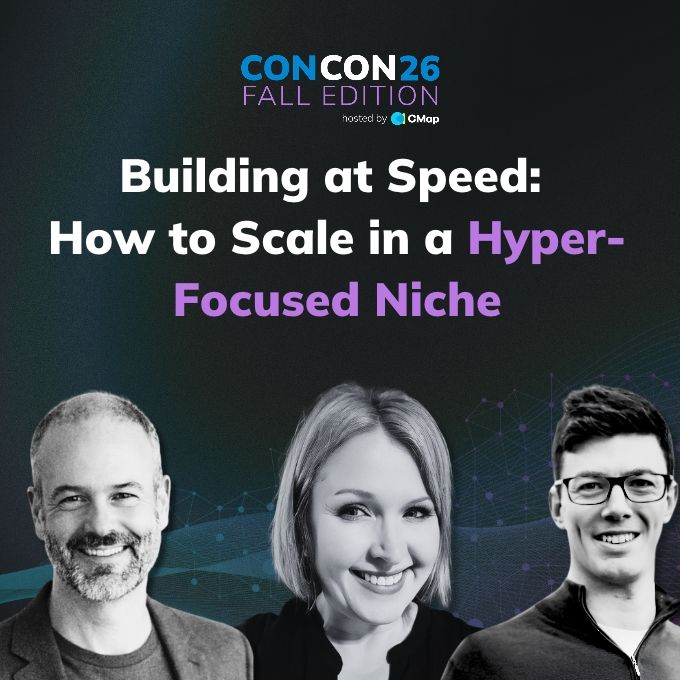
Building at speed: How to scale in a hyper-focused niche
The session, at a glance
A founder who exited in four years, a CEO who hit 110 people in two, and a growth partner to 70+ consulting firms.
- “Keep it broad and see what sticks” is the advice one founder ignored on her way to a four-year exit.
- The test for too narrow: are there enough buyers with an urgent, recurring problem?
- If your client could produce your deliverable in 15 minutes with Claude, it isn’t good enough.
- Productize the delivery. Keep the judgment human.
Three key stats
- 50% of firms either “do whatever pays” (26%) or know who they should sell to but say reality varies (24%). Only 15% call their niche very strong or razor sharp
- 31% don’t know how their pricing compares with generalist competitors, the most common answer. Only 37% price above them
- 70% are actively using just two or three of the AI tools they’ve trialled in the last 12 months
Watch the full session
The niche wins the work, the judgment keeps it, and the firm has to be built to carry both
Esther Nzenza founded Decisive Consulting in the middle of the pandemic. The advice she got was to keep it broad and see what sticks. She went deep on value and access in life sciences and nothing else, and grew from her first contract to 55 people and an exit to a PE-backed buyer within four years. Alex Kelleher has built Quantum Rise to 110 people in two years by focusing on the underserved US mid-market. Nick Synnott’s firm, Create Engage, has worked with more than 70 consultancies, including one that grew from $2 million to $100 million.
Their shared finding: the limit on growth is usually the founder and the founder’s black book, long before the niche runs out. In the next five minutes, you’ll get their test for whether a niche is too narrow, how they’re competing with clients who can do more themselves with AI, and what to build so growth doesn’t depend on one person.
How narrow is too narrow for a consulting niche?
A niche is only too narrow when there aren’t enough buyers with an urgent, recurring problem, or when you can’t stand out in that space. That was Esther Nzenza’s test. Her niche was narrow on capability and broad on market: every pharmaceutical or medical device innovation needs value and access work when it comes to market.
Esther’s definition of “too narrow” is useful because it reframes the risk. If you’re defined by one product, highly exposed to a single technology shift, or tied to one market or one client, you have a dependency, which is a different thing from a niche. Nick Synnott offered a quick sense check: if the Big Four have a practice in it, there’s enough money in it. And with AI tools, sizing a target market is faster than it’s ever been.
Day to day, the discipline is in what you turn down. Esther had to remake the choice every time a tempting brief arrived that would have pulled the firm away from its core. Alex Kelleher’s version is outcome-led: if Quantum Rise can’t identify the dollars-and-cents savings or gains up front, it won’t do the work. Nick added that your marketing niche and your actual client list don’t have to match perfectly. You can market to a specific avatar and still take on a good-fit client outside it.
The underlying reason niches work, Nick argued, goes beyond demand generation. Repeated problems are faster and better to solve, which helps delivery and supports your rates.
“The test that I would use if I was doing this again is: are there enough buyers with an urgent recurring problem? And can you stand out in that area? If yes, then it’s not too narrow for you. When it is too narrow is when you’re defined by one product offering, when you’re highly exposed to a change in technology… or when you’re really fixed on one market or one client. Then you’ve got much more of a dependency rather than a niche.”
- Esther Nzenza, Global Practice Head, Value and Access, Acumetis
A sharp niche gets you in the door. The next question is what keeps you there when clients can ask AI first.
What is the boutique’s edge when clients can do more themselves with AI?
Being trusted to know which answer matters. Esther argued that as knowledge gets commoditized, the premium moves from knowing the answer to knowing which answer matters and when to ask which question. Nick Synnott’s analogy was a knee surgeon. You could research the procedure yourself, but you wouldn’t back yourself to do it. The surgeon uses robots too. The experience is what tells them where to cut.
Alex Kelleher put numbers on the shift. In his estimate, 60 to 80% of the challenges his clients face have become radically easier. The last 20% (making it real, measuring it, putting it into production and making it work for people) is still hard and will stay that way for some time. He’s seen the pendulum swing before: clients bring a new technology in-house, then realize they need specialists who do it for many clients and stay on the frontier.
In practice, Nick applies a blunt quality bar. His clients are smart people, so he asks what they could do in 15 minutes with Claude. If that’s what he’s producing, it isn’t good enough. Nick also warned about moving too fast with AI: firms that let it pump out generic content risk becoming known for slop, when the work that resonates comes from voice-of-customer interviews and real data.
Esther’s summary of where firms should draw the line was the most useful of the session: productize some of the delivery, and keep the judgment.
“The premium for good consultancy isn’t just about knowing the answer, particularly when knowledge is becoming far more commoditized. It’s for being trusted to know which answer matters and when to ask what question. And that’s the bit that at this moment the robots can’t do.”
- Esther Nzenza, Global Practice Head, Value and Access, Acumetis
If judgment is the product, the constraint on growth becomes how much of it the firm can carry beyond its founder.
What limits a fast-growing consulting firm?
Usually the founder and their network, rather than the market. Nick Synnott made the point deliberately controversial: rarely do consultancies outgrow their niche. They outgrow their founder and their black book. When firms blame the market, he said, it’s often because they don’t want to confront the skills gap.
The three speakers described what fixing that looks like. Esther found the hardest part of scaling Decisive was finding experts who could cope with consulting pace, then learning to trust them and get out of the room. She hired for judgment and behaviors and taught the craft. Alex Kelleher built a development program for “business-savvy engineers” and what Quantum Rise calls its operating system: a thorough set of methodologies so the firm doesn’t sell or build from scratch with every client.
Speed brings its own risks. Esther described the middle of her growth journey as “building the plane while also serving the meals” over the North Atlantic, and warned that rushed hiring decisions leave a lot of time to repent. Her answer was to watch lead indicators and stay close to what’s keeping clients up at night six to 12 months out. Alex’s goal is to grow revenue faster than headcount by measuring productivity instead of hours.
The cause is the same thing that made these firms successful in the first place. A founder’s expertise and relationships drive early growth. Beyond a point, the firm has to hold that judgment in its people, methods and data.
“This might be controversial to spark for the Q&A, but I think rarely do consultancies outgrow their niche. They outgrow their founder and their black book… If the Big Four have a practice in it, there’s probably enough money in it.”
- Nick Synnott, Director, Create Engage
All three speakers built fast by being specific and staying expert-led. And all three hit the same constraint: judgment that lives in one person can only go so far. The firms that scale make that judgment portable, with repeatable methods, clear data on what’s working and the space for experts to make the call.
That’s where CMap helps boutique firms, by putting the firm’s knowledge in everyone’s hands from bid to bill, so growth doesn’t wait on the founder.

The next session we have is building at speed, how to scale in a hyper focused niche.
We've got three experts who are going to be joining us, and each of them have got very unique perspectives and their own fantastic journeys.
Be getting them to share their intros as soon as we get started. And here they are.
Hello. Hello.
Alex, Esther, Nick. How are you all doing?
Great. Very well, Ben. Great to see you.
Likewise. So this is the third session of ConCon's full edition.
Like I've done with the the first few sessions, what I what I like to do is enable you all to introduce yourselves first. And then if I feel like you've undersold or missed a couple of tricks, I'll add a layer before we delve into the three topics around, this headline session. So it's building at speed, three genuine experts. If we get the panelist intro first, Esther, can you kick us off?
Yeah, it'd be my pleasure. Hi everybody. I'm Esther Enzenza. I'm currently the global practice head of value and access at what's now Acumetis, but I'm very much here as the former founder of a company consulting.
So I've spent nearly three decades in the life sciences industry across a whole range of different jobs and responsibilities up to VP level. I've been a general manager. And then I was a late blooming entrepreneur. So I actually founded decisive in the middle of the pandemic of all times.
And the initial advice that I was given at that time apart from what on earth are you doing was keep it broad and see what sticks. And actually I did the complete opposite. So went very deep on value and access and nothing else.
And we went from our first contract to 55 people and an exit to a P backed buyer within the wheel. So I think it was probably the right choice to make. So we joined her Spiegel in 2025 now known as Acumetis and I'm very happy to still be part of the journey. So I'm a big believer then that niche beats broad.
What a what an intro and also what a whirlwind five or six years for you.
I'm I'm looking forward to delving into those topics. Nick, second up, if you give us your intro, that'd be great.
Yeah. Absolutely, Ben. Well, thank you very much, and thank you everyone who's joined us. Really looking forward to this.
So I'm Nick Sinnott. I lead the team at CreateEngage, and we are a specialist growth partner for 8 figure consultancies, helping them to shape their go to market, identify their key growth constraints, and then most importantly, build and run the engine that drives that growth forwards. We've worked with over 70 consultancies partnering with both fast growth founders, so Esther people like yourself, as well as PE backed firms. So Esther, again, like yourself.
We have helped numerous firms to build and scale and help clients exit along that way.
Like Esther, both for us as a business and for our clients, niche or niche, Ben, you'll have to tell us which side of the pond we are we're talking to you today.
We've got fifty fifty audience. Yeah.
Yeah. Well, we will maybe you you started niche, so we'll we'll stay British with niche is such a key part. And it's one of the core things we see is what separates firms who grow very quickly from those who tend to struggle and will dive a lot into that. So that's me, that's a bit of background and excited to be here.
Cheers, Nick.
Alex, over to you.
Hello.
Yeah. Yeah. Another British accent. So, I wouldn't know how to pronounce niche or niche, but background is a bunch of startups in both SaaS and consulting.
And then I ended up through a couple of exits in bigger firms. So I spent some time at Deloitte and saw consulting at scale, ended up running marketing and a bit of strategy for Deloitte Digital globally for a couple of years. Really scaled and not very niche at all.
But within Deloitte, clearly there were sort of niche offerings, so an interesting mix. Now the founder and CEO of Quantum Rise, we've been going for two years, we're about 110 people, and we've broadened since we launched, but we're only really in the mid market in terms of clients. We sell through the CEO, and we started with a couple of industries. We've grown that a bit, but each of those industries to the CEO in the market in The US becomes a niche.
Within that niche, we do some broad things, but it's very important to have focus. It's also important to be agile and change that focus, and I'm sure we'll chat about that.
Well, you're also you're also hyperscaling as well. Zero to a 100 plus people in a couple of years is no mean feat. Am I right in saying you're based in North America, though, Alex?
I am. Chicago.
Yeah. Right. And, Esther, we met in Washington. And then, Nick, our last webinar was with you... One of your clients in North America. So we might all have a plan.
In Chicago, Alex. So after this, we'll compare that on where you are.
And, yeah, I won't ask you whether it's cubs or socks, but we'll we'll come back to that.
I wouldn't know.
Okay. So let's let's get into it. So we've got three topics underneath the sort of broad session that we're running today. So we're gonna be first looking at the niche, the niche.
Then we're gonna be going and looking at the speed. And then finally, it's the building. So let's start with the niche. What what was the moment that you committed to sort of the end market that you focused on? And what did you have to turn away or what are you turning away that's enabling you to stay focused on that?
Alex, given your... Doing some of the broadest stuff, why don't we start with you and then we can niche in with Esther and then to Nick as follow ups.
Yeah. Sounds good. So we started two years ago and, you know, the the world has clearly changed quite a bit since then.
But the... And we're backed by a family office here in Chicago who already had some idea of what the play would be. When we got together, we refined it. And so it was a conscious choice not to go after the enterprise market. And I guess SMEs are sort of another area. But most companies like us want to have the big brand names and go after sort of the enterprise world and the bigger budgets, whereas we just acknowledge that the mid market is underserved.
So, and underserved by a partner who doesn't just deliver engineering, but also thinks about all the other stuff that we did at Deloitte at scale. So training, change management, data governance, cybersecurity, all that good stuff. Like, do you package that for a mid market company who needs to be efficient with their budget, who's probably taking the budget from somewhere else? How go do in through the top so that you can get those budgets assigned and appeal to the people or person who is suddenly in charge of this huge transformation that they've got going on. And then the final thing is we decided that if we couldn't, which sounds at some level self evident, it is not unique at all, but if we couldn't identify the sort of dollars and cents or pounds and pence upfront that we were going to drive in terms of savings or outcomes, we just wouldn't do the work.
And so if we're asked to do something where the client's not sure about how to measure it, we're not sure about how to measure it. We shift our attention away to something, no, let's start somewhere we could actually measure it because that gets us on a good journey. And so the premise hasn't changed in two years, that fundamental premise. Clearly the way we do things, how we deliver, some of the industries we're focused on has changed.
So I've done a bunch of startups before that have usually pivoted a lot as you realise what people actually want to buy.
The pivoting hasn't really happened that much here. It's just refinement and reaction to the obvious change in the underlying technologies.
Very good. Just quick follow-up. So did the family office have quite a prescriptive mandate or was it more of like a meeting of minds?
Yeah, it's interesting. They came in with an idea that was probably more niche around some of the sort of gun... Governance side of it. And and we just agreed after having spent some time together that the opportunity was bigger and that for the type of client we wanted to go after, they needed somebody to put the pieces together. And they were typically sitting on top of lots of vendors and lots of different areas that wasn't coordinated.
And so while that is complex to deliver, as long as we're selfish about we're in service of the CEO and driving outcomes and not for the enterprise world, then that's led us down a really good path. I will say we do have some enterprise clients. The model we've built can apply to other sectors of the market, but all of our sales efforts, our partnerships, our marketing is still just focused on that part of the market and the industries that we care about.
Very good. Esther, in your intro, you clearly stated that you niched pretty specifically. Tell us about the decision making process there and maybe some of those things that you had to turn away when you were scaling decisive so quickly.
Yeah, clue is probably a little bit in the name Ben, but it wasn't a dramatic moment, But it was very clear decision. And it was a decision very much at the outset of the firm. But we did have to keep remaking that choice or that decision every time attempting brief that would have taken us away from our core business came in. I mean, in the pandemic was a very unique time to be setting up a business.
I look back on it with a mixture of emotions, as you can imagine. I chose value and access for a few different reasons. Had decades of credibility in it. So I knew that I could go toe to toe with anybody in the space and hold my own.
That was really important when initially the company was just me. But that experience wasn't the whole proposition. When I've been in industry for the many years that I had, I'd seen a real gap for a consultancy that could bring the technical fluency of getting work done brilliantly, together with different perspectives and the courage and confidence to challenge. So it was very much a niche within a niche, which was those clients, those companies that were willing to be challenged that were willing to have someone in the room who would tell them when they didn't agree, which was something I'd really looked for when I was within a client organisation, and hence was the core premise of the organisation that I built.
So it wasn't just another source of expertise. It was very much a mindset and a way of working. But that meant we turned things away. So in the early days, my own professional backgrounds really broad, I've worked across marketing, I've led the majority of commercial functions globally, we've got approached at all kinds of interesting stuff.
And at that time, as decisive, the decision had to be no, because we weren't scaled or built or assembled to be brilliant at that. And certainly in the early days, it was critical that we focused on the things where we were really great. And that was what our future reputation would come to lend on. So for me, a niche wasn't something that we announced, we never went out and said, this is the only thing we do.
But we proved it by only taking on work that we knew we could do brilliantly.
Nice. Nick, you probably got a number of examples from your clients that you're working with who've done this particularly well. Is there any that springs to mind?
Yeah, I think I've got a whole host. As I said in the intro, it's often one of the key differentiators. I should also say it's the way that we've approached our business. We are very specifically focused on consultancies, 8 figures, fast growing, and that has drawn those people to us.
We'll get into, I'm sure Ben, what happens in terms of marketing, go to market focus later. Client wise definitely a few examples. So one firm we worked with when we came in, they were very much just known for everything and we really helped them define that niche and we'll get onto it I think later, but the niches within because as firms scale different practices have their own niches. And over time, over the five years we worked together, they grew from what would be around 12,000,000 USD to around 35,000,000 USD exited to a global acquirer and other firms in our client base, like you say, clear examples where, I mean, one of our clients and I wouldn't wanna claim the work ourselves, they grew from 2,000,000 to a 100,000,000,000 USD and really obviously lots of choices were made in that.
But one of the key ones was where they niche down and focus. So they went from everything to a very specific avatar, very specific sector.
As we talk about in consulting, they nailed a horizontal and a vertical, and that was a real rocket ship for them.
Very good. Actually, the... A follow-up question for you as well then, Nick. So you probably get some firms come to you and if you have a conversation with them and say, right, you need to niche down and this is this is where you should potentially follow. And they say, well, isn't that too narrow? Like, is there such a thing as it being too niche?
Yeah. It's it's a great question, Ben. And I and I think it's a real a real concern. I think there's...
There is a, you know, a spreadsheet answer. There's also a timing answer. So it's much easier to build a firm, you know, Esther, as you talked about, with a niche, when it's the top of the first, not the bottom of the ninth. You really wanna be going in with that rather than frantically trying to scramble as your gross stalling at the end or the partner's black books running out.
So I think that's the first one. The other side, and Alex, bit to your point of the mid market, you very smartly go, we're not gonna go where everyone else is, we're gonna go to the Blue Ocean, and the mid market is huge. And I think this is where the answer then is, do the analysis. And now with AI tools, you go and ask the target, what's the target addressable market and provided you're not selling, I don't know, some super niche product or super niche, just ice cream sellers in the city of Chicago, you're probably gonna do okay as a business, but do that analysis first.
Alex, when you were starting the business a couple of years ago, was there some of that, like qualitative analysis that went into it, quantitative, like what made you get a sense that this wasn't going to be too narrow?
Yeah, mean, as Nick says, mid market, it depends kind of how you define the mid market, but it's pretty big in The US in that it's different from other markets, right? Because it's such a big economy here.
So it's actually quite scaled and there's lots of companies, which is why we had to break down industries and be very outcomes focused.
I guess there was a bunch of research done just to size it and see what the behaviours were like and what the budgets would be like, because they're definitely different from enterprises.
And then we had some very experienced people sort of around the table that are the group that's backing us only invested services companies. The founder of the family office really made his success, he's self made, he made his success by founding consulting companies that are now, at least one of which is now public.
So lots of probably human guts put into it, and the machines were a little less smarter two years ago, but, we certainly used them as much as we could to to decide where we should focus and what the messaging should be and that sort of good stuff.
Now you've met... Mentioned outcomes twice. Is that, like, the value that's delivered to the client, or is that actually your commercial model?
So my ideal is that a client pays us almost purely based on either the money we save them or the money we make them, because that's how I can disconnect, and I'll probably talk more about this later, but whether so I can disconnect what we do from the effort that we put into it, whether it's people's efforts, machine's efforts, whatever it might be. But the client still gets what they want, which is a great outcome.
And that changes the consulting model, right? Because typically, you know, you're dealing with people's time on this side and the client's dealing with something different on their side. So that's my ideal. Clients variably sign up for that in the sense that once they believe you're actually going to be successful, they'd like to limit your upside. But still, most of what we do, if not all today, is connected to a business case that both parties are bought into. And then the discussion is, is the overall cost the right cost versus are we spending enough hours on it or whatever that might be?
And Esther, how did you ignore some of those people who are saying you need to start broad and go in the way that you did with Decisive?
I think it's around definitions a little bit Ben. So for me it was around being narrow on capability as opposed to narrow on market.
So every pharmaceutical or medical device innovation fundamentally needs value and access services at the point that it comes to market. So the opportunity space itself is huge. The challenge is picking those projects and opportunities and clients where you can really make a compelling difference. But as a niche, if you like, and it's not a small niche, which is a little bit different.
The test that I would use if I was doing this again, is are there enough buyers with an urgent recurring problem? And can you stand out in that area? If yes, then it's not too narrow for you. When it is too narrow is when you're defined by one product offering, when you're highly exposed to a change in technology, for example, as we're all facing at the moment, or when you're really fixed on one market or one client, then you've got much more of a dependency rather than a niche.
So I think it comes down to definitions.
And that's, I guess, a quick follow-up is that how much of your growth and then the deal with Hirschsprigle and then what's going on with, you know, the Acumetis rebrand and expansion, how much of that is down to that expertise and specialization rather than something that like was underserved or can't be replicated by other firms or I guess increasingly you touched on it with AI and technology?
Yeah. Think I a lot of it then can stand to trust and being that trusted advisor and trusted partner in a way not dissimilar to the way that Alex describes. There's stuff that needs doing in all of these types of project assignments that can be done in lots of different ways, But the way that that ultimately is communicated the conviction and confidence with which it's brought across, and the kind of stamp of trust and authority of having been there, seen it and done it before, is really hard to actually replace or to compete with. That's been very much a hallmark of the different businesses that have come together under Acuvetus. They're all expert led, they're all focused on trusted partnerships, and while we focus on different aspects of life sciences, together we have a very similar kind of founding ethos.
You must be seeing this a lot given that you're in that sort of marketing and growth engine for consultancies where they're increasingly competing against home brewed or clients own people plus an AI and an LLM and a sense that these services or the outcomes they can deliver themselves rather than you in consultancy? Like, what are some of those firms that you're working with doing to combat that? How can they really let their expertise shine through and be differentiated versus that sort of, like, increasing competitor that is DIY plus AI?
Yeah, I think it's a real challenge in the space, Ben. And I think it's a question that nicely brings my answer is almost a merge of what Alex and Esther were talking about. As Alex says, tools you we are all using and should be. And there was a great piece by one of the Sequoia partners earlier in the year around the next billion dollar businesses is a tech business that's masquerading as a service business.
And the reason it can do that to Alex's point is the tool is a tool just like Excel. You know when I started my career we had Excel and people who started before me didn't have Excel. We've now got AI. It's the knowledge that makes it different.
And then you get your point Ben, how do you stand out without deep expertise? So we have a client who's growing very quickly globally and they are one of, I wanna say four if not now five people who can do the thing they do with any serious credibility.
And so it's what are you buying? What's the thing that your clients are buying? They are buying that lived experience because, yeah, I can ask... You know, I can go and ask Chat GPT or Claude, how do you operate on me? You know? I always use the example of a knee surgery. Everyone's probably been to the doctor at some point.
I could go and figure out how to do a knee surgery. I probably wouldn't back myself to do it. So, you know, they use... A surgeon uses robots, but the surgeon has tons of experience to know which bits to chop and how.
It's the same in our industry.
Alex, see, I think you look a bit like your perspectives as well on this.
I just like that analogy.
Yeah, so I mean, I've been around long enough to see this pendulum before of clients going, Oh, some new tech was released. Oh, I could probably do it in house. And then taking it in house and realising, Oh, shoot, I need experts and people who are doing this a lot and it doesn't make sense for me to be the expert.
And so, as partners to our clients, we sort of have to go with that pendulum bit and be like, Yeah, sure, you can definitely do this in house, but you also need help.
And you're going to need help from somebody who does this for a bunch of other people. They're learning all the lessons and they're staying on the frontier and all the things you can't reasonably do, particularly in the mid market. Arguably, the Fortune 50 in The US can do it in house and can employ a thousand people to do it and probably do okay.
But everybody else needs a partner who's great at it. And so we just have to go with it and it'll swing back and forth.
Is there anything in particular that any of you are communicating via marketing or saying during sales pitches when confronted with this, we could just do it ourselves situation.
Yeah, I mean, I'm happy to comment a little bit on that, Ben. I think one of the things that I reflect on quite deeply is that the premium for good consultancy isn't just about knowing the answer, particularly when knowledge is becoming far more commoditized. It's for being trusted to know which answer matters, and when to ask what question. And that's the bit that at this moment, the robots can't do.
They can do a great job of synthesising a lot of the outputs. But having been the ability to sit back and say, well, when I saw that happen before, this instance led to this, and this was the wiggle in the middle. That's the bit that the robots at the moment, I don't think capture. So it's around knowing what to ask and knowing what to do with what you get.
Very good. Nick, Alex, any other thoughts? If not, I might move through to topic two.
Which is Yeah.
Which is the speed, which all of you are, pretty accustomed to. So the pace in which the building of the firms have happened.
Alex, Esther lived experiences. Nick, your own firm as well. Plus, in addition to that, clients who you supported, consulting has always been pretty good at being able to pivot, adapt, make changes during a revolution, throw in AI and sort of, we're all living that in real time at hyper speed.
In these three questions, I want us to explore how you're managing to do that plus build a business and maintaining such pace.
Alex, let's start with you. In your intro, you said going from zero to a 100 plus people in a couple of years.
So take us through a couple of the things that, you have to rigorously focus on as you're building out that business in a market that is just changing right before our eyes.
Yeah, it's no doubt a challenge, you know, for us, for our clients, for everybody. I don't think anybody has the perfect answer or knows where this is going exactly, but it's kind of our job to have a slightly better idea of where this is going than our clients and also stay on top of the change so that we can filter that noise and say, here's what you should care about. And so we've built specific offerings and parts of offerings which are really about how often do we need to update clients, what are the model releases that matter, how do we build solutions so that if something's released next week, which would change the way we built it, it's not a big deal for us to adapt to that. And that's a very different way of working from how this used to work, which is six to nine month projects. Or if you think about the digital transformation era, you'd get it done in eighteen, twenty four months and they'd be like, I'm good for the next five years. And that's just not the case anymore.
So our most successful engagements are where we've persuaded the client to behave a bit more agile.
And so yes, we're delivering a solution to your conversion rates or your days to close for finance or whatever it might be, but let's try and do that in a sprint based two week release cycle for as long as possible, hopefully forever, because we're all going to need to stay on top of the change and keep improving this over time.
And even if we still do, which we do project based work for client, how do we think about how that tails off or doesn't tail off after that work starts?
Being agile then allows you to keep up with the speed of change, right? Because every two weeks you're reconsidering how you're doing things. And so the more we can push clients to work with us in that way, think the more successful the work we do is gonna be.
Fast follow on that though, like, how is that possible with 100 people and how is that possible going from zero to 100 people in two years?
Yeah. So not everybody at this company needs to be the person who understands the the latest frontier model release. Right? And so, who does and who doesn't is super important to decide as we scale teams.
Through an acquisition, we have a group of people in nearshore, offshore in Brazil.
That adds complexity, also adds some economic flexibility in terms of headcount costs. And so what is the mix of onshore and offshore, which any scale provider is thinking about right now?
And how do we focus on metrics that are about how productive our team can be instead of how many hours that we're charging. And so, while I love the fact that we've grown to lots of people and they're all amazing, I'd love the growth rate to be lower in connection to the revenue. That's the game here, is how efficient can we make the people that we have.
So all those things are part of kind of the growth plan, I guess.
And Esther, what was the biggest lesson or challenge or opportunity that you had going from COVID launch business, growing it to 50, 60 people, securing investment, being part of then the Hirsch Bee growth journey?
Yeah, very different at each of those stages, Ben. So perhaps one unique difference from the decisive story was that we were fully bootstrapped. So we never took any external investment or funding right through to the point that we were required. And that gives you a very different lens for what to pay attention to.
Because you can see lots of shiny, exciting things. But that acid test always then becomes am I going to put my own money behind it, which is a very different proposition. So we were really careful about the adoption of change in process or technology, unless we were really confident that it was either going to add extra value to our clients, or fundamentally transform the way that we worked. I think having that kind of founder hands on lens right from the beginning was really important.
It's, I've got some great stories about starting the business from a monitor balanced on a cake box, because I wouldn't spend money until the business was making money. And that ethos really stuck with me right the way through to the point that we were acquired.
Probably helps as well with the sort of investability of the business. Nick, what are some of your experiences with businesses you've gone through that sort of like rapid explosive growth?
Yeah. I I also I can't let that sit Esther. It's definitely a great way not to eat the cake if your monitor is on it.
Exactly.
I'm I'm gonna I'm gonna take that diet strategy.
So Ben, I I think just to check the question, the AI piece for the growth piece, sorry. Remind me which one you want. Yeah.
Yeah. Yeah.
So I think, you know, what we've seen, if I sort of link it to Alex's is, you know, the AI is helping clients to grow things much quicker and also make opportunities that weren't viable, viable.
So I was as an awards, a client of ours was up for there were, I think four firms out of hundreds who had applied for one of the big groups here in The UK, their awards for one of the best growth strategies and they're a training consultancy. And with AI what they've been able to do is turn a training program that was very good, it was all in English into something that you can self select out of, I think it was something like 200 languages.
And that's an example to your point, Ben, of the scaling of how actually you can take these offers and suddenly they're able to offer it to new markets and also they work with big global enterprises. They're able to offer it to other offices. So suddenly they're able to offer more value. And I think this to Alex's point around, Alex, focus on both the cutting costs and the making revenue.
I think a lot of the narrative around AI and growth is how do we make things quicker? And this is it, but it also is about how does that then create the opportunity because they're now able to take this new offering out, which makes them more money, which helps them grow. That's just one of them. Say plenty of us, but I don't want to take the whole conversation.
So I'll let you guide me how many more you want.
Well, I quite like to dig into can you move too fast. So do you have any lessons or experiences that you wanted to share there, Nick? We'll start with you on that.
Yeah. Well, I guess this one comes to to what we do. And and I think ties back to...
If I look at growth particularly, the tools that we all have today make it exceptionally easy to think, well, I can get Claude to create me a whole growth campaign. I can analyze my go to market and go and do that all in an afternoon. And what we find time and time again is lots of firms move too quickly. They jump to, well, we'll hire someone, we'll expect too much of them too quickly.
Like now we've got AI, they're gonna win work one month or we're firing them and talk about it, you know, if they hire someone for their team. And I think the big thing we're seeing is the things that are tried and true about consulting haven't yet changed. Work still, you still have to build with a human, you still have to go through that process to win the work. I speak to, I don't know, five, 10 sometimes consultancies a week, everyone's still taking twelve months to go from start to solve work.
And so I think that piece of what can move too fast is jumping to the solution because easy with Clause, I can just go and create a thing and post it on LinkedIn without really giving thought to it. And this is where we all see it. Now LinkedIn's got its AI slot button, that's across everything is, do you want your brand, your go to market to be, do you want your firms firm to be known as the people who just pump out slots or do you want your target client to really see it and resonate with it? Most people on this call, I suspect will say the latter and the latter only comes from investing the time to understand who those people are doing those voice of the customer interviews, analyzing, getting the data.
That's where you need to spend the time. And that's what to your point, Ben, if you move too fast, you miss that. It doesn't give you what you want.
And Alex, you said the last question response, you wish that revenue would maybe grow faster than headcount. So you got that decoupling, presumably, like useful from a margin perspective. Is there anything else that you're feeling that you just wish would slow down a little bit or is going too fast and causing some problems?
Yeah, I mean, you know, Our set of offerings, what we tell clients we do in their industry and to address their opportunities and problems, has to change pretty fast given the nature of how technology is changing. So we launch a lot of new things and part of that is just seeing what sticks, right? But are we launching too many of them? Are we confusing clients with everything that we do? So there's a constant struggle about how we communicate all the different things we do and how we package up our capabilities in a way that clients can sort of understand and understand over time as well.
Once you've been around for a while, people come back to you and they've heard about you more and you've built a bit of a brand. And so you're finding ways to shortcut that trust journey, which all consultancies have.
The bit that keeps me up at night is how communicate do through what we do more clearly and in a more consistent way so the clients who already are dealing with all this change in the world, are not trying to absorb the how we package the latest offering and whether it fits them and so on. So there's a lot of change in the world there, a lot of vendors like us in the space shouting. And so how do you kind of break through that?
Yeah. It's a good point. There's so much noise out there. Sometimes one of the best things to do is be calm and still, whilst everybody else is going at it. Exactly. Esther, was there any times in, you know, in the last four or five years where things were going super quick or felt like it was moving too fast on your own growth journey?
I think maybe taking a slightly different angle on it, probably the biggest moments where the speed felt quite overwhelming were in the moments where we were scaling up very rapidly and taking on a lot of new work. So I remember there was a lot of moments and very tense ones in the middle of the journey where it felt as if we were doing the old adage of building the plane, while also serving the meals and being somewhere over the North Atlantic. So it was a very complex picture of trying to build and fly at the same time. I think what I learned from that is measuring and anticipating demand is so key and so difficult in consulting.
Making sure that your hiring strategy has enough intuition and enough science and judgment to work so that you're not rushing hiring decisions, but you are hiring in time to be able to make sure that you've got available expertise that's skilled and ready and knows how to work together, rather than being pushed into too rapid a decision, which invariably backfires. I think one of my big learnings through the whole of my career is if you make a decision too quickly, you generally have a lot of time to repent, and to wish you hadn't. So that balance between decisiveness, judgment and taking a breath, I think is incredibly important.
Yeah, founders, leaders often have that like innate gut feel that you mentioned, plus you got to leverage the data. Is there anything in particular or a moment in time where you didn't feel like you had either of those in in complete synergy or or what what can you, I guess for the audience, about how their 2027 is looking or not looking like, what are some of the things that they should be doing to get on top of that?
I think looking at your lead indicators and knowing what those are for your business is really important.
And certainly the benefit I now have of being part of a larger platform is that you've got a lot more analytics and a lot more people to spend time looking at analytics and giving you the insight. When you're a founder growing and driving, you don't have so much of that. So a lot more of it has to be instinctual gut.
So I think it's much more evidence based as you scale. Focusing more perhaps on those people who are at the beginning of the journey, when you are very much relying on your gut. I think coming back to what Nick said, it's talking to your customer and making sure that you understand what's keeping them awake. Where do they see the problem six-twelve months from now? And do you have the right mix of skills, capabilities and products to be able to support those moments? And if not, can you build them? So that sense of anticipation.
Talking about clients is a nice segue because I get the sense from talking with people in the consulting world that your own clients, you three here plus everybody else on the call are demanding more and they have their own thoughts on speed. So you're growing your businesses at speed. My sense is that clients are demanding more at speed. Is that true? Is there anything that you're doing in terms of like the way you're servicing your clients, how you're pitching?
Again, be really useful context if that is valid. And if not, feel free to tell me, but Esther, what's your thoughts on that, on the speed element of what client expectations have?
Yeah, I guess I can reflect on it with both lenses having been a client for most of my career, then moving over to obviously, I found a consultancy, and that it's understanding the reason behind the need for speed.
So what is it that's driving that urgency, and then being prepared to have a conversation around whether that urgency is realistic and can be met. And if so, what the trade offs are, and what the benefits are of potentially going slightly more slowly. I think we operate compared to the beginning of my career. Sure most of us can identify with this with an always on culture now.
So I've worked globally for many years, the biggest tension in that was always that there was always someone awake, which meant your email never stopped, your messaging never stopped. And that's probably even more acute today than it was five years ago. So getting that balance right, locating workforces in different spaces and places around the world to maximize your use of time zones, and using technology smartly to keep people engaged while at a distance are all good strategies to address that. But fundamentally, businesses like ours are built on trust, and they're built on communication.
So never over committing, making sure that you have really clear conversations around what can and can't be done. And understanding the trade offs if you need to go faster are key to maintaining the heart as well as the speed.
Nick, have you with create engage or any of your clients had sort of introduced any new offerings or felt that need to deliver things much quicker now?
Yeah. I I think it's a great point. If I, you know, talk about us, I I think to Esther's point, it's always a case of staying ahead because doesn't matter about AI or not, there has always been someone trying to get ahead of you. And so, what we did seven years ago is very different to what we do now. I also think that's where the tools we now have actually let us deliver much more value for the cost. So to give you an example, we started working with a global feedback consultancy turn of the year, they were in an industry that we hadn't done a lot of work in before.
Previously, we would have had to do a lot of research and probably only got that much. Now the tools can give us that much research and it gives us their buyers, all of their audience or their universe data that we can then take to them to validate. We've upskilled, they've got something extra. Similarly, another organization we worked with, and we've got six or seven practice areas going out directly to clients, we've been able to create for them a real time weekly analysis tool that basically scrapes all of their clients, public news and gives them talking points.
And again, those are things that, you know, we're building assets, but the cost to build has become so low and the value to the clients become so high to Alex's point. And so for us, that's massive value add. So I think Ben, it's a slightly different answer. What I would say though, the way I apply the challenges to talk about is I always say, my clients are smart people, what could they do in fifteen minutes with Claude?
Because that's now the test. It's if your client can do it in fifteen minutes with Claude, and that's what you produce, it's probably not good enough. And so always thinking how are we adding value, but I don't think the AI has made it different. It's just given different tools.
Alex, I'm keen to get your thoughts on that as well, but an additional thought has entered my mind as well, which is like the the quality of the output.
At least with AI, you can get something that feels 80, 90 ready pretty quickly.
And given that you're in that AI space, no doubt the expectation is that things move fast and have high output. So, yeah, what's your perspective on the the speed in which clients expect outputs, something tangible, what it what it is that you're delivering? And given you've only been in two years in... With this current brand, like, what's that like twenty four months, twelve months to present day?
Yeah. So on the speed, and I think Esther talked about being always on, and that's not just because, you know, clients are sometimes multinational, but we launched an offering that is called OnCall, where literally we give them access to some of our best experts in kind of when and how they need them.
And it's like a, I don't know, like a telehealth, like a video call with your doctor. Right? And they call in. So we get to see the kinds of things people are concerned about and the kind of things they're spinning up and kind of where they feel they need help, which is the benefit to us. The benefit to them is they get straight to like a decision or an answer pretty quickly.
And so that's one way of supporting clients and building something that is an always on relationship with clients, which is clearly valuable to us and hopefully of pretty good value to them.
The world has changed so much in the last two years since we launched it, and I'm sure we did some things in our first six months, which clients could now replicate pretty easily. So that's an interesting space to be. And if you think what LLMs do in terms of taking large volumes of data and saying smart things about it, it's what consulting companies used to do.
So what value do we add? And I think Nick has said some really smart things about the human side of that and the expertise is not being replaced by this new tool.
It's giving us a step up and getting us quicker to the really important stuff. If you think about the world of challenges for clients, probably, I don't know, 60%, 7080% of that has become radically easier.
But the last 20% of making it real, measuring it, productionising it, ensuring it actually works, making it right for humans is still really, really hard and complex and will remain so for quite some time.
We still have a major role to play. It's just slightly shifted into a focus on the the the big crunchy stuff versus some of the easier things that the clients can do for themselves.
Before we move on to the final topic, which is the building of the businesses, I just wanna draw everyone's attention again to the polls.
So we launched three for this session. The first of which is of the AI tools your firm has trialed in the last twelve months, how many are you actually using? Quite interesting. How does your pricing compare with generalist competitors?
32% of people don't know, which I think is, quite interesting. And then there's a a strong percentage of people that are either the same or higher, so good for you. And how sharply defined is your firm's niche or niche today? 26% saying they do whatever they can to get paid.
25% saying we know who we should sell to, but the reality varies. So, look, gotta applaud all of the honesty there. We're talking with the best intentions as a group, but, you know, businesses need sometimes the revenue in. But the the highest percentage of people are saying they've got a strong focus, but could be better at 35%.
Very...
Only a limited number of people are saying very strong or razor sharp. So there's, you know, potential opportunities going into '27 to make some improvements there. Well, first of all, into the final section, Alex, Nick, Astro, don't know if any...
If anything that jumps out to you there, feel free to comment.
I'll pause for a second in case there is.
I think I'd I'd just add one piece, Ben, and and it...
If it it takes us to the next section, great. It doesn't, could be a standalone because I think this is where sometimes to those questions and to that section of the audience, there is a big difference in niche between who you target and to Alex's point, he...
I thought, Alex, what you said earlier was spot on that when the world is so busy, you've got to talk about why you are helpful to your target clients or your target avatar. And that is...
And I think Esther, you made this point, that can sometimes be different from who you actually sell to. Now if they're polar opposite, you've got a bit of a problem, but sometimes people think, well, to niche down, I have to exclude everyone. And very much we market to people, but if, we specialize in consultancies, but if a law firm comes to us and we feel we can support them we will. And that does two things.
One it means you're not as tied to, oh we can't sell to anyone because that's usually the fear, it's a revenue fear. So very much look at the outward. I think then to that point then on the rates, and I can speak for our business and I'll let Alex and Esther speak for theirs.
If you focus on a niche from delivery, it's easier because it's repeatable.
And consultants were bright, we can figure out problems, but it's much easier if you've already done the problem, back to my knee surgeon. I'm sure it's not hard for a knee surgeon to do the knee surgery, but if it was a shoulder surgeon, it'd take them a little longer, it'd be a lot harder, you'd probably still do it. And that's then to the rates piece.
Niche is good for actual demand generation. It's also good for the back end as well.
But that's my view, Alex, Esther, I don't know if you'd agree or disagree.
No, I'd agree very much. Think, again, the space that myself and my team generally work in tends to be very problem specific. But there are elements and templates and methods that are repeatable. It's identifying what is the core that you can train people on consistently that you can build consistent infrastructure around, that leaves room for the uniqueness of the decision problem, and the uniqueness of the specific client issue to be addressed around that. So productizing some of the delivery rather than the judgment.
Do quick fire for the last topic. So I've also got time for the q and a. I've just seen the where we're up to, it's all good.
Lots of good value in the first 15. We'll make sure that we're we're back ending it with a a strong final 10. So the the final sort of area that we wanted to get your insights on is the building of the businesses. So deep expertise is scarce by definition. Right? Like, so how did you find and grow the people who delivered to your standards?
Esther, start with you, then Alex, and then Nick.
It's a great question Ben and it was hard. So the hardest part for me wasn't finding expertise. It was finding expertise that could cope with consulting pace, that enjoyed consulting pace and could move in multiple dimensions at the same time. And then for me personally, it was learning honestly to trust that expertise and that ability to move at pace and to get out of the room. So a lot of it was hiring for the right judgment, hiring people who were often brighter, smarter, better at things than I was, and teaching them the fundamentals of what I needed them to do, and then trusting them to do it their way.
So yeah, I think it would come down to hiring for judgment, then teaching the craft, and hiring for the behaviors that allow people to thrive in consultancy, which are often very different to the skills and aptitudes that enable people to thrive in an in house role.
So good comments coming in in the chat from friends in the industry. I appreciate seeing those. Alex, have you have you got a 100 domain experts? What's the what's the flywheel like to make sure that you're getting that level of talent into the business?
Yeah. And it's a different kind of talent than probably we would have hired a couple of years ago, which is interesting too. Just to simplify the sort of larger group, it's business savvy engineers. So it's really two skill sets, just to be a cliche for a second.
So that's made it even more challenging. I think we've had to develop and been thoughtful about developing a development programme, training programme to get people to have the skills and the expertise and the guardrails we need them to have. In parallel, we've built what we've grandly called an operating system. It's really a very thorough set of methodologies where you can start to productize service. What does that look like? How do you make it repeatable?
How do you not sell from scratch with every client?
And the tooling is there today to do that, whereas it wasn't there previously. And so what is that? If you get people, you're able to develop them very quickly and then give them the tooling give them some context and expertise that maybe they don't have and certainly guardrails about the solutions they're building.
That's how you get efficiencies versus kind of holding out for those unicorn hires that are also very expensive in this market.
Nick, final thoughts on that question?
In the interest of time, Ben, what Esther and Alex said, agreed.
Okay. Well, why don't you take this next question, Nick?
So how do you know when a consultant has sort of outgrown their niche? Like... And and what do you have to do to build and operate for that next stage? I'm sure you've come across that a few times. So let's let's get your lead response on that, and then we'll come to Esther and then Alex. Yeah.
So...
And and this might be, you know, controversial to spark for the, you know, for the q and a, but I think rarely do consultancies outgrow their their niche. They outgrow their founder and their black book. And I say that back to the market point is, Esther, you're in pharmaceuticals. I mean, there is infinite money in that industry.
And so if you look at every big four has a practice in every major industry and Ben you asked earlier about how do you define your niche? If the big four have a practice in it, there's probably enough money in it because they're sustaining billions of pounds of revenue. Take Accenture. If Accenture can do it, you can do it.
So it's then what's limiting you and that's where often it comes down to more, okay, do we need more partners, people to grow practice areas? And then it can be a question of do we need different verticals? So to my client example at the start, we've helped clients who have different verticals build each of those go to markets and the marketing that comes behind it.
But I think it comes back to your target addressable market and then is it skills or is it market? And often we look at market because we don't want to confront the skills.
Esther, do you have any thoughts on that question?
Yeah, absolutely. And I guess for me, when I think about the decisive journey, the signal was when clients started to ask us to do more for them than we could do on our own. And also my team, I built an amazing team, but they needed more from their careers than I could offer them as decisive company that we were. And that was very much the trigger for them joining a bigger organisation with complementary adjacent skills and expertise, both to be able to offer more to clients, but also to be able to offer a broader career experience. So for me, it wasn't so much a case of changing what decisive at that time did, but taking decisive into an ecosystem where we could do more.
I might move to Q and A because I know there's one for you here, Alex, and then we don't run over. You raised a point earlier about using some nearshore in Brazil. Somebody's asked, can you elaborate on your thoughts about stuffing nearshore versus working remote?
Yeah. That's an interesting distinction.
In some ways, the models can be similar, right? Because at some level, it doesn't matter where people are in the world. We have people who work out of other countries because they just happen to be there or travel there or whatever it might be. So it's an interesting distinction. Clearly, economics of nearshore, offshore are where it becomes sort of interesting from a cost model point of view.
And so what is the mix? The clients that provide the same level of benefits to clients, but it doesn't matter which country that the individual is employed in. And so, we're working on what that right ratio is, and there's some clients where the ratio is different, and there's some clients that actually mandate onshore headcount and so on. We were founded in Chicago.
We built the initial team here, which is great. There's a culture aspect to it. Now we really recruit in The US anywhere, doesn't matter to us. And even some people in Chicago are are mainly remote.
Right? So it's...
So we're pretty relaxed about that. I think we all are after, you know, things that happened in the last, six or seven years. But, yeah, I hope...
Hopefully, I answered the question a little bit.
Yeah. I I would like your thoughts on it as well, Esther, because given I know Acumaticis context where they had decisive with UK folks, had the Hirschspring with the North American folks. I believe there was another business which might have been more Asian folks as well. Like, how has all of that come to fruition? Number one. And is anything changing because of the fact that like you have that niche expertise? Is that, does that global brand enable you to recruit in areas that maybe you previously couldn't?
Definitely, I think it enables us to think about a globally connected workforce and in areas where time pressures from our clients are tight. In very practical terms, having people working on different clocks can be incredibly helpful.
I've always been a great proponent of flexible working, Alex, I founded the business during the pandemic. So it was kind of inevitable that we would be. But we've held on to that. And I think that gives a lot of value to employees and to individuals as well as to companies, if you harness it in the right way. But it does mean that you have to have really slick systems, processes and operations to be able to work together remotely when you don't have the water cooler moments, you don't have the ability to just walk past someone's desk. So it requires a different kind of working.
And I think, without wishing to generalise too much, some of the younger generations, perhaps are more adept at that, because that's the environment they've grown up in. It's been more of a relearning perhaps for my generation.
Do you think any, any, so I was getting better fever. Do you think... Final question this is, do you think any of that changes with leveraging AI and technology? Do you think offshoring or nearshoring actually becomes less of a requirement because this unit economics, I don't wanna bring this down too brutally, but you might be able to use technology and AI to replace some of that workforce as much as I... Pains me to say it. Any thoughts from the three of you there? It's a nice cheery sign off for the say session.
Yeah.
We're all gonna be out of a job soon, so it's it's all good.
Yeah. Fair. Let's leave it let's leave it at that. Do you know what? That's an that's an unfair question.
With a minute to go, I can't throw everyone under the bus with a question like that. What I will say, Alex, Esther, Nick, it's been a a pleasure to speak to you. I really appreciate all of your insights.
Congrats on the growth journeys that you're all experiencing, and Nick as well in addition to the ones that you support really well for CreateEngage. Unless any of you've got any final comments, I'm just gonna quickly scan to see.
Yeah. I'll just say thank you to you. And, if everyone can stick around, we've got our final session coming up. I will still be here in the background, but feel free to take a couple of minutes as we've done between the previous sessions, and then join us again in a couple of minutes. Alex, Esther, Nick, thanks, and hopefully speak to you soon.
Thank you. Bye bye, Ben.
Thanks, Esther.
Thanks, Alex.
Join the story live
Sign up to upcoming webinars and live demos with industry experts
From reports to answers: Intelligence reporting and insights in CMap
Ready to transform your operations with CMap?
CMap replaces your existing homegrown systems, centralizes your data, and solves your ops pain


