Book a demo
To see exactly how we can help you drive your company in the right direction, book a demo with an expert.
Book a demo


Every chapter follows the same shape - you can jump to the chapter you need using the left-hand menu.
We've found this is the rhythm boutique leaders actually act on:
Every quote in this document was lifted directly from the ConCon26 sessions.
The speakers, by session:
Dannii Mathers - SBR Consulting - Prospecting, Pitching & Closing in the AI Era - Consulting Sales for the Future
Stuart Coleman - Superstep Capital | Jonathan Wilson - Dubb Value Creation - The Biggest Investor & Exit Pitfalls in 2026
Luk Smeyers | Florian Heinrichs - The Visible Authority - Become The Visible Authority in your Niche: Proposition & Positioning
Christian Barnard - KUNGFU.AI | Prof. Joe O’Mahoney - Equity Sherpa - How to Beat the Big Consultancies: The Power of Niche in Boutiques
Ben Gaddis - Superstep Capital, ex-T3 | Nick Synnott - Create Engage - Building a Powerful Consulting Brand: The Biggest Strategic Benefit in the Age of AI
Brian Albers | Randell Mauricio - Pemmerations | Maria Recker - SDG - Grinding to Shining: Elevating Ops from Back-Office to Front-and-Center
Ben Jervis | Tom Rains - CMap - AI Without the Headache: Practical Tools for Consulting Firms
Reading this end to end takes about sixty minutes. Most readers won't act on more than three things from it.
The Where-to-start section at the end of this playbook proposes five role-specific five-day plans (founder, ops, marketing, finance, and the rising senior leader) - pick the one that fits your role and go.
For full recordings of each session, including executive summaries, blogs & key highlights, check out our Insights Hub.
Seven pillars. They are the consensus across the day, in the order you should be tackling when you grow your firm.
The profile that wins engagements and retains clients operates fluently at the executive level. They can have C-level conversations about business value and outcomes, and they can roll up their sleeves and do the work.
That combination of strategic judgement plus hands-on execution is a rare and extremely valuable asset.
-- Christian Barnard, KUNGFU.AI
By year-end 2026, the firms that act on this manual will be visibly different. The firms that don't will be visibly different too - to their detriment.
The window isn't far away - it's the months in front of you.
The chapters that follow are evidence-led. The qualitative evidence comes from seven sessions and fifteen speakers. The quantitative evidence comes from polls we ran during the day.
The patterns are remarkably consistent - and they map cleanly onto every chapter in this manual.
Every speaker on the day arrived at a version of the same observation from different chairs.
The market structure of consulting - built around partner economics, junior leverage, brand authority, and slow buyer journeys - is now genuinely changing.
Not in 2030. Not in 2028. In 2026.
The structural advantages that big firms have historically had and relied on for decades are eroding. The operating model is fundamentally different. McKinsey just cut roughly 5,000 jobs. The publicly stated reason was AI tools.
-- Christian Barnard, KUNGFU.AI
Christian's framing is doing work in two directions. It's not just that the big firms are getting smaller. They're publicly attributing it to AI - which means the work they used to charge for is now legible to clients as automatable. That's a one-way ratchet.
Boutique consultancy growth rates have exceeded those of the Big Four and MBB for over 20 years now. I only see that accelerating now.
-- Professor Joe O'Mahoney, Equity Sherpa
AI didn't start the trend. AI is accelerating one that's been running for two decades - exit of sub-partners from big firms, changing buyer behavior, and a clear management-education message that niching wins.
The implication for any 2026 strategy: assume the trend continues, then ask whether your firm is structured to ride it or absorb it.
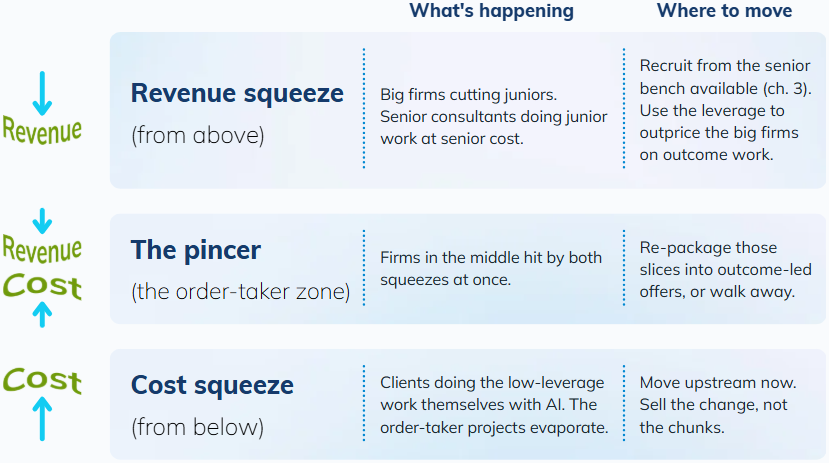
There is revenue pressure because some of the lower-level order-taker project work is being skipped by clients. And there's cost pressure because big firms are substantially reducing junior consultants - so higher-cost specialists are dragged into work that used to be leveraged.
-- Luk Smeyers, The Visible Authority
Two squeezes at the same time, on the same population: firms still sitting in the order-taker zone. The exit door is upstream - selling the whole change, not chunks of capability. We'll come back to it in chapter 4.
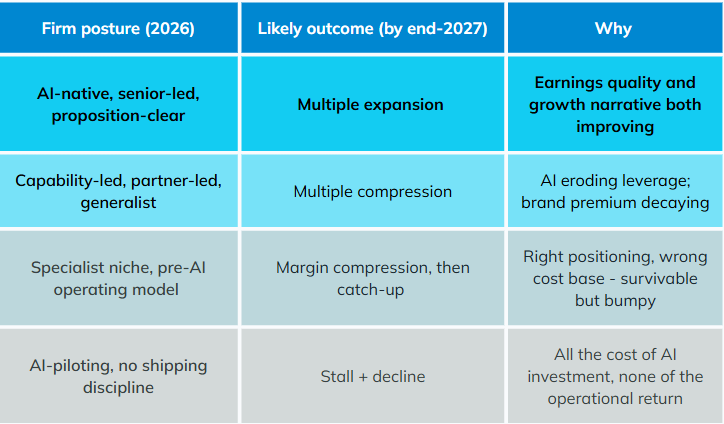
What this looks like, firm by firm, over the next 18 months. Stuart Coleman's framing, applied:
Asked what % of closed-lost pipeline went to 'no decision' / status quo last year, 47% of boutique firms in our ConCon26 survey said 26–50%. Add the firms losing 10–25% and the number rises to 73%.
The bifurcation isn't hypothetical - it's the gap between the firms reading this manual and acting, and the firms reading this and waiting for the buyer's decision to come back around.
Every subsequent chapter assumes you accept the inflection. If you don't - if you think this is a 2028 problem - the manual won't help you. If you do, every chapter is about translating the inflection into a specific operating decision your firm can make this quarter.
The single highest-density theme across the seven sessions. Five different speakers, in five different conversations, arrived at the same conclusion:
Boutiques win by being specific about the issue they own, not the capabilities they sell. Visible authority. Proposition specificity. Niche depth. Different vocabulary, same engineering.
Proposition specificity creates commercial strength.
-- Luk Smeyers, The Visible Authority
Generalist firms cannot grow. Would you rather go to a knee specialist or a general surgeon for a knee injury?
-- Nick Synnott, Create Engage
We've sharpened our ICP until it hurts a little. Then layered on the second half - the squared part - the ideal client project.
-- Christian Barnard, KUNGFU.AI
Florian Heinrichs gave the cleanest deconstruction of why so many boutiques default to capability selling - and why it commoditizes them so quickly.
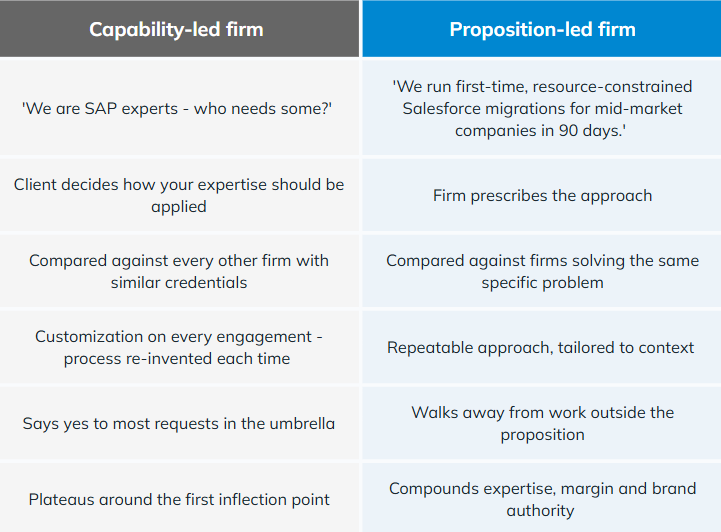
You can just have a conversation with the founder or the marketing team and ask - “real quick, what are we the best at?” If they can't answer that, and it's almost like verbal vomit - you’ve failed.
-- Ben Gaddis, Superstep Capital
Time the answer when you ask it of your team. If it takes more than ten seconds, your firm is capability-led.
When we asked boutique consulting leaders at ConCon26 what % of revenue last year came from their stated 'ideal client', the answers told a quieter story than most positioning conversations admit. Only 27% said more than 75% of revenue came from their ICP.
The ICP exists. The revenue doesn't yet match it - which is the single most common form of the verbal-vomit problem. The clients you actually serve are the data your real positioning lives in. Most firms haven't looked.
If the client says, “If Claude can do this, what exactly are you adding?” - LLMs are probability engines, generating the most likely next token. That's not the same as giving you a differentiating strategy.
-- Florian Heinrichs, The Visible Authority
For each of your top three service lines, ask whether a competent client plus Claude plus a forward-deployed engineer could deliver 80% of it.
If yes, that service is going to be repriced by the market - or removed from it - within 18 months.
Niching is necessary but not sufficient. Joe's three-property test for whether your niche is good or bad:
Pull every case study from the last 24 months into a single spreadsheet. Tag each by problem solved, outcome delivered, margin earned, time spent.
Find your top three highest-margin, highest-impact problem patterns. Those become the new homepage. The rest move to the bottom or get retired.
Replace 'we customize every engagement' with Luk's verbatim positioning line: "We have built a proven approach that we tailor to your context."
He never got pushback once he started using it.
If you're sub-$10M, pick one very specific problem. If you're past $10M, abstract the problem one level up and layer 2-3 sub-propositions underneath - each still concrete.
Don't go from one specific to one vague. Go from one to a stack of three.
The number-one mistake founders make: they confuse 'industry vertical' with 'proposition'. Industry is who you sell to. Proposition is the problem you solve.
You can be a Salesforce migration boutique and serve four industries - what matters is the consistency of the problem you solve, not the breadth of who pays you for it.
Cross-references: chapter 4 (sell the change), chapter 8 (brand AI can't fake), chapter 9 (investor-ready - proposition is the single biggest valuation driver).
This wasn't a session topic. It just kept appearing.
Dannii (sales), Stu (PE), Flo (positioning), Christian (AI consulting), Joe (academic + operator) - different chairs, same observation. :
The most valuable consultant in 2026 is the one who can operate at C-level, hold their own with a buyer, thinks strategically and can roll up their sleeves to build.
The profile that wins engagements and retains clients operates fluently at the executive level, can have C-level conversations about business value and outcomes, AND can roll up their sleeves and do the work. That combination of strategic judgement plus hands-on execution is a rare and extremely valuable asset.
-- Christian Barnard, KUNGFU.AI
Where the buyer will really want to speak to a consultant is - I need somebody to challenge me. I need somebody to connect with me from an emotionally intelligent perspective.
-- Dannii Mathers, SBR Consulting
The pyramid is collapsing for three reasons at once. None of them are speculative - they are visible in the data and in the public statements of the firms doing it.
When we asked boutique leaders at ConCon26 to name their single biggest advantage over the big firms, two answers tied at 27% - 'senior involvement on every project' and 'better outcomes'.
Nothing else came close. Flexibility (13%), domain depth (13%), and speed (13%) trailed. The buyer-side market is telling boutiques exactly where their right-to-win is - and it's a structural one big firms can't easily replicate.
Run this on every senior consultant in your firm. The unicorns score yes on all three:
Can they walk into a $100k+ first conversation and earn the next meeting alone?
Big firms are cutting laterals who can't sell. Sales density is the new partner economics.
Can they deliver a prototype, an analysis, and a recommendation without a delivery team behind them?
Buyers want proof, not promises (chapter 10). AI lets one senior do what three juniors used to.
Can they hold a strategic conversation, challenge the client's thinking, and bring judgement under pressure?
It's the part LLMs cannot replicate (chapter 4). Buyers will pay for it. They won't pay for anything else.
Joe O'Mahoney's pattern: four out of every five lateral hires fail in boutique consulting, especially in sales. Build the senior layer from inside. Promote earlier than feels comfortable.
Pay above market for the people who fit the three-test.
Joe's caveat: 'Big Four doesn't always translate into boutique success - there's very often cultural reasons.'
Test for fit with the proposition (chapter 2) and the engagement shape (chapter 5) before you bring them in. The skills are there; the culture might not be.
Brian's distinction: “A job description is usually a job post. An outcome profile is what the role should be doing and what its outcomes are.”
Write outcome profiles for every senior role. Tie them to firm metrics. Review quarterly.
Christian was honest about this: “Big firms have much greater bench depth than boutiques do.” Don't compete on it. Compete on senior density and engagement shape (chapter 5).
The bench-depth argument is the one big firms still win - let them have it, and win the engagements where the buyer actually wants senior density.
Cross-references: chapter 4 (sell the change), chapter 5 (winning engagement shape), chapter 8 (brand - your senior consultants are your brand).
This chapter is the operational counterpart to chapter 1. The inflection is real; the way out of the squeeze is also real. It just demands a different sales motion, a different engagement model, and a different conversation with the buyer.
What you're actually selling, if you're in the business of consulting, is successful change. The LLMs cannot sell successful change. They can contribute to it - no doubt about it - but they cannot sell the full thing. If you're just selling chunks right now, figure out how you can step up and sell a bigger part of the change.
-- Florian Heinrichs, The Visible Authority
Florian's most under-appreciated point. The biggest LLM companies - OpenAI, Anthropic - are now selling 'forward-deployed engineers' alongside their models.
Why? Because the software alone can't solve enterprise problems. They are admitting publicly that you need humans in the room to convert AI capability into client value.
Open AI and Anthropic are doing just that - betting bazillions of dollars on a hybrid model. They have a software product that's cost $600 billion in CapEx to date and it can't solve the problem alone. So they're adding a forward-deployed engineer to the mix.
-- Florian Heinrichs, The Visible Authority
Read this as a signal. If the largest AI companies in the world have concluded they need humans alongside their models to solve enterprise problems, the consulting opportunity is not going to zero. It's moving upstream - toward judgement, change, the human moment LLMs can't replicate.
Florian's framing for what is and isn't AI-vulnerable:
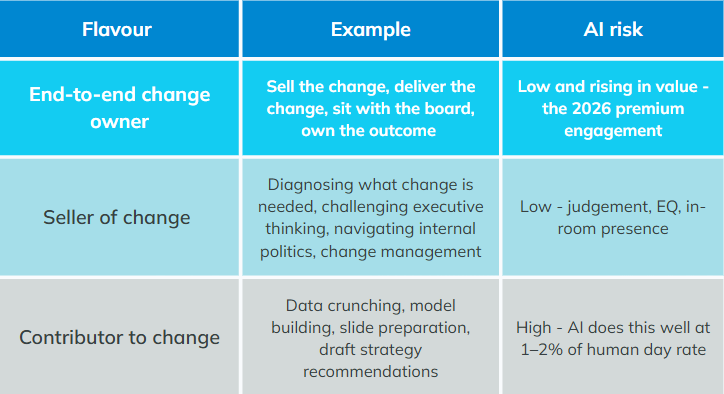
For each active service, ask: could a smart client + Claude + a forward-deployed engineer deliver 80% of this without us? If yes, that service is going to be repriced by the market within 18 months.
Move it upstream, or accept it as a high-volume / low-margin tier-3 offering and stop pricing it like a tier-1 engagement.
Don't try to upmarket every service. Use Florian's productization/standardization distinction (chapter 8):
For the chunks that stay, build repeatable delivery and let AI compound the margin. For the chunks that won't compound, walk away. Don't subsidize low-margin work with senior-consultant attention.
Florian's nuance: “You don't get to productize as a consulting firm without leaving the category. Bake your expertise into software and you're a software company.”
Standardize the approach. Build the modules. Don't try to ship SaaS as a side project - most of the boutiques that tried lost five years of cashflow to it.
Cross-references: chapter 3 (senior consultant premium - the people who sell change), chapter 5 (engagement shape), chapter 10 (the buyer's side of this).
The most consistent operational signal of the day was about how the work itself is changing.
The deals that are winning in 2026 share three characteristics: senior density on the actual delivery, fees mapped to measurable outcomes, and turnaround in weeks not quarters.
Each of those is a structural advantage for boutiques. None of them are easy for the big firms to replicate.
The engagements I see winning right now are the ones that map fees to measurable outcomes, that put senior consultants on the work, and have the ability to go fast and iterate. They deliver something real and tangible that delivers ROI. Small, nimble boutique firms are structurally better positioned to do all three.
-- Christian Barnard, KUNGFU.AI
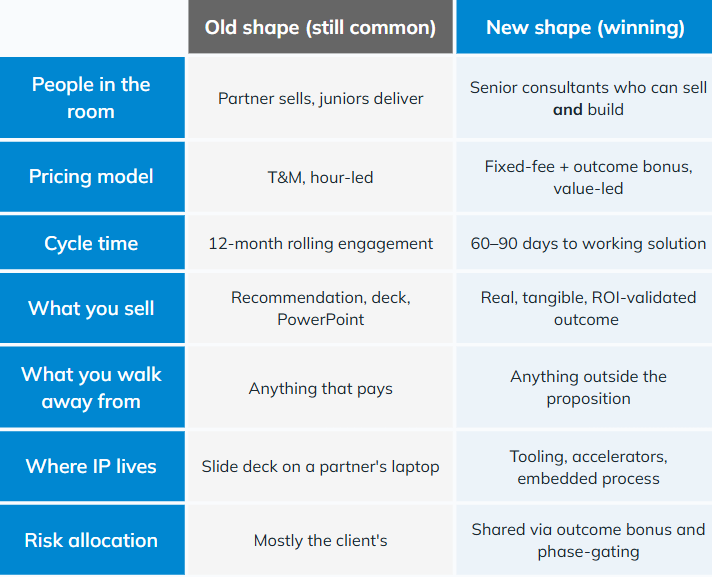
Fractional embedded team models are growing really fast right now. Rather than project-based engagements, clients are hiring boutiques as their functional team. They're getting a retained embedded capability that runs alongside their internal organization.
-- Christian Barnard, KUNGFU.AI
Why it works: the client gets senior expertise without the overhead of a full team hire. The boutique gets recurring revenue without the project-by-project resell.
Big firms can't economically run this model - their staffing structures need large teams on multi-year deals to be viable.
There's always been this illusory idea of percent-of-revenue and tons of upside. Honestly, that's not going to happen. But you can have a bonus-based engagement model where if you do hit certain metrics, you can get a bonus that's all margin.
-- Stuart Coleman, Superstep Capital
Stu's frame: outcome-based pricing as a fairy tale (% of client revenue) is dead. Outcome-based as a fixed-fee base + capped bonus is real and growing. The trick is calibrating the bonus so the client feels protected and the boutique captures the upside.
A pilot-first phase-gated approach to selling - we're seeing a lot of traction with that right now because clients want to test before they commit to a long-term relationship. Big firms prefer large scope commitments upfront because the economics require it.
-- Christian Barnard, KUNGFU.AI
Sell the first 60 days at a fixed scope. Earn the next phase. Build trust + proof + working artefact in the pilot - and the second phase usually re-prices upward because the buyer has seen ROI.
Nobody wants to be sold to. The moment your client feels you're selling to them, they'll start backing off. There's a really easy approach - what do you want them to know? How do you want them to feel? What do you want them to do?
-- Dannii Mathers, SBR Consulting
Before every meaningful prospect interaction, write down the know / feel / do triple. Ten minutes. Completely changes the conversation.
Tier-3 prospects: high-volume AI prospecting tools (Apollo, Outreach, Ample Market). Tier-2: AI-augmented sequences, but with proprietary data layered on top. Tier-1: human-only outreach with deep prep. Don't blanket-bomb tier-1 - the noise is already too loud.
Christian's third differentiator: telling clients what won't work, even when it costs scope. Big firms are incentivized to keep the meter running. Boutiques aren't. Use it.
Trust compounds faster than billings - and the same client comes back with bigger scope when they're ready.
Sharpen your ICP until it hurts. Then layer on the ideal client project - the work your team actually wants to do. Build qualification around the square. KUNGFU.AI nearly doubled revenue on this discipline alone.
Joe's biggest weakness for boutiques: “Internationalization is incredibly risky for boutiques.” US expansion in particular eats cash.
Don't underestimate the labor cost differential, the brand build, and the time to first $1M of revenue in a new geography. Some hundred-person firms have done it well - almost all by following a single very big client over.
Cross-references: chapter 3 (senior people in the room), chapter 4 (sell the change), chapter 9 (investor-ready - engagement shape drives margin).
The single sharpest line of the day, delivered by an AI consulting COO. Most consulting firms are pitching AI transformation to clients while running their own firms on spreadsheets.
The credibility risk is real, growing, and visible to the clients sitting across the table.
Drinking our own champagne - being an AI consulting firm for a long time, we didn't adopt tools internally. We've made a massive push to adopt the right tools quickly, test, learn and iterate. I feel like we can operate as a 50-person firm and deliver value similar to a 10,000-person firm. Which is crazy to think about, but it's true.
-- Christian Barnard, KUNGFU.AI
Every consulting firm runs on two engines. Most are trying to do AI on both at once, with neither the bandwidth nor the budget to do either well.
The 2026 winners are the ones that get the trade-off explicit - and let the platform underneath the firm handle the engine that doesn't earn revenue, so they can spend their scarce energy on the one that does.
Quoting. Resourcing. Margin. Cash. Utilization. Reporting. Forecasting.
Critical - but not what your clients pay for.
Let your platform do this.
Your IP. Your methodology. Your clients' problems.
This is where your AI ambition deserves your scarce attention.
Spend your energy here.
Every consulting firm from my experience is made up of two halves. You've got your internal operations - finance, resourcing, ops, HR - and you've got your client delivery. You shouldn't need to choose. You should be able to get the benefits from AI on both.
-- Ben Jervis, CMap
The practical reframe: adopting an AI-enabled operating layer for the firm itself (quoting, resourcing, project financials, forecasting, reporting) frees your scarce AI bandwidth to be spent where it actually compounds your differentiation - in the work you sell to clients.
That's how CMap fits into the picture. Not as another AI initiative on top of the firm. As the engine underneath it that lets your team's AI ambition focus on client delivery without sacrificing the operating discipline that makes the firm worth running.
Before any AI initiative in the firm - operations side or delivery side - the foundations have to hold. Three reasons speakers across the day kept circling, in different vocabulary, around the same point:
If your utilization, margin and pipeline numbers come from disconnected or inaccurate spreadsheets, no AI initiative built on top will be credible. AI scales whatever is underneath - including the noise.
Connected operational data - every project, every quote, every hour - compounds. Disconnected data depreciates.
The firms with clean operating histories will train better internal AI than the ones still cleaning data while their competitors deploy it.
Selling transformation while running on VLOOKUPs is a trust problem. The gap between what you advise and how you operate is already visible to the clients sitting across the table. Christian called it the cobblers'-children risk.
Hiding behind bad data is no longer feasible if you want to get the impact from AI
-- Dannii Mathers, SBR Consulting
When we asked boutique leaders at ConCon26 where AI is actually delivering value in their firm today, 33% said delivery, 33% said research and analysis, 14% said marketing and content. Only 10% said operations and finance.
Most firms are pitching AI transformation to clients while their own operating engine is still running on spreadsheets and AI-untouched workflows.
The credibility risk is real, growing, and visible. The fix is in the two-engines framing - let the operating platform handle this engine, free your team's bandwidth for the other.
If the foundations argument lands, the second question is timing. Three reasons not to wait:
Every engagement delivered through an intelligent operating system trains the next quote, the next resource decision, the next forecast. Firms that wait aren't standing still - they're falling behind, project by project.
Spreadsheets used to be a defensible trade-off. When the alternative recommends what to quote, who to staff, and what to chase - on your own data - the status quo gets expensive fast.
AI is only as good as the data it learns from. Firms that connect their operational data in 2026 will have a structural advantage over firms that start in 2028. By then, the movers have eighteen extra months of clean operating data behind their AI.
Christian walked the audience through the actual stack running underneath KUNGFU.AI near-doubled-revenue, but not doubled headcount year.
We've used KUNGFU.AI’s setup as the crux and generalized it below into a reference architecture you can map your own firm against.
The exact tools change firm by firm - many firms will run Salesforce + Agentforce instead of HubSpot + Breeze, NetSuite instead of Xero etc - but the shape is consistent.
CRM at the front, finance at the back, an operational backbone in the middle that connects them - with AI orchestration running across all three.
The middle layer is the one most boutique firms quietly under-invest in (Chapter 7), and the one that pays for everything else.

How to read the diagram:
Pick your tools at each layer (HubSpot/Salesforce/DIY at CRM; QuickBooks, Sage, Xero or NetSuite at finance). The architectural role each layer plays doesn't change. Offshoots - data enrichment (Clay), conversational intelligence (Fireflies and others) - plug in around the edges.
Native in-platform Chat solutions can often deliver what most teams need (e.g CMap Chat); or alternatively Claude/ChatGPT can sit underneath the stack as the orchestration layer to join it all together.
AI should be simple by design - you should not need a PhD in computer science. It needs to be embedded in the core of the platform you already run. It's not using AI for AI's sake.
-- Ben Jervis, CMap
Useful filter for any AI vendor pitch you're sitting on. Four tests; vendors that fail two or more probably don't make sense for a boutique.
Before you evaluate a single AI vendor, write down which initiatives sit on the operations engine and which sit on the client delivery engine.
The operations side should be inherited from your platform. The delivery side is where your AI investment, hiring and roadmap go. Get the split explicit; the tool selection becomes much easier.
Dannii's hard-won line: “AI is not going to fix a bad process.” If your CRM data is rotten or your sales methodology is undefined, AI scales the rot. Fix the inputs before you scale the outputs.
Dannii's pattern across SBR's enterprise clients: “AI is just sometimes put on people - we've now got Copilot, use it. There hasn't been a layer of enablement.”
Put one person, even part-time, in the enablement role. Show people how to get great output instead of average output.
Every CRM, every productivity vendor is adding an AI surcharge at renewal. “People don't want to keep buying more premiums.”
Audit your renewals; consolidate AI surface area into the platforms with the cleanest integration story - not the loudest sales motion.
The most common 2026 misallocation: founders pour their team's AI bandwidth into a new client-facing AI service line, while internal operations still run on spreadsheets.
The firms compounding fastest are doing it the other way round - letting an AI-enabled operating platform handle the engine that runs the firm, and saving the scarce bandwidth for the client-delivery work that actually differentiates them.
Operations is plumbing. Differentiate where you make money.
Cross-references: chapter 7 (the operating layer - what the platform underneath you actually has to do), chapter 10 (the buyer is going to notice if you don't drink your own champagne).
Brand is the only consulting moat that strengthens as AI strengthens. Every word, image, deck and webpage AI can now generate floods your buyer's inbox - which means the only firms breaking through are the ones with a point of view AI demonstrably cannot fake.
I think of brand not as the site, not as an email, not as a first touch. If a buyer saw five different things from your firm, could they come back to you and explain why you're different? AI is terrible. It might do one of those five things okay. That's why brand is more important now than it ever has been.
-- Ben Gaddis, Superstep Capital
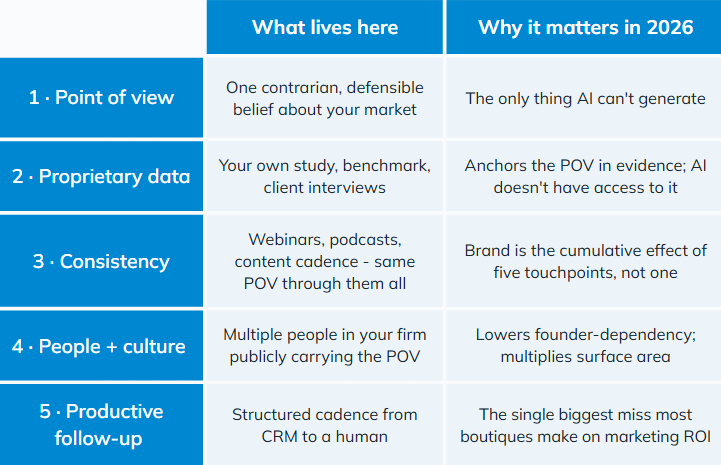
The biggest mistake is thinking that referrals equals brand. You can build a successful consultancy off referrals - that's great, it signals you have a great product. Often that can then be confused with a brand.
-- Nick Synnott, Create Engage
If your pipeline is 80% referral, you have a great product. You don't have a brand. Treat your referral pattern as the data set - find the pattern in the firms referring you. That's the sharper ICP your brand should be built around.
Marketing strategy gets a bad reputation because someone comes in, spends 12 weeks doing a strategy and produces a pitch deck and a website. For us it's a day's workshop supported by a ton of insight. The gym can produce marathon runners or bodybuilders. If your goal is to look like Arnold Schwarzenegger but you're doing the wrong thing, you're going to say the gym doesn't work.
-- Nick Synnott, Create Engage
Compress your strategy into a single intensive workshop, informed by three inputs: client interviews, team perspectives, your own commercial book of business. Get to a working strategy in a day. Iterate in market.
Find your own data and spend the money to make that worthwhile. Once you do that, your marketing becomes - in your category, did you know you're number five out of seven because of these key areas? Here's how we think you might fix it. Would you like a conversation?
-- Ben Gaddis, Superstep Capital
Ben's example at T3 was a 20,000-respondent survey that ranked 300 brands on a 'useful brand index.' Marketing became business development. Most boutiques can't run a 20,000-person study. They can convene 10 sector leaders quarterly. Same flywheel, smaller scale.
If you're selling a $10 million deal with a seven-year average client relationship, you should be spending much more on customer acquisition than you would somewhere else - anywhere between 2 and 5%. A $150k event that takes 18 months to convert shows zero ROI until it generates a $10M deal and becomes the best ROI in the history of the company.
-- Ben Gaddis, Superstep Capital
Useful frame for any board conversation about brand spend. The arithmetic in services is asymmetric - a single deal can validate three years of marketing investment. Don't optimize quarter by quarter. Optimize on customer lifetime value.
Nick's pet peeve: “I have a personal dislike for sponsored conferences. You can burn a lot of money for them.”
Ben's data at T3: best-positioned firms spend almost nothing on advertising and almost everything on proprietary events. Same money, all the eyeballs, infinitely more brand equity.
Nick's most counter-intuitive observation: “In the age of AI, the basics drive the outcome.”
Consistency. Follow-up. Structured cadence from CRM to a human. The unsexy disciplines compound when everyone else is chasing the next AI tool.
Nick's smaller-scale flywheel: quarterly roundtables of 10 leaders in your target sector. Real-world client examples. Proprietary qualitative insight that becomes quantitative when you do it three times.
Florian and Ben's shared diagnosis: “AI just produces more of what you've got. Garbage in, garbage out - at scale.”
If your firm doesn't have a POV, AI doesn't fix it. AI scales whatever is underneath. If what's underneath is generic, you become genericised faster.
Cross-references: chapter 2 (positioning - POV starts there), chapter 10 (the buyer - 94% are using AI to research suppliers).
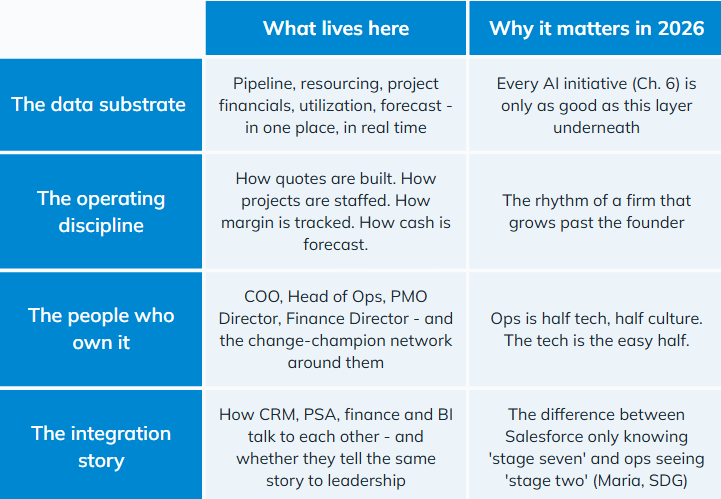
The operating layer is the system underneath everything else in your firm. Quoting. Resourcing. Project margin. Cash. Forecasting. Reporting. The connective tissue between sales, delivery, finance and people.
The firms that quietly compound are the ones that treat it as strategic. The firms that quietly stall are the ones that left it in the back office.
Three operators on the panel - Brian Albers and Randell Mauricio at Pemmerations (fractional ops leadership across many boutique consulting firms) and Maria Recker at SDG (a c.500-person IT consulting firm running on CMap) - independently described it as the most under-invested function in boutique consulting.
They're right. And it's where every other chapter in this manual either lands or breaks.
It's broader than the finance system, broader than the PSA, broader than the CRM. The operating layer is the operating discipline + the data + the people who own them.
When we asked boutique leaders at ConCon26, “If you could ask your project data one question right now, what would matter most?”, 55% chose 'Where are we under-pricing?' - by a long way the largest single answer.
‘Where are we leaking money?’ was second. This is the value-articulation gap Luk and Florian named in chapter 2, surfaced as an operating-layer pain. Under-pricing isn't a finance question. It's a unit-margin-visibility question, and answering it lives in the operating layer.
Where are the dead bodies buried - and are those dead bodies being recovered, identified, and the data actually merged together? The story finance tells is different from what a project will tell you. Finance is too late. If you're just waiting for your month-end report and making decisions off that, you've missed the boat.
-- Randell Mauricio, Pemmerations
By the time finance closes the books, the decisions that mattered were two weeks ago. The operating layer's job is to compress that lag - surface the project running over budget while you can still act on it, the resource conflict before it becomes a missed deadline, the deal at risk before it slips quarter.
I get it now, that question on resourcing and utilization - it affects my EBITDA.
-- A founder, paraphrased by Randell Mauricio
Randell's framing of the founder light-bulb moment is the cleanest reason for the operating-layer investment.
Resourcing stops being a HR problem and becomes a gross-margin one. Utilization stops being a soft metric and becomes the EBITDA driver. Time tracking stops being admin and becomes the input data the firm runs on.
This is the part most boutique consulting firms get wrong, and it's the most important section of this chapter. The operating layer isn't a tech project. It's a people project that happens to involve tech. Get this in your bones before you spend a dollar on tooling.
We're in this world of AI and high tech and automation. All things are great. But ultimately somebody's got to own it. If you don't have the right convergence of people, tools, tech, and data, and somebody to own it and do the right thing, then you're going to fall flat. … Make sure you don't forget about people and the importance of people owning it. The convergence of people, data, tech, systems - all of that in one.
-- Randell Mauricio, Pemmerations
Randell's framing is the single most useful line of the day on operations. Reading it slowly:
Any operating-layer program that under-invests in any one of the three falls flat. Randell's word, earned the hard way across years of fractional COO work. The most common failure mode in boutique consulting isn't a bad tool - it's a great tool deployed without the people layer underneath it.
AI can be the bridge. Just letting the user dictate the type of information they want to pull in a way that speaks to them makes a world of a difference. The founder CEO wants to interact with data differently from the way Brian, myself and Maria look at the same data.
-- Randell Mauricio, Pemmerations
Different personas need different views of the same data. Founders care about EBITDA. Ops care about utilization. PMs care about budget. Finance care about invoicing. Salespeople care about pipeline.
Same operating layer; five different conversations on top of it. That's the role conversational AI (CMap Chat, Claude, Copilot) is now playing - not replacing dashboards, but giving each persona the question they'd naturally ask, in their own language.
The most-quoted line from the entire ops session, and the strongest direct customer voice on what an operating layer actually unlocks at scale:
Operations and finance are coming very forward due to our CMap implementation. The data is out there. With the integration of Salesforce and CMap, we're actually very front-facing. The perception in the past was we were holding the business back - a huge shift in the past two years.
-- Maria Recker, SDG
Maria's framing matters because it captures what the operating layer unlocks culturally, not just operationally.
In most boutique consulting firms, ops and finance start every leadership conversation behind the curve - the team chasing data the rest of the business already needs.
Once the operating layer is live, that flips. Ops and finance walk into the room with the picture. Leadership conversations shift from 'what happened' to 'what should we do next' - on the same set of numbers.
We are the glue. Our operations is the glue, but it also should be the force multiplier in any organization. You cannot be afraid to make change.
-- Randell Mauricio, Pemmerations
The metaphor - glue plus force multiplier - only works if both halves are true. Glue alone holds the firm together but doesn't move it. A force multiplier alone risks scaling chaos.
The 2026 ops leader has to do both: protect operating integrity and accelerate the rate at which the firm makes decisions on it.
The most concrete benchmark we captured for whether your operating layer is producing the margin profile that matches your ambition.
Whether you ever sell the firm or not, this is the yardstick PE uses. Includes bench time and all delivery cost.

Not at firm level - at the unit. Stu's framing: 'there's project margin, there's client margin, there's gross margin.' You need all three. Without unit-level visibility, you can't make pricing, scoping or proposition decisions that compound.
Not just billable vs capacity. Specialism-weighted, because in 2026 your scarcest resource is usually one or two unicorn senior consultants (chapter 3). One person on leave can stall three projects.
Jonathan Wilson's investor-readiness framing applied to ops. A forecast you can beat builds momentum into every quarterly leadership review. A forecast you miss kills the conversation.
Build it. Defend it. Move it as the world moves - but don't pretend not to have one.
Stu's killer line: 'you get one chance to present that information.' This isn't just for diligence. It's for board meetings, partner meetings, client conversations. The firm that restates its numbers loses credibility every time it does so.
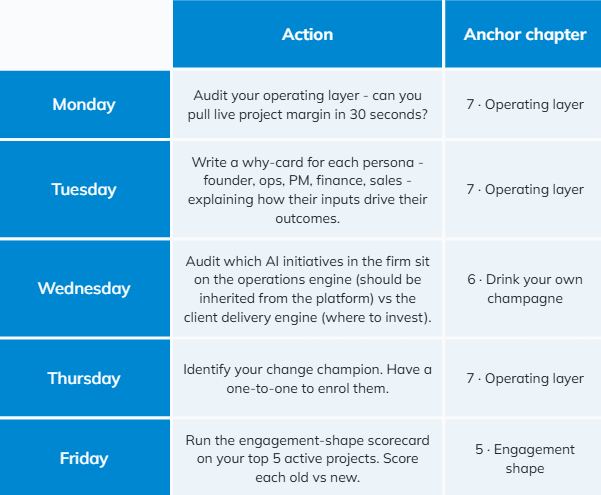
Maria's discipline at SDG. Build a why-card for each persona. Re-evangelize it every quarter.
The operating layer's adoption decays in real time - if you stop telling people why their input matters, the data quality erodes quietly and the rest collapses.
Brian (Pemmerations) hot take: "Sometimes operations gets put on the back burner. All of a sudden it's two or three years later, you've doubled revenue, and the dead bodies are still there."
Treat ops as future-tax-avoidance, not current-cost.
Randell's analogy: “If you're choosing a restaurant and you see one with a line out the door, that's the one you're going to.”
Same with operational change. Find the senior PM or delivery lead who hates the chaos most, enroll them, and let them be the visible advocate inside the firm.
Brian's most common failure pattern: “$100,000 spent trying to implement something but they didn't know what they were implementing.”
Define the operating problem first. Pick the tool that solves it. Don't reverse the order.
Salespeople care about commission impact. PMs care about budget. Finance cares about clean invoicing. Same data - different conversations. Build a why-card for each persona. Re-evangelize quarterly.
Don't build five dashboards. Build one operating layer with five conversational entry points.
Each persona asks their own question of the same data, in their own language. The system stays single-source-of-truth; the experience becomes persona-specific.
Maria's most important line, often missed: “It's people first. You have to meet them where they are.”
The rollout fails when ops treats the operating layer as a tech project. It works when ops treats it as a change-management program that happens to involve software.
I'm a big believer in PSAs, in CMap. There's a real convergence of those two data sets - finance and projects - that gives you the real story of what's happening in your business. Not just the result.
-- Randell Mauricio, Pemmerations
Cross-references: Ch. 6 (the AI inside the firm sits on this layer), Ch. 8 (brand is the visible top of the iceberg; the operating layer is the rest), Ch. 9 (the operating layer is what makes the firm investor-ready).
Even if you never sell the firm, run it as if a buyer might walk in tomorrow.
The disciplines below were independently emphasized by Stu Coleman (PE) and Jonathan Wilson (M&A) in session two - they make the firm worth more, and easier to run, every quarter you compound them.
By the time you're in a process, the deal is already 70% done; the remaining 30% is the credibility you built across the previous 12 months.
Getting your data in order is pretty critical. You get one chance to present that information. If you go back and have a change for whatever reason, it diminishes credibility. That's first and foremost what you want to make sure you've got in order.
-- Stuart Coleman, Superstep Capital
What someone is really purchasing - they're purchasing your future vision while they're validating it with your past performance. A lot of times I've looked at companies where they had vision and intuition and worked hard, but how can a buyer ensure there's continuity in the future? Look at the forecast - not just for this year, but three years out.
-- Jonathan Wilson, Dubb Value Creation
When we asked boutique founders at ConCon26 'if a serious buyer did operational due diligence on you tomorrow, where would you feel most exposed?' - 60% picked pipeline reliability.
The next answer ('we'd be fine') was 20%. Customer concentration was 13%. Utilization and resourcing data was 7%. Pipeline is the single biggest valuation lever in this entire chapter, and it's the one most founders quietly know they can't yet defend.
A lot of firms have a really skinny operating expense. They haven't invested in the scale a business will ultimately need. Their EBITDA margin looks healthy, but it's really because they haven't invested in SG&A. Maybe gross margins aren't as healthy either.
-- Stuart Coleman, Superstep Capital
Most pre-process founders think their margin profile is fine. PE firms looking at them disagree. If you have high EBITDA on skinny OpEx with low gross margin, you have a firm that hasn't yet been built to scale - and the buyer will price for that.
Stu's most useful piece of strategic guidance for AI investment from a buyer's perspective:
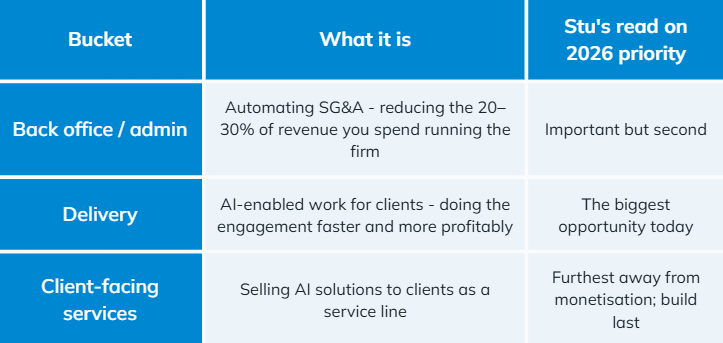
Most firms over-invest in bucket three (the new AI service line) and under-invest in bucket two (AI-enabled delivery). Reverse it.
CEOs and sellers are actually focused on adding their agents into the org chart. When you're looking at a company, you're thinking about revenue per head count - you have to realize that some of that headcount may not actually be human. Now it's revenue per human head count.
-- Jonathan Wilson, Dubb Value Creation
Buyers are starting to ask which of your revenue is being generated by agents and which by humans. The firms structurally lifting revenue-per-human are pricing into expansion. The firms growing revenue-per-headcount but not lifting revenue-per-human are getting harder questions.
Run a clean data-room rehearsal months before you go to market. Most founders only learn how brittle their data story is the first time a buyer asks for it. By then, the valuation multiple is already moving.
Stu and Jonathan both flagged this. The firms commanding premium multiples are visibly running AI-enabled operations. If your only AI investment is the client-facing service line, the diligence story is incomplete.
Stu's biggest pre-deal win for any founder: “Get some scale to the founder. Who's number two? Who's number three? That reduces founder dependency.” Buyers will ask the question; you want a credible answer.
Jonathan's chilling story: a seller laid off one low-utilization employee late in a process to boost EBITDA.
That employee was the cultural anchor. A third of the company left within six months. The last 90 days of a deal is not the time to optimize. It is the time to protect what you already have.
Cross-references: chapter 7 (the operating layer makes diligence painless), chapter 8 (brand drives premium multiples).
Every chapter so far has been about how to redesign your firm. This one is the mirror - what the buyer is doing on the other side of the table.
Worth reading in full, because the disciplines in chapters 2 to 9 only matter if they're calibrated to a buyer whose behavior has changed materially over the last 24 months.
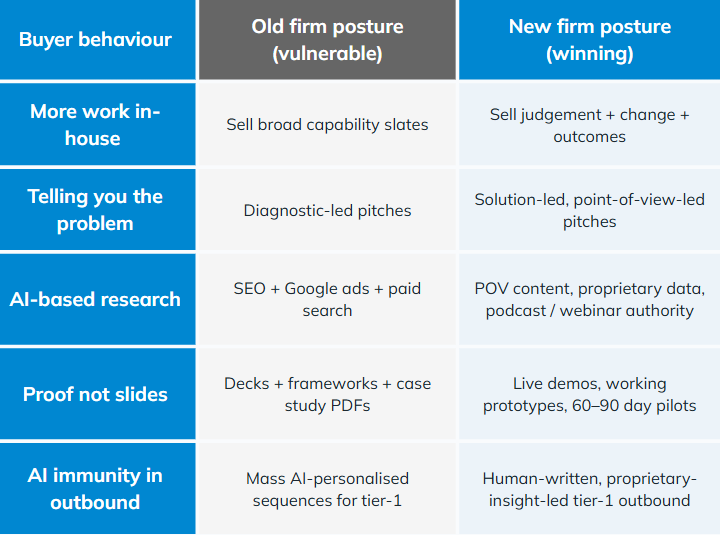
AI lets in-house teams handle work consultancies used to scope and price. Boutique opportunity = the strategic, the judgemental, the politically delicate.
Buyers walk in with the diagnosis. Consultancies bid to solve it. Don't waste pitch time on diagnosis. Lead with solution.
94% of buyers use AI tools to find and evaluate firms (vs. Google). Your content needs to be cited by LLMs, not just indexed by search.
Buyers are waiting longer. They want proof you can build it, not just recommend it. Show working prototypes. Ship in 60–90 days. Tell the truth on what won't work.
The AI prospecting flood is creating its own backlash. Tier-1 wins on craft. Human-written, proprietary insight, real point of view.
We start every new relationship really at a trust deficit. Big firms carry pre-established institutional trust. When McKinsey walks into a room, the credibility question is already answered. When a boutique walks in, it has to be earned every single time.
-- Christian Barnard, KUNGFU.AI
Christian's honesty is useful. Boutiques don't win on brand recognition - yet. They win by closing the trust deficit faster than big firms can mobilize - through proof, through specificity, through senior people in the room.
The firms that systematize the trust-deficit close-down win the most engagements.
Cross-references: chapter 4 (sell the change), chapter 5 (winning engagement shape), chapter 8 (brand AI can't fake).
Across seven hours of conversation, the single most consistent observation was this: the boutique consulting market has been underserved by the rest of the industry for years.
The advantage is now in the boutiques' hands. The structural moat of the big firms is decaying. The operating model has changed. The talent pool just opened up. The buyer behavior has flipped. AI rewards the firms with clean data and a clear point of view.
Six months to act. Most of your competitors will spend it in pilots. Spend yours delivering.
If the playbook was useful - pass it on. The boutique consulting community is the smartest, most under-served audience we know.
Every leader who reads this and acts on it is making the community as a whole more competitive against the firms that have been telling our story for us for too long.
CMap is the operations and intelligence platform built for boutique consulting firms. More than 700 firms run pipeline, resourcing, project financials and billing on a single operating layer - with AI built in, not bolted on.
If this playbook was useful, the easiest next step is a 30-minute walk-through. We promise - no slides!
ConCon26 happened because fifteen operators, advisors and product leaders gave seven hours of their time to a community most events don't serve well enough. This playbook exists because of what they said.
Listed below in session order - with our thanks.
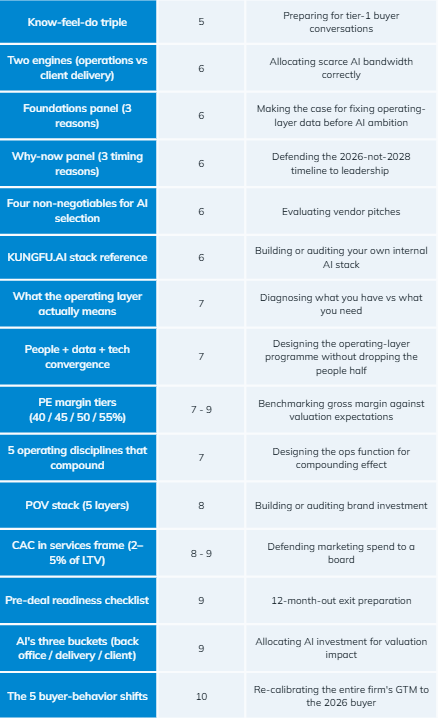
Use this as the cheat-sheet - every framework that appeared in the manual, paged for fast reference.

Pick the path that matches your seat. Run the five-day plan. Then come back to the manual for chapter two of your transformation.

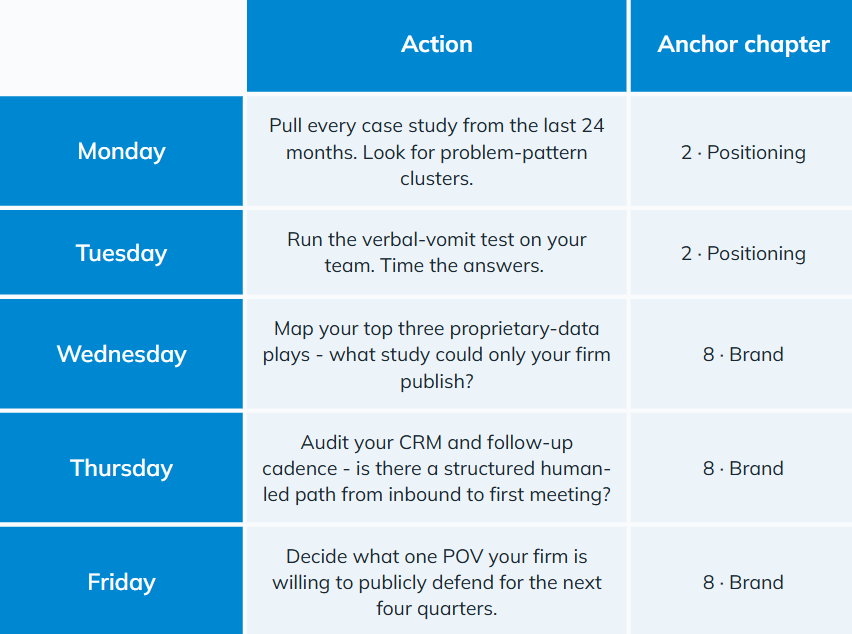

For the senior practitioners who aren't yet at the C-suite table but want to be. The manual is yours too.
The senior consultant who can sell, build and sit with a CEO is now the most valuable role in consulting (Ch. 3) - this path is about making sure you're that person, and visibly.
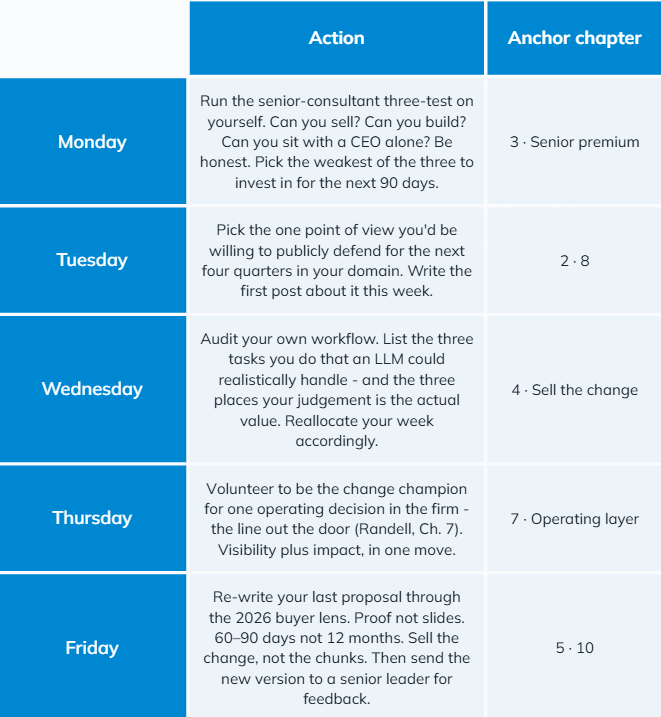
The pattern: this path is less about reshaping the firm and more about positioning yourself as someone the firm cannot run without. The same disciplines, applied to your own seat.
Get the full recording, executive summary, and key highlights from each session:
Never miss out on the next CMap event:
Chat with ConCon26's host, Ben Edwards, for tailored advice:
To see exactly how we can help you drive your company in the right direction, book a demo with an expert.


